
Analysis Why Putin’s Delhi Visit Showcases India’s Finest Strategic Balancing | India News

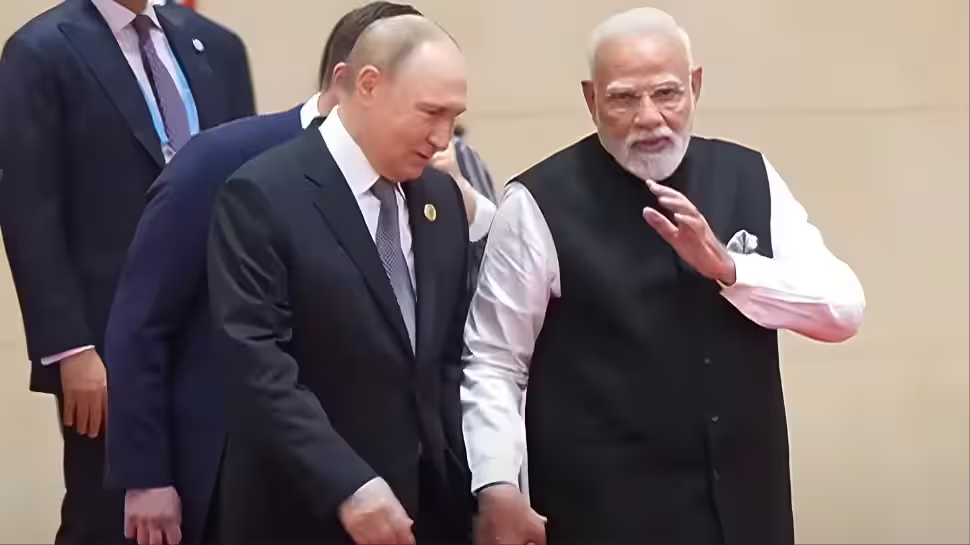
Russian President Vladimir Putin’s arrival in New Delhi for the 23rd India-Russia Annual Summit was far more than a ceremonial engagement. In a world marked by geopolitical fractures, the visit reaffirmed the depth and durability of a partnership that has weathered decades of global realignments. It also underlined India’s determination to steer its foreign policy through strategic autonomy rather than alignment with any single power bloc.
The summit delivered a wide set of agreements — a Vision 2030 roadmap for trade and technology, fresh commitments on energy and nuclear cooperation, the landmark RELOS logistics pact, and new arrangements on labor mobility, healthcare, maritime training, and food safety. Yet the most consequential outcomes were the ones that lay beneath the surface.
A Shift Shaped By Sanctions
Add Zee News as a Preferred Source
Washington’s sweeping sanctions and tariffs against Moscow were designed to isolate Russia and weaken its economic standing. Instead, they accelerated Russia’s economic and strategic tilt toward Asia, with India emerging as one of its most significant partners. Far from severe Moscow’s links, these measures inadvertently strengthened India’s geopolitical position.
The clearest example is energy. Shut out of Western markets, Russia began offering discounted crude oil. India, facing rising energy demand, seized the opportunity. Russian oil helped contain inflation and ensured steady, affordable supplies. Even though sanctions on Russian oil firms have recently pushed Indian buyers to scale back purchases, the trade corridor built over the past two years is now sturdy enough to expand into other goods.
A Partnership Reinforced By Necessity
Russia, cut off from Western technology and finance, is in search of trusted partners who can both buy its exports and supply essential imports. India’s large market and growing international clout make it a natural fit. For New Delhi, deeper ties with Russia serve a clear purpose: they strengthen India’s autonomy and broaden its strategic choices at a time of widening global divides.
India continues to balance multiple relationships. It has expanded cooperation with the United States and Europe, but it has also maintained its historic ties with Moscow. India’s decision to abstain on UN votes against Russia, increase energy purchases, and simultaneously deepen defense and technology engagements with the West is not a contradiction; it is deliberate, flexible diplomacy.
Managing The Risks
The partnership does not come without challenges. India risks attracting criticism from Western capitals, particularly if the war in Ukraine drags on. New Delhi must navigate these pressures with careful diplomacy and transparent communication. However, the advantages are substantial. India positions itself as a major actor able to work with rival powers, strengthening its leverage in a multipolar world.
Three Strategic Pillars
India-Russia ties rest on three enduring pillars: defence, economics, and energy, all of which received renewed attention during the summit.
Defense Cooperation: Russian or Soviet-origin equipment still forms roughly two-thirds of India’s military inventory, making Russian support indispensable for maintenance, upgrades, and spare parts. The new RELOS logistics pact, which includes Indian access to Russian Arctic facilities, further strengthens operational cooperation. Defense Minister Rajnath Singh’s remarks on steady cooperation despite global uncertainty highlighted the political importance India assigns to this partnership.
Trade and Economic Engagement: The two sides have set an ambitious target of USD 100 billion in annual trade by 2030. Progress continues on a potential Free Trade Agreement with the Eurasian Economic Union. Efforts to boost rupee-ruble settlements and explore linkages between India’s RuPay and Russia’s Mir payments systems point to a push for de-dollarised trade. With Russian imports from India lower than they were in the early 1990s, Moscow is now looking afresh at Indian goods and services.
Energy and Minerals: Russia assured India of uninterrupted fuel supplies. Both countries announced cooperation on civil nuclear projects, including small modular reactors and floating nuclear plants. They also pledged joint work on critical minerals. Agreements on labor mobility aim to ensure safer, legal routes for workers.
Strategic Autonomy At The Center
Putin’s visit offered a clear demonstration of New Delhi’s multi-alignment approach, maintaining close ties with Russia while strengthening partnerships with the United States, Europe, and the Indo-Pacific. The warm personal gestures during the visit, from Prime Minister Modi receiving Putin at the airport to hosting him for a private dinner, conveyed the political significance India attaches to the relationship.
For Russia, India provides a balance against overdependence on China. For India, Russia remains vital for defense preparedness and affordable energy.
A Partnership Recalibrated, Not Repeated
The summit was neither a nostalgic reunion nor a symbolic exercise. It was a pragmatic recalibration in a turbulent world. The visit reaffirmed that the India-Russia relationship remains strategic rather than transactional. Both nations recognize that, despite shifts in the global order, their core interests continue to align.
As the leaders concluded their meeting, the message was clear: India intends to preserve its strategic autonomy by keeping all channels open, while an eighty-year partnership enters a new phase grounded in practical cooperation and shared resilience.

Comments are closed.