
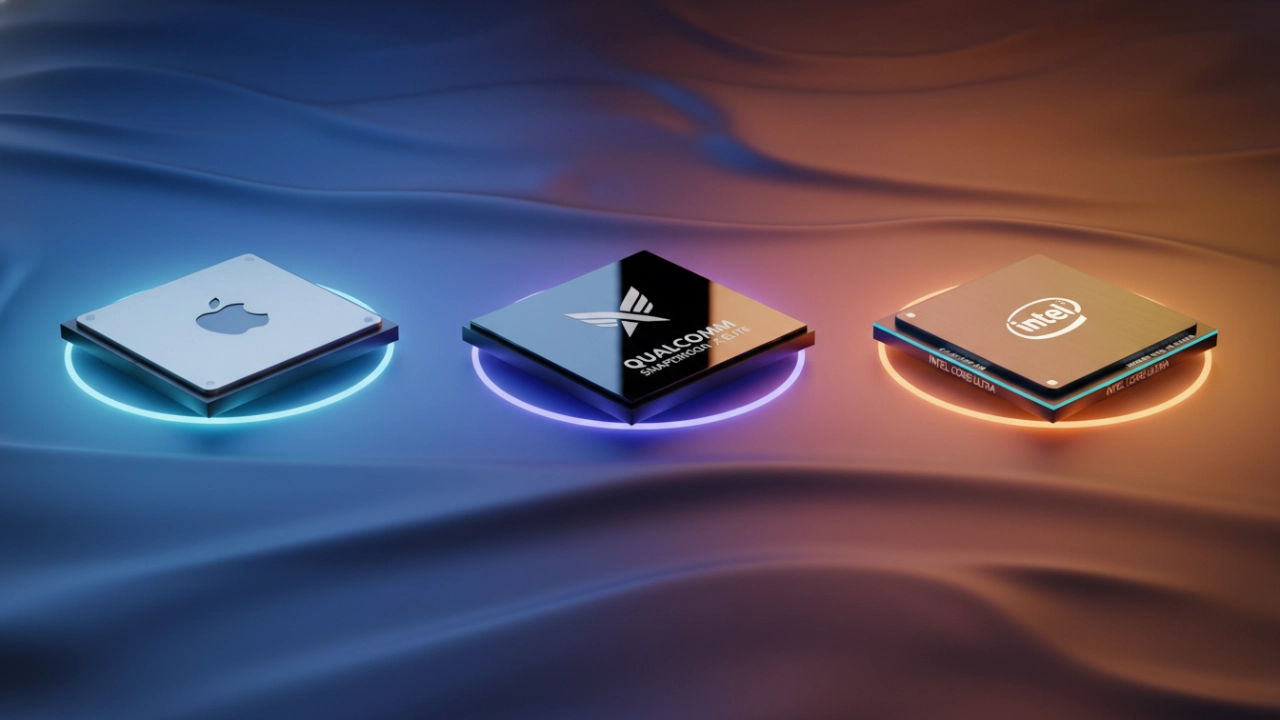

Highlights
- Apple M4, Qualcomm X Elite, and Intel Core Ultra dominate the 2025 laptop chip war, each excelling in efficiency, AI performance, and overall performance.
- In Apple M4 vs Qualcomm X Elite vs Intel Core Ultra, M4 leads in battery life and thermals, X Elite boosts Windows laptops with ARM efficiency and strong NPUs. At the same time, Core Ultra offers the best compatibility and gaming support.
- Choosing Apple M4 vs Qualcomm X Elite vs Intel Core Ultra depends on needs: M4 for creators, X Elite for Windows AI mobility, and Core Ultra for gamers and x86 workflows.
The laptop processor market in 2025 reached a unique moment that hasn’t been seen for the past two decades. The landscape that was once predictable and dominated by Intel has now evolved into a three-way battle of different architectures, efficiency, and AI-powered performance. Apple’s M-series silicon has kept on breaking the limits, Qualcomm’s X Elite has sparked competition in Windows laptops, and Intel’s Core Ultra lineup has made a reinvention that was long overdue.
A different chip denotes a different vision for the future of mobile computing, and each of them shines in different real-life scenarios. In the past, the superiority of a processor was determined solely by either its raw clock speed or the number of cores, but in 2025, the competition has shifted to a wider landscape of considerations: performance, thermal stability, battery efficiency, AI co-processors, and ecosystem-level optimization.
Aditya Joshi/Unsplash
)The question has changed from “Which chip is fastest in a benchmark?” to “Which laptop actually feels the best to use in daily life?”This is the story of the battle between Apple, Qualcomm, and Intel for the answer.
Apple M4: The Efficiency King with Quiet Power
Apple’s M4 series takes a step further in the architectural principles that have been the foundation of the company’s silicon strategy since 2020: first, efficiency; second, brute force. The combination of M4 is a performance late engineered with precision cores, efficiency cores, a better unified memory architecture, and a Neural Engine that continues to leave competitors far behind in AI throughput on-device.
What gives the M4 its uniqueness is not the raw clock speed but the balance instead. Apple is still making chips that barely get hot during normal use, have silent fan modes, and give battery life that is far better than the Windows ecosystem.
MacBook’s real-world battery life tests vary from 18 to 24 hours of mixed work, i.e., video calls, numerous browser tabs, photo editing, and coding all happening simultaneously till users are not in a hurry to plug in again. No silicon besides M4 was so well-managed in terms of heat dissipation, and this green plus power consumption was the main aspect of the user experience.
Apple’s GPU improvement, though focused on non-gaming, has provided great support for creators and is thus very impressive. Video editors who work with 8K ProRes clips in FCP or DaVinci Resolve report no lag and a smooth experience with video jumping or moving back & forth. Similarly, developers are getting strong compiler times and great performance in Xcode as well.
M4’s main trait is pulp ability: it is fast, it is silent, and it is steady, even on battery. The M4’s decisive advantage comes from its local AI performance. The Neural Engine, which delivers miraculous trillions of operations per second, is very well suited for on-device models, image generation, and real-time transcription.
Apple doesn’t go after flashy demonstrations; instead, it assimilates AI into macOS, diplomatically improving photo editing, video making, accessibility, and live language processing in ways users often don’t realize until they try working on another machine. M4 has its drawbacks, though.
Gaming is still restricted due to macOS limitations, GPU compatibility challenges, and a limited number of AAA titles. There is no upgrade path, as every component, from RAM to storage, is soldered in place. Additionally, since Apple is the sole proprietor of the end-to-end ecosystem, consumers have to go with macOS rather than mix hardware and operating systems. Nonetheless, Apple’s world is the one where M4 brings about a uniquely elegant laptop experience.
Qualcomm’s X Elite: The Disruptor Windows Has Been Waiting For
If Apple stands for refinement, then Qualcomm stands for disruption. The X Elite is a complete transformation of the previous Arm architecture generation; this is the first time in years that Windows laptops are not simply improved, but completely overhauled. Among the three surprises presented by X Elite laptops, the foremost is the immediacy of everything.
The conversion of Windows on Arm to a smooth operation really puts the app responsiveness in the sharpest light, as this operating system is no longer an emulated layer and is not struggling to keep up.
Qualcomm’s Nuvia-based CPU cores provide the X Elite with a combination of high performance and power efficiency that is on par with Apple’s. It is not uncommon for X Elite laptops to show a maximum of 15 hours of actual use, a significant improvement over previous generations’ Intel-based computers.
The X Elite impresses with the highest performance in multithreaded workloads for creators. Heavy applications like Photoshop, Lightroom, Premiere Pro, Blender, and others have released native ARM versions, transforming X Elite notebooks into portable workstations with great power. Not only the developer but also the compiler reports that the Arm-native code was completed in a shorter period, resulting in excellent performance in areas like container builds.
Qualcomm’s boldest statement is with AI. The Hexagon NPU integrated is advertised as one of the most powerful AI processors in laptops and has been optimized for generative tasks, live transcription, and on-device model execution. Windows 11’s “AI PC” marketing heavily relies on Qualcomm’s technology, which enables features like real-time background blurring, Live Captions, system summarization, and local generative tools without relying on the cloud.
Nonetheless, the X Elite platform has yet to overcome some obstacles. Although the app compatibility issue has been solved to a great extent, some niche software still needs improvement. Gaming is not consistent: quite several titles work great, others have a hard time due to the translation layers, and GPU drivers are still in their development stage.
Thermals have been reported as stable, but the performance of some of the first X Elite laptops significantly varies depending on the cooling strategies of the respective vendors. Possibly the most significant drawback to this whole setup is the users’ perception, convincing them that Windows on Arm is finally worth it.
Despite this, 2025 marks the beginning of a decade of truly compelling rivalry between Windows laptops and MacBooks, in which Qualcomm must be acknowledged as the breakthrough.
Intel Core Ultra: Reinventing the Legacy
Intel has been looking at Apple and Qualcomm for years, while the efficiency battle raged on, and it had to deal with heat, power draw, and production delays. But for the Core Ultra line, particularly the 2025 refresh, this marks the first substantial reset of Intel’s mobile strategy.
Core Ultra, the next generation of chips, unveils a hybrid architecture inspired by Apple’s model, integrating performance, efficiency, and low-power island cores for background task execution. The real-world application can be seen in laptops with Intel inside that finally offer battery life that is tolerable, often between 10 and 14 hours, which is a massive jump from prior generations.
However, the performance aspect has also taken a giant leap forward. The new integrated graphics built by Intel, called Arc, offer considerable gains in creative workloads, light gaming, and even the CPU has revived its strength to deal with video editing, 3D modeling, and software development, which previously made Core Ultra laptops unappealing to users who want performance without investing in Arm-based platforms.
The most noteworthy transformation is that of AI. The NPUs Intel has developed can support system-level AI features, though they might not be as effective as those from Apple or Qualcomm; they contribute to a balanced AI environment alongside Intel’s robust CPU/GPU performance. Windows 11 features like Live Captions, AI-powered clip editing, transcription, and background tasks run seamlessly on Core Ultra.
Intel, nevertheless, is still a company that embodies the legacy of past architecture. The heat level of its chips is higher than that of the M4 or X Elite; the fans on laptops with such chips run more frequently, and users report inconsistent power consumption across devices.
Due to Windows OEM fragmentation, some laptops are performing well, while others are lagging. The era of Intel being the preferred brand is over, and it has to show its worth again. Still, for those looking for backward compatibility, full gaming support, or specific x86 software, the Core Ultra is the most secure and versatile option.
Real-World Performance: Where Each Chip Truly Excels
The fascinating thing about 2025 is that every chip is extraordinary in a different environment. Apple’s M4 is the champion in terms of experience: constant performance, quiet thermals, no software drama, and unbeatable battery life.
Qualcomm’s X Elite is the champion in terms of innovation: finally, ARM’s efficiency and AI capability are coming to Windows. Intel’s Core Ultra is the champion of compatibility: it can run everything, including games, specialized industry software, and x86-native tools. The creators will choose M4 for video, color grading, and application stability.
Developers, however, are divided: in-group those writing for iOS/macOS choose Apple, while cross-platform ones appreciate either Intel’s flexibility or Qualcomm’s modern ARM approach. Office workers, on the other hand, are choosing between Intel or X Elite machines based on their priorities: battery life or software compatibility.
Gamers still depend on Intel, but some early X Elite titles run surprisingly well. M4 gaming is still limited, not because of hardware but because of the lack of titles and optimizations on macOS.AI workloads turn out to be a different story. The on-device generative tasks are fastest on M4 and X Elite, with Core Ultra coming in second. Apple’s Neural Engine is still the best overall, while Qualcomm’s NPU is rapidly making it the most attractive feature.
Battery, Heat, and the Future of Mobility
The most significant difference is battery life: Apple is far ahead, Qualcomm has made impressive strides, and Intel is getting better, but still not as good as Arm-based systems. The same holds for thermal performance. M4 devices generate hardly any heat, X Elite laptops are moderately warm during regular use, and Intel systems rely on good cooling designs. This situation affects the mobility aspect.
Students, journalists, travelers, and field workers, etc., are increasingly inclined to choose M4 or X Elite machines because they believe they will not fail throughout the workday. Intel systems are getting closer, but the difference is still there.
Final Decision: Defining the Right Chip in 2025
In the laptop chip wars of 2025, there is no single winner but clear winners for specific needs. Generally, Apple’s M4 chip is the best for user experience, efficiency, creative workloads, and smooth OS integration. For anyone already in the Apple ecosystem, nothing feels as polished or as trustworthy. Qualcomm’s X Elite is the most revolutionary chip to unlock the battery life, responsiveness, and AI power that Windows has lacked for years.
It is the new era of mobile Windows laptops. Intel’s Core Ultra is the king of compatibility, able to run every app, every workflow, and every gaming library thanks to its decades of maturity. It is still the most reliable option for mixed workloads and industry software. The rivalry has never been so tight. The future has never been so varied.

Comments are closed.