
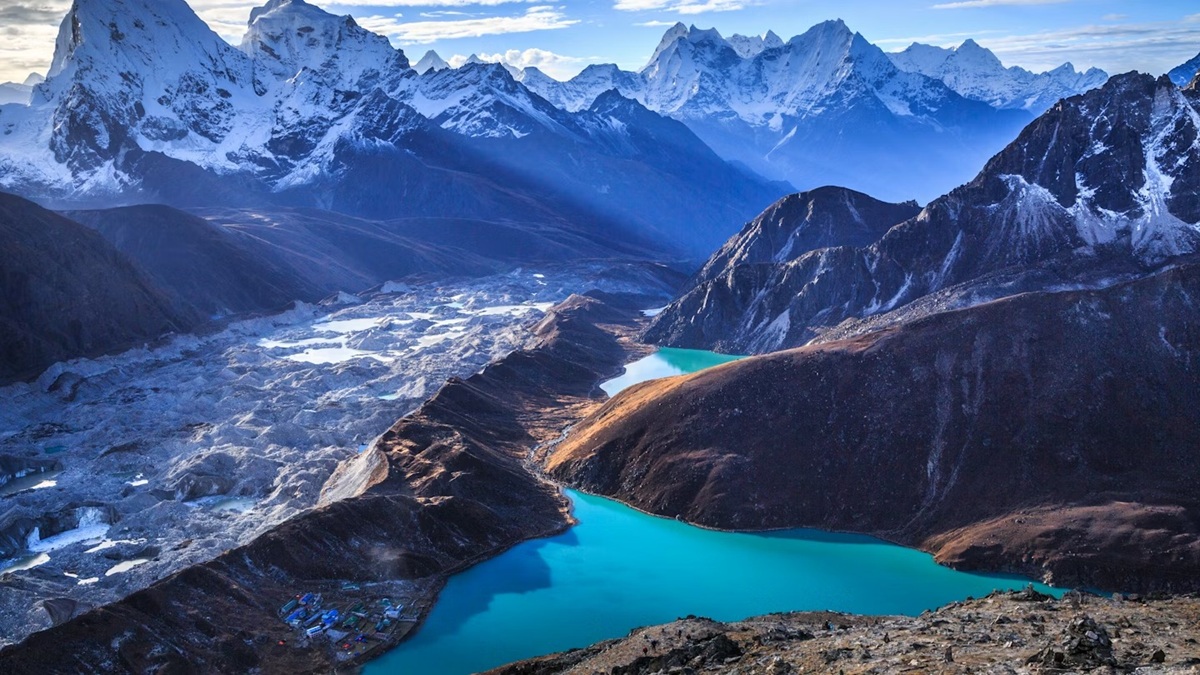

New warnings issued regarding a possible megaquake in Japan have reignited the debate over earthquake risk in Asia. While Japan remains under constant threat of major earthquakes due to its location on the Pacific Ring of Fire, experts in India are making new comparisons about the possibility of a megaearthquake in the Himalayan region.
“Great Himalayan Earthquake” is a potentially huge earthquake that can occur at any time on the Main Himalayan Thrust (MHT) located beneath the Himalayan mountain range. This is the same zone where the Indian tectonic plate is continuously sinking beneath the Eurasian plate. In this process, the stress accumulated over centuries can suddenly break one day in the form of a major earthquake.
According to experts, an earthquake of magnitude 8 or more can occur in this zone, which can cause massive devastation in North India, Nepal and surrounding areas. This threat is considered even more serious due to the densely populated areas of the Himalayas, weak infrastructure, and the possibility of landslides. History shows that this region has already suffered many major earthquakes, 1934 Bihar-Nepal earthquake (8.0), 2015 Nepal earthquake (7.8), both of them had caused massive loss of life and property.
According to Dr. Om Prakash Mishra, Director of the National Center for Seismology, at present the situation does not appear to be that serious. He said, “At this moment it seems that the Himalayas themselves are saving us. The stress is gradually being released by small M2.5–3.5 tremors, due to which the chances of a major earthquake are low at the moment.” Scientists call this ‘seismic creep’, a process in which small tremors gradually release large stresses. However, experts also believe that deep geological pressure has not gone away and the possibility of a major earthquake in the long run cannot be completely ruled out.
Recently India has given a major update to the earthquake risk map under the revised earthquake design code of BIS. For the first time, the entire Himalayan Arc has been placed in the most dangerous Zone VI. According to new mapping, 61% of the country is now in the moderate to high earthquake risk zone. This is considered to be one of the most important changes in the country’s disaster-management policy.
Experts say that continuous monitoring, better early warning systems, strong construction standards and public awareness—all these are essential for the Himalayan region. As Japan prepares for its own possible megaquake, the Himalayan region is also on alert. Even though nature is giving some time with small tremors, the next big earthquake can happen at any time. The scientific community is repeating this warning again and again.
Also read:
After America, Mexico also imposed 50 percent tariff on China and India
Bangladesh’s inclination towards China-Pakistan; Considering leaving India
Operation Sagar Bandhu: Indian Army treated more than 5 thousand people in Sri Lanka

Comments are closed.