
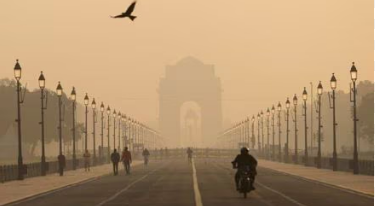
Pollution increased as mercury fell in NCR, AQI crossed 400 in many areas, entire area turned into gas chamber.

Noida, 12 December. Cold has knocked in Delhi-NCR. A continuous decline is being recorded in the minimum temperature. According to the India Meteorological Department (IMD), shallow to moderate fog conditions will prevail in Delhi-NCR on 12, 13 and 14 December. On December 12, the temperature is likely to be maximum 24 degrees Celsius and minimum 9 degrees Celsius. The temperature is expected to remain like this for the next three days.
Due to continuously increasing humidity and cold winds, the wind speed has slowed down, due to which the pollutants are staying near the ground. The air quality in Delhi has deteriorated rapidly. Many stations have reached the very poor to severe category. According to the data received, 391 in Anand Vihar, 379 in Ashok Vihar, 368 in Bawana, 354 in Burari, 366 in Chandni Chowk, 309 in Mathura Road, 321 in Dr. Karni Singh Shooting Range, 366 in DTU, 364 in Narela, 362 in Nehru Nagar, 394 in Dwarka and 364 in Punjabi Bagh. AQI has been recorded. In many areas the AQI has reached above 350 and in some near 390, which is a very dangerous situation.
AQI has been recorded at critical level at all the active stations of Noida, including 371 in Sector-125, 314 in Sector-62, 355 in Sector-1 and the most dangerous AQI has reached 400 in Sector-116. The situation remains worrying in Ghaziabad also. Indirapuram recorded AQI of 350, Loni 427 (the most polluted area of NCR), Sanjay Nagar 326 and Vasundhara 242. Greater Noida is also badly affected. Here, 312 AQI has been recorded in Knowledge Park-III and 373 in Knowledge Park-V.
The weather department estimates that if the mercury falls now, pollution will increase. IMD says that the night temperature will fall further in the coming days and the wind speed will remain slow. This will have a direct impact on the air quality and AQI may increase further. According to the Air Quality App, the air in the current situation is “very poor” and prolonged exposure can increase the risk of respiratory diseases.

Comments are closed.