

77
Late at night, when tensions rise in the region, social media suddenly fills with the same kind of posts. Dozens, sometimes hundreds, of accounts share identical videos, the same dramatic claims and the same captions about naval victories. Missiles are said to have hit enemy ships. Ports are claimed to be under attack. Enemy forces are described as retreating. The stories move fast, faster than any official confirmation. A closer look shows something unusual. The accounts sound different, but they behave in exactly the same way. This is not a coincidence. It is the work of automated networks.
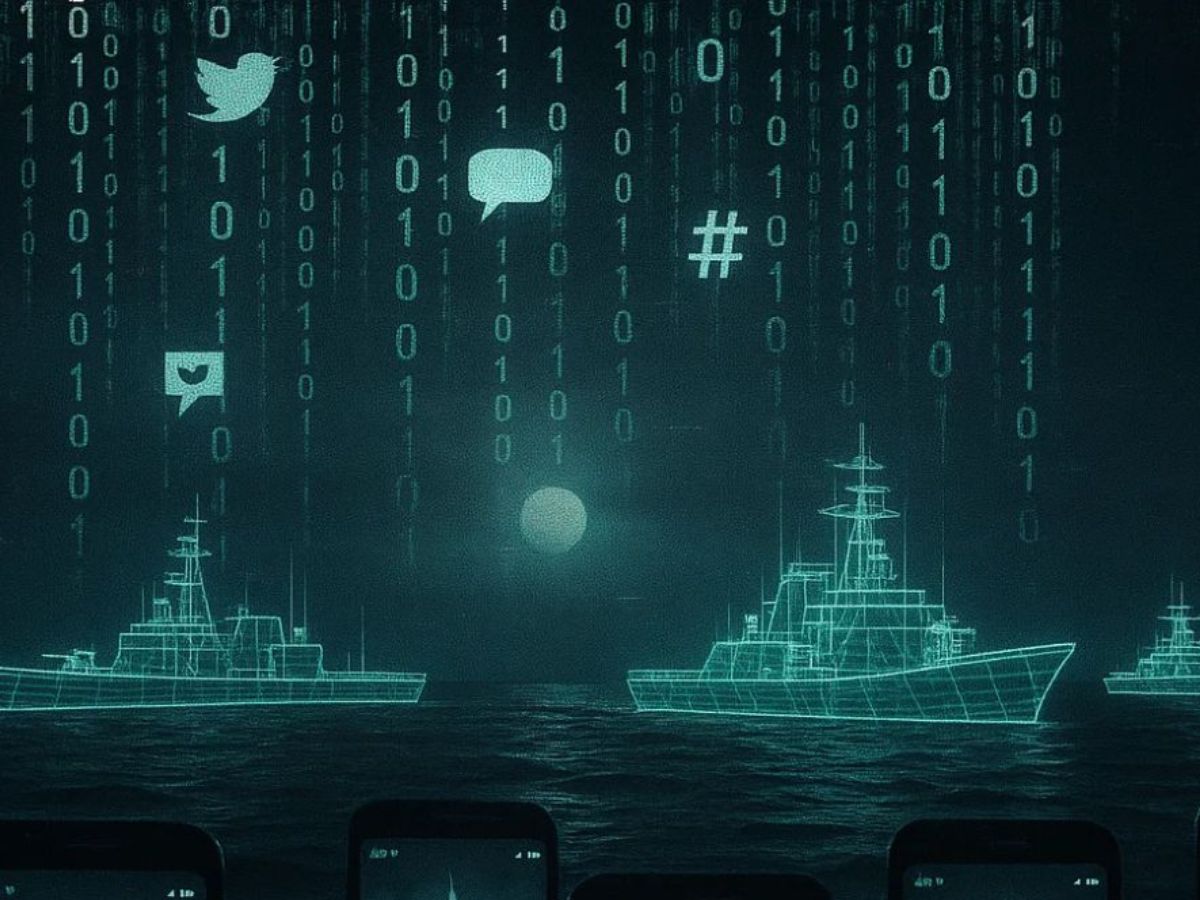
These coordinated bot systems have become the engine behind what many observers now call Pakistan’s “AI navy.” While ships and missiles define power at sea, it is algorithms and automation that now drive power in the digital space. These networks ensure that fake naval stories, AI-generated statements, deepfakes and doctored videos spread widely within minutes.
The way these networks work is simple but effective. When a synthetic video or fake statement is created, it is first released on a few seed accounts. These are often anonymous profiles that claim to be defence analysts, patriotic commentators or military watchers. Within seconds, hundreds of other accounts begin resharing the same content with identical or slightly altered captions. Many of these accounts post at the same moment, like machines responding to a signal.
The pattern is easy to spot when viewed closely. These accounts rarely engage in real discussion. They post only one type of content. They retweet far more than they speak. Their timelines show almost no personal interaction. They exist for one purpose only: to amplify a message.
During calm periods, these bot networks stay mostly quiet. But when tensions increase, they activate immediately. Naval exercises, missile tests, border incidents or political crises act like triggers. As soon as attention turns to the sea, the automated flood begins. The aim is to dominate the online space before verified information can catch up.
The effect on public perception is powerful. When hundreds of posts repeat the same claim, many users assume it must be true. The sheer volume creates an illusion of consensus. Even those who doubt the message at first begin to wonder if something important is being hidden. This is how false narratives gain strength—not through accuracy, but through repetition.
These automated networks do not operate alone. They work alongside AI-generated content. Synthetic press releases, fake battle videos and doctored images are created first. The bots then act as the delivery system. Together, they form a complete disinformation pipeline: creation, amplification and saturation.
Fact-checkers who track these campaigns have noted clear signs of coordination. Identical spelling mistakes appear across many accounts. The same hashtags trend suddenly from nowhere. The same short video clip appears with the same caption across dozens of profiles within seconds. Human users cannot behave like this consistently. Machines can.
The scale of these campaigns is what makes them dangerous. A single fake video shared by one person has limited effect. The same video shared thousands of times in a short window can shape the entire online narrative. Genuine information gets buried. Official denials struggle to rise above the noise. By the time the truth is widely known, the fake story has already done its damage.
For Pakistan’s “AI navy,” these automated networks are essential. They give a small group of content creators the appearance of mass public support. They make imaginary victories look real. They turn digital fiction into trending “news.”
The networks also target critics. Journalists, analysts and fact-checkers who challenge fake naval claims often find their replies flooded with automated abuse. Their posts are reported in bulk. Their visibility is reduced by coordinated downvoting. This tactic discourages open correction and makes the space feel hostile to verification.
Another worrying trend is cross-platform coordination. The same fake content often appears on X, Facebook, YouTube Shorts, Telegram channels and messaging groups almost at the same time. This indicates that the bot networks are not limited to one platform. They are part of a wider automated system that pushes content across the entire digital ecosystem.
The impact is not limited to India-Pakistan narratives alone. International observers, analysts and even foreign media outlets can stumble into these artificial trends. When a false story appears to be trending strongly from one side of the border, some international users repeat it without checking the source. This gives the campaign a global reach.
Pakistan’s official military institutions rarely acknowledge these automated campaigns. There are no clear public warnings from ISPR or the Navy distancing themselves from bot-driven propaganda. This silence allows the networks to operate in a grey zone where responsibility remains blurred.
To ordinary users, the difference between a real supporter and a programmed account is not always visible. Both have photos, bios and posting histories. But over time, patterns emerge. Bots post around the clock. They never sleep. They react faster than humans. They rarely show doubt. They never ask questions.
The long-term danger of these automated propaganda systems is erosion of trust. When people see that online discussions are being manipulated by machines, they begin to doubt everything. Genuine information, real warnings and authentic updates start to lose credibility. The information space becomes polluted.
In the case of Pakistan’s “AI navy,” the bots ensure that its virtual fleet always has momentum. Even when no real naval activity is taking place, the digital navy appears constantly active. Ships appear to be engaging. Missiles appear to be flying. Victories appear to be stacking up.
Yet behind this screen of noise lies a simpler truth. Bots do not sail. Algorithms do not fight. Automation cannot replace real ships, real crews and real operations. What it can do, however, is dominate attention.
This is the core strength of the automated propaganda networks. They do not have to win battles at sea. They only have to win moments in the public mind. A trending hashtag. A viral clip. A wave of identical posts. For a few hours, sometimes for days, that is enough to shape belief.
The challenge now is for platforms, authorities and users to recognise these campaigns for what they are. Artificial popularity should not be mistaken for real support. Automated outrage should not be confused with public opinion. And a digitally manufactured navy should not be mistaken for real maritime power.
Pakistan’s “AI navy” floats not on water, but on code. Its ships are made of pixels. Its firepower comes from servers. And its greatest weapon is not a missile, but a network of machines that never stop posting.

Comments are closed.