
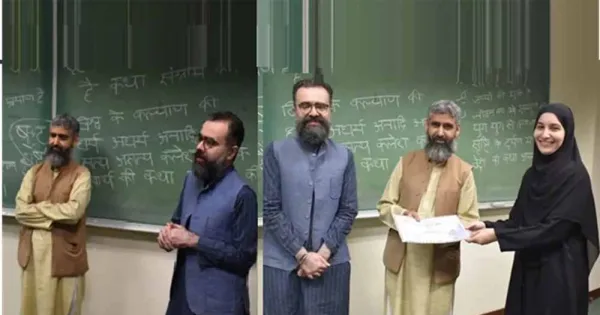
For the first time, study of Sanskrit started in Pakistan, course will be on Bhagavad Gita and Mahabharata.

Lahore: For the first time after independence in Pakistan, a university has started a course on Sanskrit language. Lahore University of Management Sciences i.e. LUMS had earlier started a 3-month weekend workshop, but after the overwhelming response, it has been converted into a full 4 credit university course. A senior official of the university said that this weekend workshop was opened for everyone including students, researchers and teachers. He said that the library of Punjab University in Pakistan has a large but neglected collection of old Sanskrit documents.
‘The number of students will increase in the coming times’
“In the 1930s, scholar JCR Woolner had cataloged several Sanskrit manuscripts written on palm leaves, but since 1947, no Pakistani scholar has been associated with the collection,” the official said. Only foreign researchers use it. This can change if we train local scholars. “When we saw the response, we decided to start it as a university course,” Dr Ali Usman Qasmi, director of Gurmani Centre, told the Tribune. Right now the number of students is low, but we hope it will increase in the next few years. By the spring of 2027, we will be able to teach this language as a year-long course.
There will also be courses on Bhagavad Gita and Mahabharata
Qasmi said LUMS is now planning to start courses on Bhagavad Gita and Mahabharata. “Hopefully this will create momentum,” he said. In 10-15 years we will be able to see scholars of Bhagavad Gita and Mahabharata in Pakistan itself. According to Tribune, the credit for starting this course goes to Dr. Shahid Rashid, Associate Professor of Sociology at Forman Christian College, Lahore. Dr Rashid said that he learned Sanskrit from online platforms as there were no local books available in the country. He took guidance from Cambridge Sanskrit scholar Antonia Ruppel and Australian Indologist McComas Taylor.
‘Sanskrit is not tied to any one religion’
Dr Rasheed was quoted in the Tribune as saying, ‘Classical languages hold a lot of wisdom for humanity. I first learned Arabic and Persian, then Sanskrit. It took about a year to cover classical Sanskrit grammar. And I’m still reading it.’ Dr. Rashid further said, ‘I tell people why should we not learn it? It is the language that binds the entire region. The village of Panini, the great scholar of Sanskrit grammar, was in this area. A lot of writing took place here during the Indus Valley Civilization. Sanskrit is like a mountain, a cultural monument. We should adopt it. It is ours too; It is not tied to any one religion.

Comments are closed.