
Scientists Discover Strongest Evidence Yet Of An Atmosphere On A Molten Rocky Exoplanet | world news

The James Webb Space Telescope has made significant strides in detecting atmospheres around exoplanets, ever since it commenced science operations in mid-2022. This data includes providing the first clear evidence of carbon dioxide in an exoplanet atmosphere (WASP-39b), atmospheric water vapor (WASP-96 b), and even heavier elements like oxygen and carbon (HD149026b).
According to the latest release, researchers have announced the detection of the strongest evidence to date for an atmosphere around a rocky planet.
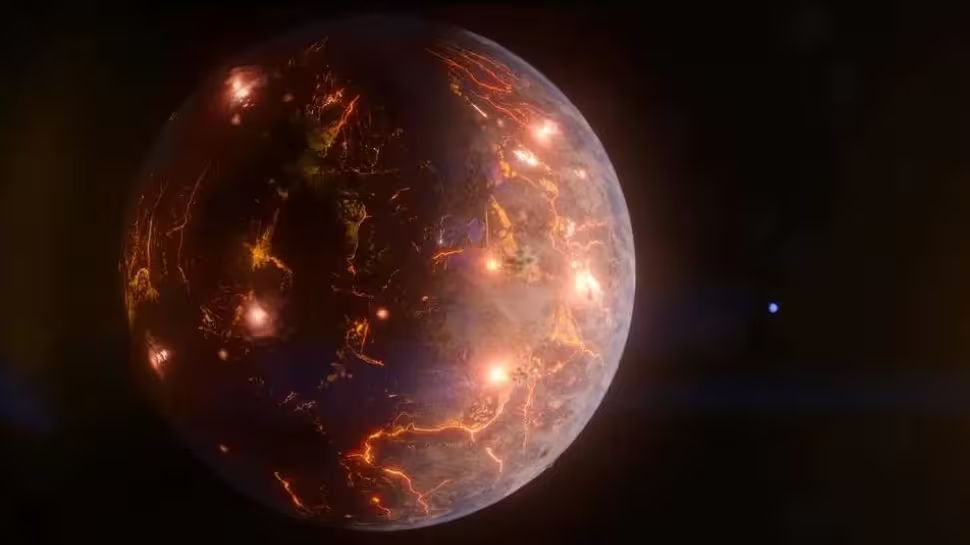
Meet TOI-561 b: A Planet of Fire and Gas
Add Zee News as a Preferred Source
The planet at the center of this breakthrough is TOI-561 b, an ultra-hot super-Earth located about 275 light-years from Earth. Measuring roughly 1.4 times the radius of Earth, the rocky world orbits a Sun-like star in less than 11 hours, placing it in the rare category of ultra-short-period (USP) exoplanets.
Observations made with Webb’s Near-Infrared Spectrometer (NIRSpec) suggest TOI-561 b is covered by a global magma ocean, topped by a thick layer of gases. This directly challenges the long-standing assumption that small rocky planets orbiting so close to their stars would quickly lose any atmosphere due to intense stellar radiation.
A Discovery That Defies Planetary Theory
The research was led by Johanna Teske of the Earth and Planets Laboratory at the Carnegie Institution for Science, alongside an international team of astronomers. Their findings were published on December 11 in The Astrophysical Journal Letters.
Because TOI-561 b orbits at less than one-fortieth the distance between Mercury and the Sun, scientists believe the planet is tidally locked, meaning one side permanently faces its star. As a result, temperatures on the daytime soar beyond the melting point of rock, creating a vast lava-covered surface.
Surprisingly, measurements of the planet’s mass and size reveal a lower-than-expected density. This could indicate a relatively small iron core and a mantle made of rock less dense than Earth’s, or it could mean that an atmosphere is making the planet appear larger than it actually is.
Tracking Heat to Reveal an Atmosphere
To test whether TOI-561 b truly has an atmosphere, the team observed the system for more than 37 hours as the planet completed nearly four orbits. They measured changes in brightness as the planet passed behind its star, a method similar to, but reversed from, the transit technique commonly used to discover exoplanets.
If the planet lacked an atmosphere, it would be unable to redistribute heat, leading to a blistering dayside temperature of around 2,700°C. Instead, Webb recorded a significantly cooler temperature of about 1,800°C.
This temperature difference strongly suggests the presence of an atmosphere capable of transferring heat between the planet’s dayside and nightside.
A ‘Wet Lava Ball’ World
Despite the evidence, one major mystery remains: how does such a small planet, bombarded by extreme radiation, manage to hold onto a dense atmosphere?
Researchers propose that TOI-561 b exists in a delicate balance between its magma ocean and atmosphere. Gases released from the molten surface feed the atmosphere, while the magma simultaneously reabsorbs them back into the planet’s interior.
To explain the observations, scientists believe the planet must be far richer in volatile elements than Earth, earning it a striking description from researchers as something akin to a “wet lava ball.”
What comes next
These findings mark the first results from Webb’s General Observers Program 3860, part of its Cycle 2 mission. Scientists are now analyzing the complete dataset to map temperatures on both the day and night sides of TOI-561 b and to better understand the composition of its atmosphere.
If confirmed in greater detail, this discovery could expand the list of worlds capable of hosting atmospheres, even under the most extreme cosmic conditions, and reshape how astronomers think about rocky planets beyond our solar system.

Comments are closed.