
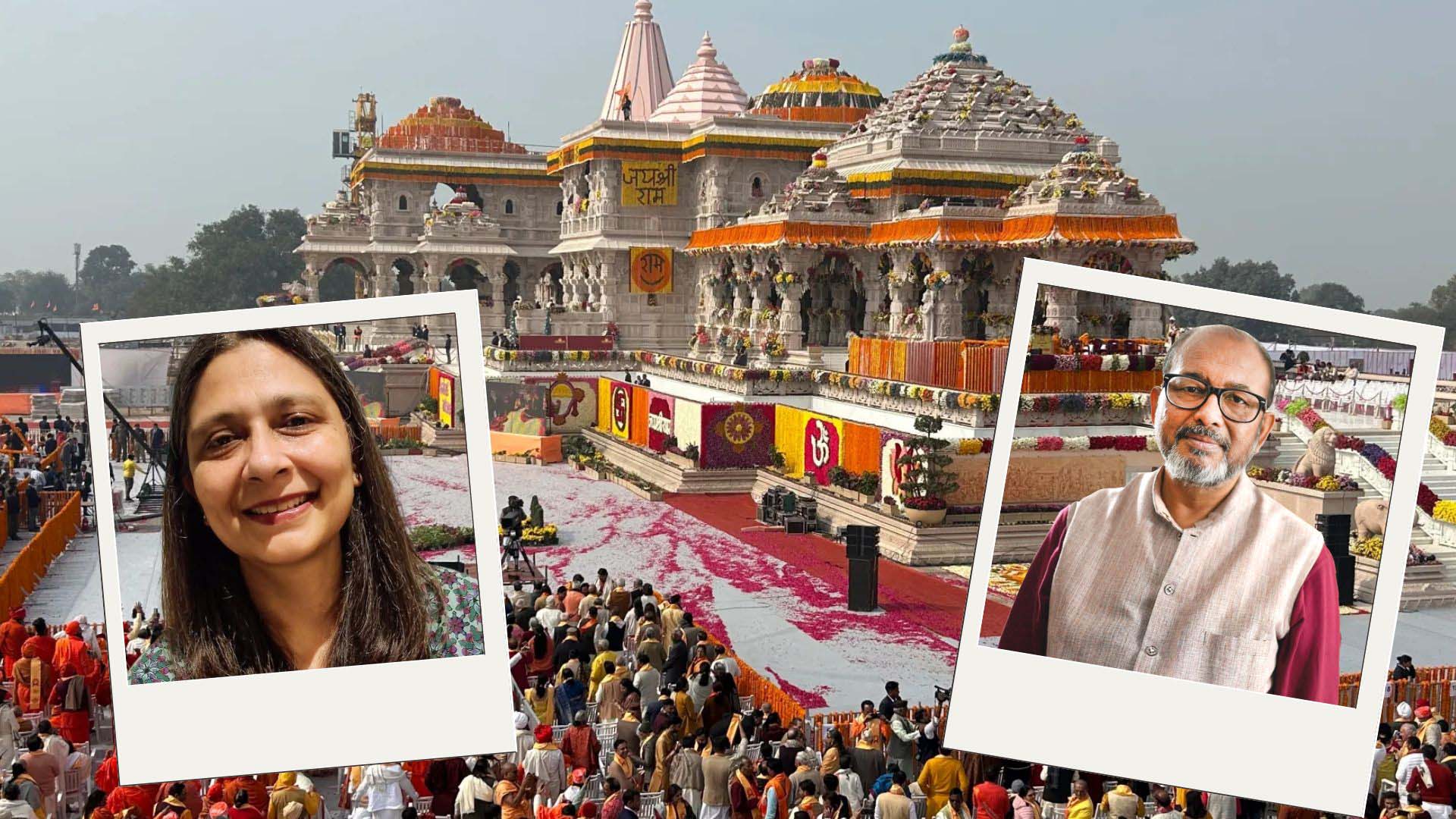

As part of The Federal’s RSS at 100 interview series, senior journalist Nilanjan Mukhopadhyay speaks with Manjari Katju, professor of political science at the University of Hyderabad and one of India’s foremost scholars on the Vishwa Hindu Parishad (VHP). Drawing on decades of research, Katju traces how the VHP — largely unknown until the early 1980s — became the principal driver of the Ram Janmabhoomi movement, turning Ayodhya into a national political symbol and reshaping the trajectory of Hindu nationalist politics.
Would the rise of the BJP and the Sangh Parivar have been possible without the VHP-led Ram Janmabhoomi movement?
Katju agrees that the Ram Janmabhoomi movement was central to the rise of Hindu nationalist politics. She explains that the VHP took the agitation far beyond Ayodhya and Uttar Pradesh, consciously transforming it into a nationwide mobilisation. This process helped build a mass social and political base for Hindutva, from which the BJP benefited electorally.
At the same time, the movement also reshaped the VHP itself. From being a little-known organisation within Hindutva circles, it became the public face of the Ram temple agitation. By the early 1990s, Katju notes, Ram Janmabhoomi and the VHP had become almost interchangeable in the public imagination.
What was the original purpose behind the RSS creating the Vishwa Hindu Parishad?
Katju explains that the VHP was not initially conceived as an activist organisation. In its early decades, particularly during the 1960s and 1970s, it was meant to function as a quiet, broad Hindu platform that could reach constituencies the RSS could not.
The RSS, constrained by its post-Gandhi assassination image, its male-only structure, and its reluctance to engage in open mass politics, saw the VHP as a way to bring together religious leaders, sadhus, sympathetic politicians, and sections of society unwilling to openly associate with the RSS.
How did the political context of the 1960s and 1970s shape the VHP’s formation?
Katju places the VHP’s emergence in a period marked by Partition anxieties, the formation of Nagaland, the Punjabi Suba movement, and the growing influence of communists and socialists. Within this context, the RSS leadership framed Islam, Christianity, and communism as “alien ideologies” that threatened Hindu society.
The VHP was designed as a religious-nationalist organisation that could counter these influences, particularly through religious legitimacy and cultural mobilisation rather than overt political confrontation.
Why was the 1983 Ekatmata Yagna a turning point for the VHP?
The Ekatmata Yagna, Katju says, marked the VHP’s first large-scale national mobilisation. Organised against the backdrop of turmoil in Punjab, Assam, and Jammu and Kashmir, the yatras sought to project a sense of Hindu unity across regions.
The programme drew massive participation, including large numbers of women, revealing the VHP’s potential for mass outreach. Its success convinced the organisation that nationwide mobilisation was possible, directly leading to the open launch of the Ram Janmabhoomi movement in 1984.
How did the Shah Bano case and the opening of the Ayodhya locks influence the movement?
Katju explains that the Rajiv Gandhi government’s handling of the Shah Bano judgement, followed by the opening of the locks at the Ayodhya site, was widely seen as appeasement politics. This perception strengthened the Sangh Parivar’s claim that Congress selectively favoured minorities while making tactical concessions to Hindus.
It was during this period, she notes, that the idea of “minority appeasement” entered mainstream political discourse, giving further momentum to the Ram temple agitation.
Why did the VHP rely more on mass religious mobilisation than elite Hindu clergy?
While the VHP did seek the support of prominent religious figures, Katju says backing from major Hindu clergy was uneven. Some Shankaracharyas supported the movement, while others strongly opposed it.
As popular participation grew, the VHP realised it no longer depended on elite religious endorsement. Support from akhadas and mid-level religious leaders, combined with mass mobilisation, proved sufficient to sustain the movement.
How did the Ram Janmabhoomi movement expand Hindutva’s social base?
Katju highlights the VHP’s outreach to Dalits, OBCs, and tribal communities — groups the RSS had previously struggled to mobilise directly. Incidents such as the Meenakshipuram conversions alarmed the VHP and pushed it to emphasise Hindu unity while publicly rejecting caste discrimination.
The Ram Janmabhoomi movement became the vehicle through which Hindutva politics acquired a genuinely mass character, cutting across caste and regional lines.
How did Mandal politics alter the course of the movement?
The implementation of the Mandal Commission recommendations posed a direct challenge to the Hindu unity constructed around the Ram movement. Katju explains that LK Advani’s Rath Yatra functioned as a counter-mobilisation, shifting political focus from caste to religion.
At this stage, she argues, the movement moved decisively from ideological mobilisation to power politics, pursued despite widespread communal violence.
Was the demolition of the Babri Masjid inevitable?
Katju refrains from attributing clear intent but notes that by 1992, sustained mobilisation, repeated yatras, and rising popular enthusiasm suggested that events were moving toward an irreversible outcome.
After the demolition, however, the Sangh Parivar — particularly the VHP — entered a phase of uncertainty, having achieved its most visible objective without a clear roadmap ahead.
What role does the VHP play today?
According to Katju, the VHP now operates in a fundamentally altered political environment. Its core objectives — the Ram temple and the BJP’s rise to power — have been achieved. As a result, the organisation is searching for relevance through cultural campaigns, selective protests, and alignment with the broader Hindutva agenda of the government in power.
While the VHP remains active, she concludes, it no longer occupies the transformative position it once did during the 1980s and 1990s.
(The content above has been transcribed from video using a fine-tuned AI model. To ensure accuracy, quality and editorial integrity, we employ a Human-In-The-Loop (HITL) process. While AI assists in the initial draft, our editorial team reviews, edits and refines the material before publication. At The Federal, we combine AI efficiency with human expertise to deliver credible, nuanced journalism.)

Comments are closed.