
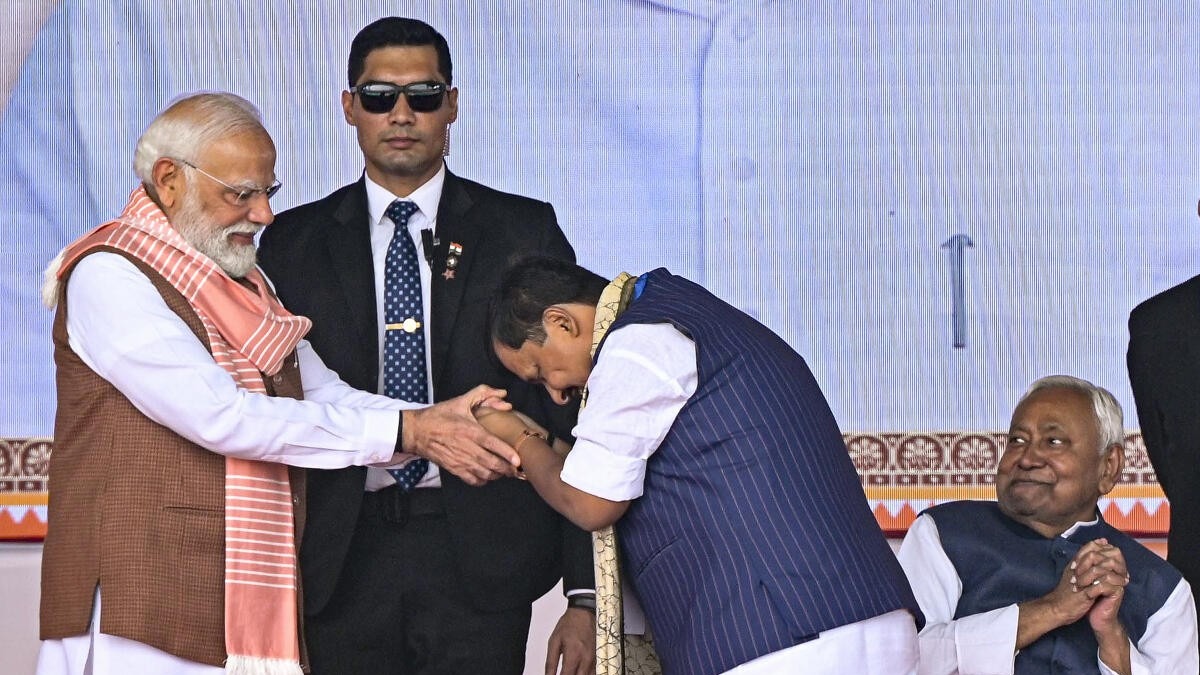

If any party in Indian politics has used ‘surprise politics’ most effectively in leadership selection, it is the Bharatiya Janata Party. It has been seen time and again that the party bypasses obvious contenders and big names and hands over top responsibilities to relatively low-profile but organizationally reliable leaders. The appointment of Nitin Nabin as the National Working President of BJP is being considered as the latest link in this long pattern.
Nitin Nabin, around 45, is seen within the party as a young and hardworking organization architect. From leading the BJP’s youth wing in Bihar to election management and later to a ministerial berth in the Nitish Kumar government, he has worked at different levels of the organization for nearly two decades. From the outside view, this appointment may seem sudden and unexpected, but in the internal structure of BJP, it is being considered as part of a well-planned and long-term strategy.
Nitin Nabin’s coronation fits perfectly into the BJP’s ‘surprise politics’, in which the party gives priority to organizational efficiency, booth-level understanding and cadre management over mass support. He is not considered a big public leader, but is definitely a disciplined and trustworthy face for the party.
This is not a new strategy. Even before this, BJP has elected such Chief Ministers in many states, whose names were not prominent during the election campaign. Making Bhajanlal Sharma, who became the MLA for the first time after the hat-trick victory in Rajasthan, the Chief Minister, was a big example of this. Organizational loyalty of three decades was said to be the main basis for his selection.
In Madhya Pradesh too, Mohan Yadav was made the Chief Minister by keeping aside experienced leaders like Shivraj Singh Chauhan, Kailash Vijayvargiya and Narendra Tomar. Despite limited national identity, the OBC equation and organizational acceptance worked in their favor. The selection of Vishnu Dev Sai in Chhattisgarh was also in accordance with this thinking. The appointment of Deputy Chief Ministers in these states indicated that the BJP does not want to allow power to become individual-centric.
The recent appointment of Harsh Sanghvi as Deputy Chief Minister in Gujarat was also seen as a similar unexpected but controlled strategy. If we look at all these decisions together, the picture becomes clear, under the leadership of PM Modi, BJP is reorganizing the state leadership with a long-term view.
In this context, the continuation of BJP Nitin Nabin’s Surprise Politics is to ensure that the national leadership of BJP is also reorganized with a long-term vision.
Critics raise questions whether the BJP is ignoring public leaders. It is possible that such decisions may make aspiring leaders uncomfortable. But Modi-Shah seem ready to take this risk. On the contrary, many parties struggling with dynasticism appear to be weakened by such surprise packages and organizational changes.
Also read:
Senior terrorist of Hezbollah killed in South Lebanon, swift action by Israel
Former Yes Bank CEO Rana Kapoor appears before ED in money laundering case related to Anil Ambani.
Strong growth of 19.37% in India’s exports in November, imports decreased

Comments are closed.