
A Lost CIA Nuclear Device Still Haunts The Himalayas, 60 Years After A Cold War Mission world news

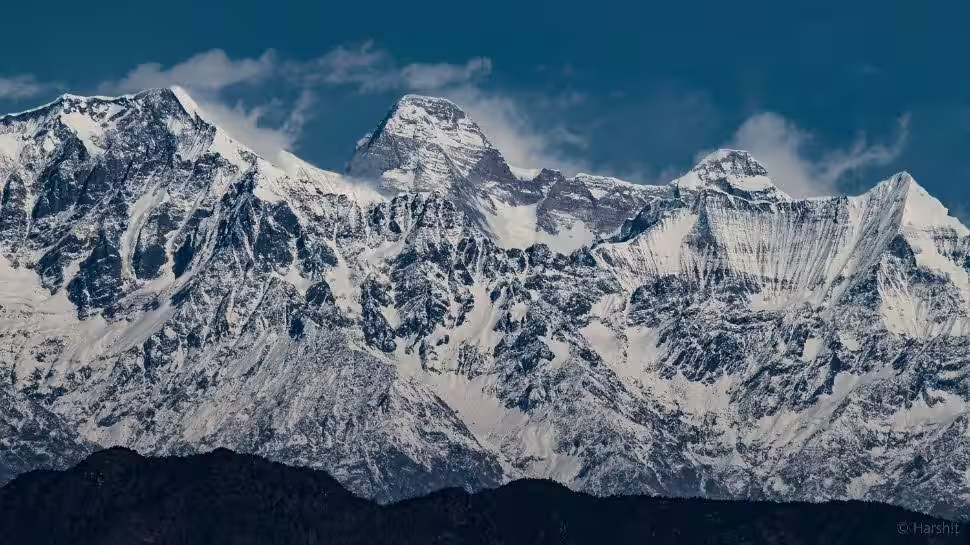
New Delhi: In the autumn of 1965, as the Cold War tightened its grip on the world, a small group of American and Indian climbers set out on a mission that few people knew about and even fewer would ever acknowledge. Their destination was Nanda Devi, one of India’s most formidable Himalayan peaks. Their cargo was far more dangerous than ropes, tents or food supplies. Hidden inside metal casing was a plutonium-powered generator designed to spy on China.
China had recently tested an atomic bomb, ringing alarm bells across Washington. The Central Intelligence Agency (CIA) wanted eyes and ears deep into Chinese territory, which is focused on missile tests. The solution was daring and reckless at the same time, placing a nuclear-powered surveillance antenna high in the Himalayas, where geography itself would do the spying.
The climbers carried an antenna, cables and a 13-kilogram generator known as the SNAP-19C. Inside it sat plutonium, nearly a third of the amount used in the Nagasaki bomb. The mission moved under the cover of science, officially presented as research. In reality, it was intelligence gathering at extreme altitude.
Add Zee News as a Preferred Source
As the team prepared for the final ascent, nature intervened. A violent blizzard rolled in, swallowing the mountain in white chaos. From the advanced base camp below, Captain MS Kohli, the Indian officer leading the expedition, sensed disaster unfolding. He reached for the radio.
“Camp Four, this is Advance Base. Can you hear me? … Come back quickly… don’t waste a single minute.”
Then came the instruction that sealed the fate of the mission.
“Secure the equipment. Don’t bring it down.”
The climbers hid the generator and antenna on an icy ledge near Camp Four and rushed downhill to save their lives. What they left behind was a nuclear device embedded in one of the most sensitive mountain ecosystems on earth. It was never seen again.
Officially, nothing had happened. The United States never acknowledged the operation.
The origins of the mission traced back to an unlikely setting. At a cocktail party, General Curtis LeMay, head of the US Air Force, found himself listening to Barry Bishop, a National Geographic photographer and experienced Everest climber. Bishop talked about Himalayan peaks offering clear views deep into Tibet and across the Chinese border. The idea took hold almost instantly.
Soon after, the CIA asked Bishop to organize a covert expedition disguised as scientific work. He was tasked with recruiting climbers, creating a believable cover story and keeping the real purpose hidden.
Bishop agreed and assembled what was called the Sikkim Scientific Expedition. Among those recruited was Jim McCarthy, a young American climber and lawyer, paid $1,000 a month for what the agency described as a vital national security assignment.
India also participated. Memories of the 1962 war with China were still fresh, and fear guided decision-making. Captain Kohli, however, remained sceptical. “It was nonsense,” he said later.
When the CIA initially proposed placing the device on Kanchenjunga, the world’s third-highest peak, Kohli did not hold back. “I told them whoever is advising the CIA is a stupid man.”
McCarthy shared the disbelief. “I looked at that Kanchenjunga plan and said, ‘Are you out of your mind?’”
Eventually, Nanda Devi became the chosen site.
The climb began in September 1965. Helicopters rushed the climbers to high altitude without proper acclimatisation. Many fell ill as their bodies struggled to adjust. The plutonium generator, radiating heat, became an odd source of comfort. According to Kohli, Sherpas argued over who would carry it because it kept them warm.
“At the time,” he said, “we had no idea about the danger.”
On October 16, near the summit, survival became uncertain. The storm hit with full force.
“We were 99 percent dead. We had empty stomachs, no water, no food and we were totally exhausted,” recalled Sonam Wangyal, one of the Indian climbers.
When Kohli ordered the equipment to be abandoned, McCarthy reacted in fury, “You have to bring that generator down, you’re making a huge mistake.”
The order stood.
The following year, the team returned, hoping to retrieve the device. What they found was absence. The ledge was gone. Ice, rock and equipment had vanished, torn away by an avalanche.
“Oh my God, this will be very, very serious. These are plutonium capsules,” Kohli remembered the CIA officers saying.
Search missions followed. Radiation detectors swept the slopes. Infrared sensors scanned the ice. Nothing appeared.
“That damn thing was very warm. It would melt the ice around it and keep sinking,” McCarthy said.
The mission failed, and the secret remained buried until 1978, when a young reporter named Howard Kohn uncovered the story in Outside magazine.
Public reaction erupted. Protesters in India carried signs reading, “The CIA is poisoning our waters.”
Behind closed doors, damage control moved fast. US President Jimmy Carter and Indian Prime Minister Morarji Desai worked to contain the fallout. In a private letter, Carter praised Desai for handling “the Himalayan device problem”, calling it an “unfortunate matter”. Publicly, both governments remained largely silent.
Decades later, the climbers are elderly or gone. Jim McCarthy, now in his 90s, still shakes with anger.
“You can’t leave plutonium by a glacier feeding into the Ganges. Do you know how many people depend on the Ganges?” he shouted.
Captain Kohli, before his death, reflected with sorrow.
“I would not have done the mission in the same way. The CIA kept us out of the picture. Their plan was foolish, their actions were foolish, whoever advised them was foolish. And we were caught in that.”
He paused before adding, “The whole thing is a sad chapter in my life.”

Comments are closed.