
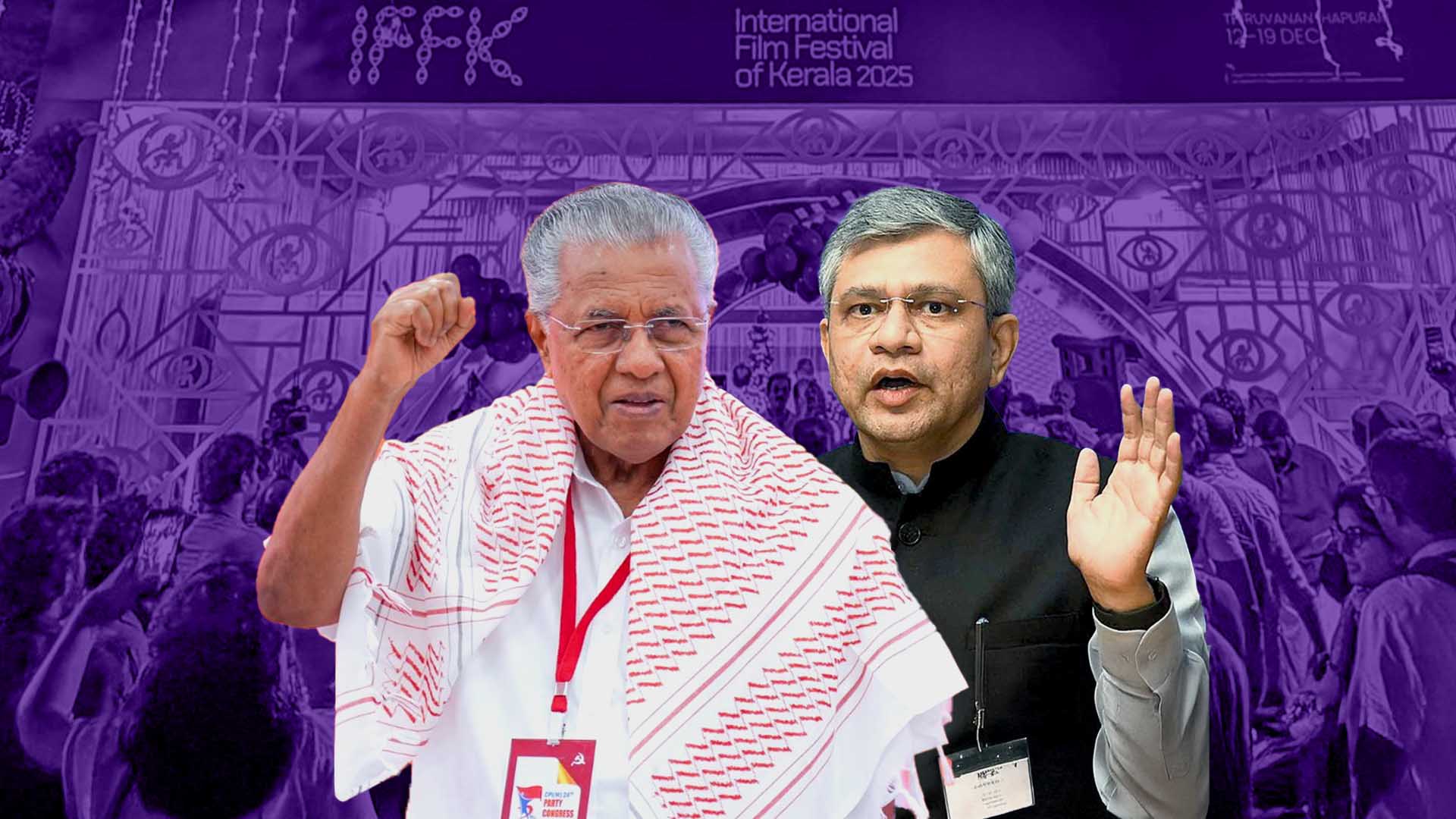

What began as a dispute over censor exemptions at the International Film Festival of Kerala (IFFK) has now evolved into a wider political confrontation over power, autonomy and control over what audiences are allowed to watch.
During the 30th edition of IFFK, several films were abruptly removed mid-festival after the Ministry of Information and Broadcasting declined to grant censor exemptions to 19 titles, including the opening film Palestine 36. Screenings were cancelled and protests erupted inside the festival venues.
Cinema quickly took a back seat as censorship dominated discussions for nearly two days, with festival delegates expressing outrage over the sudden decision.
Festival disruption
The films affected were not marginal works. Classics such as Sergei Eisenstein’s Battleship Potemkin and Fernando Solanas’s The Hour of the Furnaces have long been part of Kerala’s film culture, tracing back to the 16mm film society movement and international festival circuits.
Also Read: Kerala LSG elections: What numbers say about UDF, LDF, NDA performance
The cancellations triggered protests at the Tagore Theatre, where the Democratic Youth Federation of India led an agitation within the festival premises. At that stage, the Centre’s refusal appeared final, leaving organisers and audiences in limbo.
For many at the festival, the episode raised deeper concerns about whether politically engaged cinema was being deliberately sidelined through administrative decisions.
State’s defiance
The situation has since taken a decisive turn. The Kerala State Chalachitra Academy, backed by the state government, has chosen not to accept the Union government’s non-clearance stance.
Films that were earlier denied permission are now being screened. Titles such as The Eagles of the Republic and Once Upon a Time in Gaza are scheduled for exhibition, with the state opting to proceed despite the Centre’s position.
Kerala’s Minister for Culture Saji Cherian has stated that the government will go ahead with the original list of films, signalling a clear break from compliance and a willingness to confront central authority.
Legal debate
This is not without precedent. A similar stand was taken earlier by the West Bengal government during the Kolkata International Film Festival, where state authorities resisted delays and objections linked to censor exemptions.
However, a more cautious view has also emerged. Some filmmakers and observers argue that censor exemptions are a legal requirement and that festival organisers are expected to complete formalities well in advance.
From this perspective, the controversy could reflect organisational lapses or procedural miscalculations by the festival authorities, rather than a deliberate political clampdown by the Centre.
Bigger questions
That argument, while relevant, leads to a larger question. Would these films have received clearance even if applications had been submitted months earlier?
The Academy believes the pattern of denial suggests otherwise, noting that many of the affected films deal with politics, resistance and Palestine — themes that have become increasingly sensitive in the current political climate.
Censorship, the argument goes, does not always arrive as an explicit ban. It often operates through silence, delay and last-minute refusals, a tactic that becomes particularly damaging when deployed in the middle of an international festival.
Autonomy at stake
The issue now extends far beyond IFFK or the 19 films involved. At its core is a question about whether cultural spaces in India can retain autonomy, and whether state-run festivals can function without constant anxiety over central intervention. Kerala has chosen confrontation over compliance. Whether this leads to resolution or further escalation remains uncertain.
What is clear is that this year’s IFFK will be remembered not just for its films, but for the battle over who controls the screen.
The content above has been transcribed from video using a fine-tuned AI model. To ensure accuracy, quality, and editorial integrity, we employ a Human-In-The-Loop (HITL) process. While AI assists in creating the initial draft, our experienced editorial team carefully reviews, edits, and refines the content before publication. At The Federal, we combine the efficiency of AI with the expertise of human editors to deliver reliable and insightful journalism.

Comments are closed.