
BS-4 and Above Compliant Engines to get Exemption in Delhi, Government Planning Overhaul of PUC Certificates

NEW DELHI, Dec 17: Only vehicles with BS4 compliant engines and above will be exempted from action if they are found running in Delhi, the Supreme Court said on Wednesday, modifying its earlier order banning 10-year-old diesel-run vehicles and 15-year-old petrol-run vehicles from December 18 in view of the massive air pollution in Delhi.
A 15-year-old petrol-run vehicle in India and its 10-year-old diesel counterpart are likely to have a BS-III (Bharat Stage 3) compliant engine. The BS-IV engines were launched the next year.
Earlier, the Supreme Court, acting on a petition from the Delhi government, had ordered that no strict action would be taken against 10-year-old diesel and 15-year-old petrol vehicles. That left a gray area both for vehicle owners and the implementing agencies.
The court’s clarification came today following a request from the Central pollution watchdog CAQM (Commission for Air Quality Management). Citing the extreme pollution blanket over Delhi-NCR, the Commission had asked that vehicles with older engines (BSIII) contribute massively to pollution and deserve no exemption.
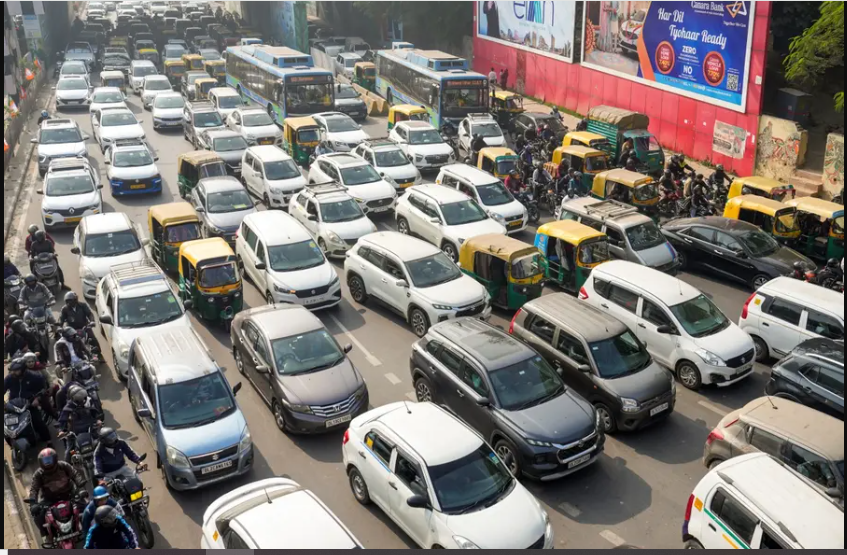
The crackdown on older engines came after evidence mounted that vehicular pollution remained the key reason for the smog blanket over Delhi every winter. The CAQM has found that around 93 per cent of the 2.88 crore vehicles on the road in Delhi-NCR are light motor vehicles — cars and two-wheelers. Around 37% – run on BS III or even older engines. These emit between 2.5 and 31 times more particulate matter, 6.25 to 12 times more nitrogen oxides, and 1.28 to 5.4 times more carbon monoxide compared to newer vehicles, the CAQM said in the data submitted to the top court. As the AQI in Delhi keeps spiraling, the Prime Minister’s office has ordered strict action against polluting vehicles.
Delhi environment minister Manjinder Singh Sirsa on Wednesday announced a series of new steps to address vehicular pollution. These include not providing fuel to a vehicle without a valid Pollution Under Control (PUC) certificate, an integrated traffic system that will cut down on time and pollution at traffic lights and a car-pooling app.
The Delhi government said it was considering an overhaul of the PUC certificate issuing system as the existing centers were old with many shortcomings. A third party monitoring system to be brought in,” Mr Sirsa said. He also said the government was also working toward building a carpooling app and an integrated traffic management system.
On the carpooling app, Mr Sirsa said, “We are also trying for a carpooling app for Delhi. There is no system in place right now for car-pooling. We are trying to make a carpooling app for Delhi. There will be options for people to use their cars for carpooling or to travel via carpooling.” The government is planning a tie up with Map India and Google Maps in this regard. “Today, we have a meeting with Google Maps to identify major traffic hotspots using the data available with them,” Mr Sirsa added.
Mr Sirsa also announced that the Delhi government has signed a memorandum of understanding (MoU) with IIT-Madras to identify smog-eating surfaces. Earlier in September, Mr Sirsa had said his department would conduct a technology-backed study on titanium oxide-based “smog-eating” photocatalytic coatings that can be applied to roads to fortify the Delhi’s air protection efforts.
The technology can reduce nitrogen dioxide and harmful hydrocarbons in spaces where people live, travel, and work, he had said, adding that the technology has been used in some cities abroad but not yet in India.
(Rohit Kumar)

Comments are closed.