
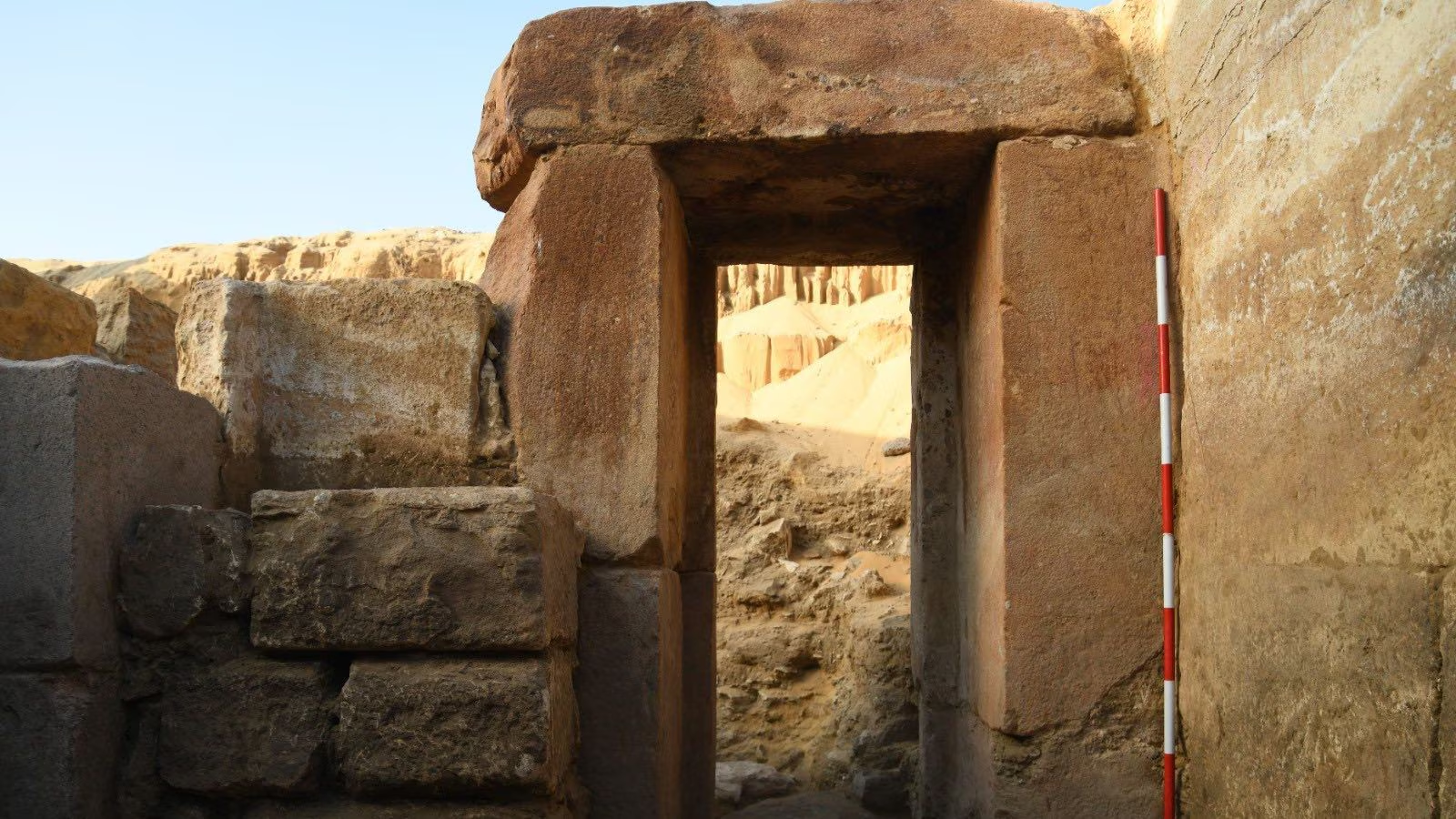
Archaeologists reveal valley temple at Abu Ghurab that once worshipped Egyptian Sun god Ra

Archaeologists working in Egypt have uncovered the remains of a 4,500-year-old valley temple that once formed part of a grand sun temple complex dedicated to Ra, the ancient Egyptian sun god. The discovery, announced by the Egyptian Ministry of Tourism and Antiquities, sheds new light on how people accessed and experienced one of the Old Kingdom’s most important religious monuments.
The newly excavated structure lies at Abu Ghurab, around 16 kilometres southwest of Cairo, close to the Nile River. Ancient Egyptian sun temples were typically divided into two connected sections: an upper temple, positioned on higher ground and used for core ritual activities, and a valley temple, located closer to the river. The two were linked by a causeway that guided visitors from the water’s edge up to the sacred precinct. While the upper temple at Abu Ghurab had been excavated several years ago, the valley temple only became accessible recently, with systematic work beginning in 2024.
Although the site itself was not entirely unknown, earlier attempts to excavate it had been cut short. German Egyptologist Ludwig Borchardt explored parts of the valley temple in 1901 but was forced to abandon the work because high groundwater levels made further digging impossible.
Today, with groundwater levels significantly lower, a joint Italian archaeological mission led by Massimiliano Nuzzolo and Rosanna Pirelli has managed to excavate roughly half of the valley temple, revealing substantial new details about its design and function.
Among the most significant finds is a columned entrance portico, which appears to have served as the main point of arrival for visitors coming by boat from the Nile or one of its channels. From there, worshippers would have moved through the valley temple and ascended the causeway to reach the upper temple on the hill. Numerous decorated stone blocks were also uncovered, many bearing inscriptions that name Pharaoh Niuserre, who ruled during the Fifth Dynasty and is credited with commissioning the sun temple complex.
One of the most striking discoveries is a series of inscribed blocks forming what researchers believe to be a public calendar of religious events. Parts of this calendar were first identified over a century ago, but the new excavations have revealed additional sections.
The inscriptions list festivals dedicated to Sokar, a falcon-headed god linked to Memphis, celebrations honouring the fertility god Min, and processions associated with Ra himself. The placement of these blocks near the entrance suggests that the temple façade displayed the calendar openly, making it one of the earliest known examples of a public religious schedule.
The team also uncovered a staircase leading to the roof of the valley temple. According to the researchers, this elevated space was likely used for observing the sky rather than for ritual celebrations, hinting at the importance of astronomy in the temple’s daily activities.
Evidence from later phases shows that the valley temple did not remain a purely sacred space forever. After roughly a century of use, it appears to have been converted into a residential area. Archaeologists found wooden gaming pieces associated with senet, a popular ancient Egyptian board game whose rules remain partly mysterious. The presence of these objects suggests that everyday life eventually replaced formal worship within the former sanctuary.
Together, the discoveries at Abu Ghurab provide a rare glimpse into how monumental sun temples functioned not only as places of worship but also as living spaces that evolved over time, reflecting changes in religious practice, social use, and daily life in ancient Egypt.

Comments are closed.