

Highlights
- Synthetic reality merges AI and AR to turn everyday life into editable, immersive experiences.
- AI-generated worlds are transforming shopping, workspaces, education, and entertainment globally.
- Affordable AR devices bring advanced digital experiences to the global middle class.
- Ethical risks around privacy, identity, and manipulation rise as synthetic worlds feel real.
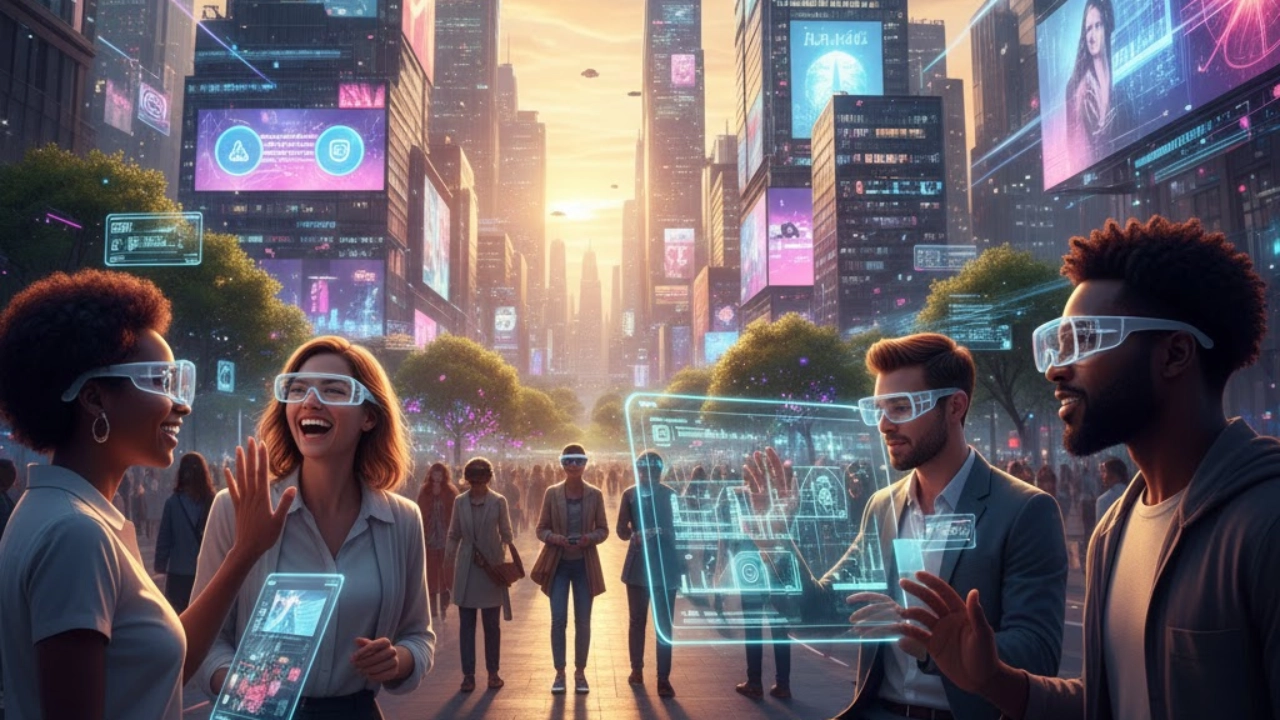
Imagine walking through a city and seeing floating navigational arrows guiding your route. Picture your living room instantly transforming into a digital workspace during office hours. Through a simple glance with AR glasses, you could identify objects, translate foreign languages, or even summon virtual humans for assistance, collaboration, or companionship.
Synthetic reality brings capabilities once exclusive to high-income users directly into the hands of low- and middle-income citizens around the world. What was once costly, like advanced therapy sessions, international travel, specialized learning labs, or corporate-grade training simulations, can now be experienced for a fraction of the price through synthetic environments.
But what exactly happens when daily reality becomes editable?
How does synthetic reality reshape the way we work, learn, shop, and experience emotions?
How AI + AR Transform Daily Life: The New Normal for Global Consumers
AI AR Shopping Future for Consumers
Synthetic reality turns shopping into an intelligent, personalized experience. Instead of scrolling through static images:
- The AI provides an immediate recommendation for items depending on your price, preferences, and past purchasing history.
- Nutritional Alerts/Allergen Warnings appear on grocery products at the time of purchase.
- Groceries appear with nutritional alerts or allergen warnings overlaid in real-time.
- In-store pricing reflects the customer’s individual “product pricing” (discount pricing) based on their loyalty, buying behaviours, and inventory levels.
The Global Middle Class can make more informed choices with greater transparency.
Think of families comparing household appliances under USD 300, or students selecting budget laptops, as AI-generated comparisonsvisual overlays, and reviews appear right in the room.
In Indian cities, Southeast Asia, or rural America, where online shopping dominates, synthetic reality can help users “try before buying” without physical stores.
But if our purchasing decisions become AI-mediated, do we risk losing our instincts for choice and judgment?
What does this shift mean for work and productivity?
AI Workspaces and Spatial Computing Are Redefining Productivity
AI AR Workspace Productivity Tools
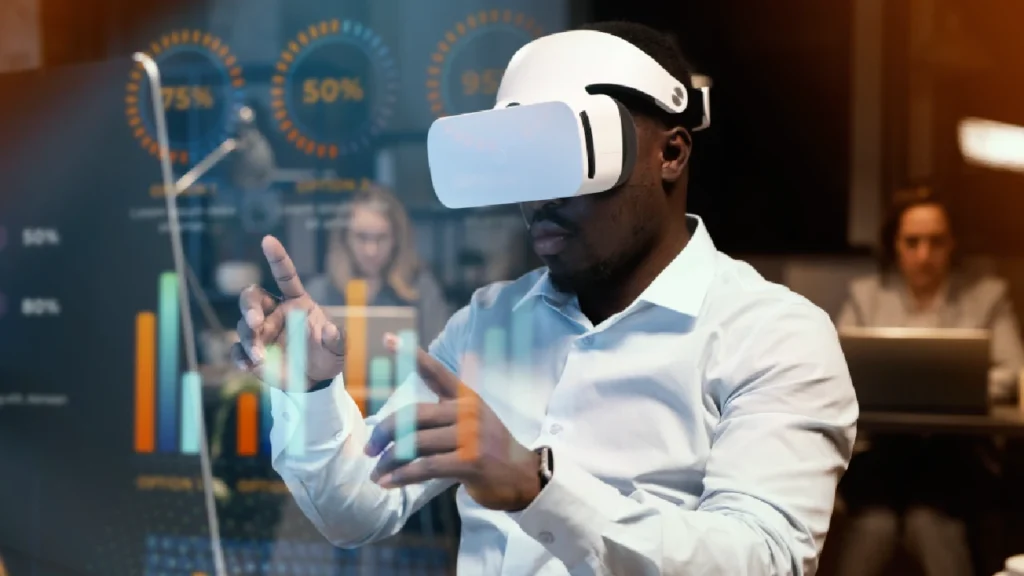
The workplace is one of the biggest beneficiaries of synthetic reality. Using spatial computing, users can create virtually limitless displays without purchasing any physical screens.
Spatial Computing enables a truly 3D collaborative environment, with members of a global team working on the same digital object or model as if they were standing in the same room together, regardless of where they are located (New York City or Nairobi, for instance).
Global middle-class professionals will feel the impact most strongly:
- Freelancers in India or Africa gain access to the same immersive work environments as Silicon Valley teams.
- Office workers get AI assistants that summarize calls, generate reports, or translate speech in real time.
- Students can practice anatomy or engineering using AR overlays instead of expensive lab equipment.
This democratizes career opportunities, like having your “office” wherever your AR glasses are.
But if our workspaces become virtual and omnipresent, how does synthetic reality transform entertainment and leisure?
Do our evenings, weekends, and emotions shift too?
Entertainment, Emotions, and Human Identity in Synthetic Worlds
AI AR Entertainment Future of Storytelling
Synthetic reality revolutionizes entertainment by offering stories you can step into. AI creates dynamic scenes that adapt to your emotions, preferences, and even heartbeat:
- Horror scenes intensify if your pulse rises.
- Virtual concerts feel like front-row stadium shows for USD 10.
- VR fitness becomes as engaging as a video game.
- Families create AI-generated vacation memories when real travel is too expensive.
For middle-class users globally, this offers unmatched access. Someone who can’t afford tickets to Tokyo or Paris may still “walk” those streets through photorealistic AI projections. Loneliness may be reduced as virtual companions become emotionally intelligent.
But here lies the deeper psychological twist, when synthetic characters feel real, and artificial environments become comforting, which world becomes more attractive: the physical or the digital?
If synthetic reality reshapes our emotions, what does it mean for education and future generations?
How will children learn, understand history, or build skills in an AI-AR world?
Education Reinvented: AI-AR Learning for the Next Generation
AI AR Education Benefits for Students Worldwide
Education is one of synthetic reality’s most transformative frontiers. Instead of memorizing facts from textbooks, learners can experience knowledge.
- Children walk through the solar system in their living rooms.
- History students watch AI reconstructions of ancient civilizations.
- Enabl medical students to train using physical mannequins augmented with AR technology for performing procedures..
- Virtual simulations also offer a safer, more economical way to provide vocational training in welding, carpentry, plumbing, and related fields.
For many middle-class households worldwide, the financial barriers to providing their children with a high-quality education will be lower.

Countries such as India or Nigeria may have limited availability of classroom materials. Still, synthetic reality provides students with opportunities to learn from instructors with world-class credentials on a USD 300 AR product.
A significant concern arises regarding the morality, privacy, and control surrounding young people as education becomes more immersive and individualized.
Who develops these synthetic environments, and who ultimately benefits?
The Ethical, Social, and Identity Risks of Living in Synthetic Reality
AI AR Ethics Privacy and Risks
Although synthetic reality offers extraordinary benefits, it also raises serious concerns.
- Data privacy: AR glasses map your home, your face, your behavior, and your emotions.
- Identity rewriting: AI-generated avatars may replace fundamental social interactions.
- Synthetic propaganda: Hyper-realistic AI scenes can distort political events.
- Economic inequality: Some regions will adopt AR faster, widening digital divides.
Users in the middle class are most easily manipulated because they adopt technology quickly, but they do not yet have advanced digital literacy.
Given that this risk will continue to increase, how can we prepare for a responsible synthetic future through society, businesses, and people? What can you do now?
Conclusion
There’s nothing new about synthetic reality.
Currently, people use the latest in AI, AR, and spatial computing to change the way they exist and engage in their world, from work to shop, to learn, to connect, etc.
About the global middle-class community, it is a revolution and a responsibility, given the significant power synthetic worlds hold; they must be used wisely to avoid misuse.
As we move forward, people need to grasp that this technology will control the future entirely, not those who will lose themselves to it.
So, do you have the mind to create the future you desire? Or will your future make your created self for you?

Comments are closed.