
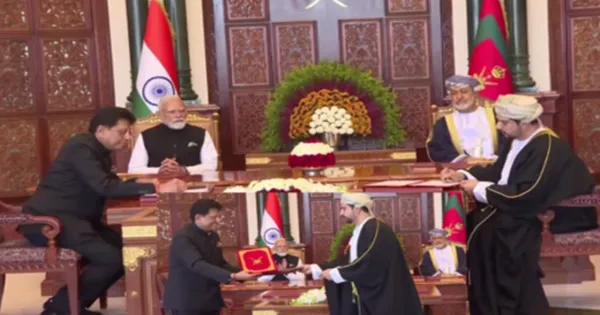
India-Oman signed free trade deal agreement, PM Modi was also present, see main points

Muscat. India and Oman signed a free trade agreement on Thursday. Under this, 98 percent of India’s exports including textiles, agricultural products and leather goods will be provided duty free access to Oman. On the other hand, India will reduce duties on Omani products like dates, marble and petrochemicals. This agreement is expected to come into effect from the first quarter of the next financial year 2026-27. This agreement is coming at a time when India is facing heavy duty of up to 50 percent in its largest export destination America.
The agreement was signed by Commerce and Industry Minister Piyush Goyal and Oman’s Minister of Commerce, Industry and Investment Promotion Qais bin Mohammed Al Yusuf in the presence of Prime Minister Narendra Modi in Muscat. Oman has offered zero duty on more than 98 per cent of its duty categories (or product categories) which include 99.38 per cent of India’s exports to Oman. All major labour-intensive sectors including gems and jewellery, textiles, leather, footwear, sporting goods, plastics, furniture, agricultural products, engineering products, pharmaceuticals, medical devices and motor vehicles have been completely duty free. Of these, immediate duty abolition is being offered on 97.96 per cent of product categories.
On the other hand, India is offering duty liberalization on 77.79 per cent of its total duty categories (12,556) which includes 94.81 per cent of India’s imports from Oman by value. For export-important products for Oman and sensitive products for India, the proposal is primarily for tariff-rate quota (TRQ) based duty liberalization for commodities such as dates, marble and petrochemical products.
To protect its interests, India has kept sensitive products in a separate category without offering any concessions. Particularly agricultural products, including milk, tea, coffee, rubber and tobacco products, gold and silver ingots, jewellery, other labour-intensive products such as shoes, sporting goods and many base metal scrap.
Oman currently attracts about five percent import duty on labour-intensive goods. On the services sector front, Oman will make significant commitments in various sectors including computer-related services, business and professional services, audio-visual services, research and development, education and health services.
Oman’s global services imports stood at US $ 12.52 billion, in which India’s share was only 5.31 percent. This shows immense potential for Indian service providers. Additionally, a key feature of CEPA is an improved mobility framework for Indian professionals.
Oman has for the first time introduced broader commitments under the Movement of Skilled Professionals (Mode-4), increasing the limit on employees who can move within a company from 20 per cent to 50 per cent. The permitted period of stay for those providing services on contract basis has also been increased. It has been increased from the current 90 days to two years. It can be extended for two more years.
The agreement also provides for more liberal entry and stay conditions for skilled professionals in key sectors such as accounting, taxation, architecture, medicine and allied services, thereby promoting deeper and more accessible business engagement. The agreement also provides for 100 percent foreign direct investment by Indian companies in key service sectors of Oman.
Under this, India’s service industry will get vast opportunities to expand its operations in this region through commercial presence. Additionally, both parties have agreed to discuss a social security agreement in the future once Oman’s contributory social security system is implemented.
It outlines a visionary approach to facilitate labor movement and labor protection. Oman is an important strategic partner in the region and is a major gateway for Indian goods and services to reach the wider West Asia and Africa. There are approximately seven lakh Indian citizens living in Oman.
India receives approximately two billion US dollars annually from Oman. Indian enterprises have established a strong presence in Oman, with over 6,000 Indian establishments operating across various sectors. India has received foreign direct investment of US $ 615.54 million from Oman between April 2000 and September 2025. This is the second trade deal signed in the last six months after Britain.
This is part of the strategy to strike trade agreements with developed economies that do not compete with our labour-intensive interests and provide opportunities for Indian businesses. This is India’s second trade agreement with a Gulf Cooperation Council (GCC) member country. India had signed a similar agreement with the UAE in May 2022 and talks with Qatar are also expected to begin soon.
Other GCC members are Bahrain, Kuwait and Saudi Arabia. The free trade agreement is officially called the Comprehensive Economic Partnership Agreement (CEPA). Negotiations on this formally started in November 2023 and were concluded this year. India-Oman bilateral trade in the financial year 2024-25 was about US $ 10.5 billion (exports were US $ 4 billion and imports were US $ 6.54 billion).

Comments are closed.