
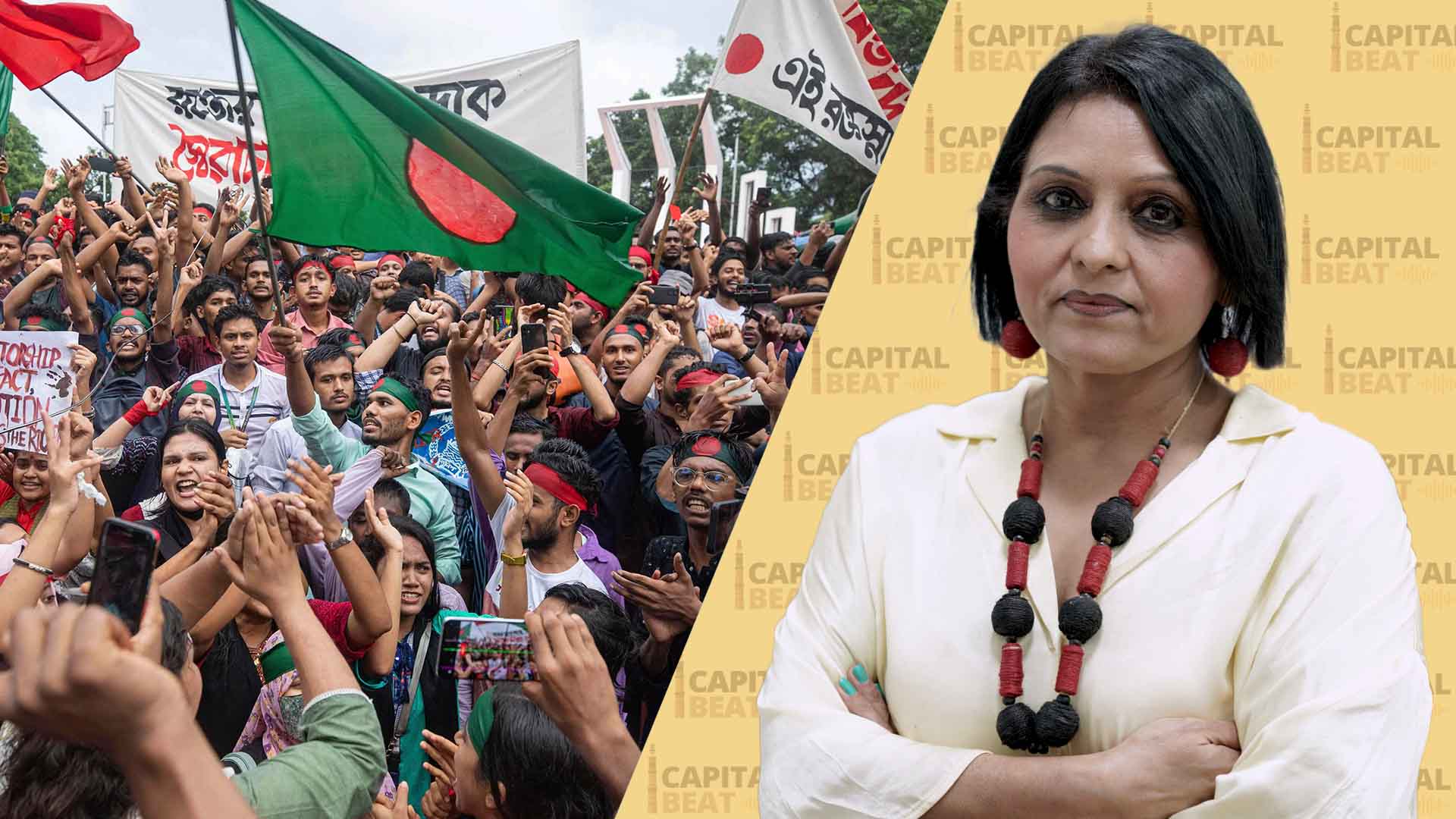

The violent protests in Bangladesh after the death of youth leader Sharif Osman Hadi is discussed at length with Sheikh Enan, a student leader from Dhaka, and senior journalist Subir Bhaumik, in this Capital Beat episode.
The discussion focused on unrest in Dhaka, attacks on media houses, law-and-order concerns, and the political situation ahead of elections.
Sharif Osman Hadi, 32, a prominent figure associated with last year’s student uprising that led to the ouster of Prime Minister Sheikh Hasina, was shot in Dhaka last week and later died in a hospital in Singapore. His death triggered widespread unrest across the country.
Authorities reported that several buildings, including offices of leading newspapers Prothom Hello and The Daily Star, were set on fire and vandalised overnight.
Bangladesh’s interim leadership announced a day of mourning and appealed for calm as tensions escalated.
Media offices attacked
Sheikh Enan described the attacks on newspaper offices as unprecedented. “Prothom Hello is the largest circulated daily of Bangladesh, and The Daily Star is the largest circulated English newspaper,” he said. “It is unimaginable that both news houses were burned and their offices looted.”
Also read: India faces rising heat as Dhaka unrest strains ties with Bangladesh
He stated that violence against media institutions could not be justified under any circumstances. “I totally disagree with any kind of murder or killing, but does it validate mob attacks and looting of newspaper offices? This should not be allowed in any country.”
Enan also raised questions about the response of the interim administration. “Whether constitutional or unconstitutional, legal or illegal, Muhammad Yunus is the head of this government. He should have stopped these things. Nothing was done last night,” he said.
Mob violence
The discussion also referred to reports of another killing in the Mymensingh district, Bhaluka sub-district. Enan stated, “A Hindu boy was brutally killed. He was beaten to death, his body hung from a tree, and then burned. This cannot be allowed anywhere in the world.”
He added that legal processes existed to deal with alleged wrongdoing. “If someone is guilty, there are law enforcement agencies. The police could ensure justice,” he said.
Enan described the broader situation as catastrophic. “What is happening in Bangladesh is a massacre. If it is not stopped right now, Bangladesh is going to be a devastated country,” he said.
The triggers
Subir Bhaumik addressed questions about what triggered the unrest. He rejected the idea that the interim leadership was unaware of underlying tensions. “It is absolutely wrong to imagine that Yunus could not sense it,” he said.
Bhaumik stated, “Yunus has perfected a new technique of governance, and that is governing through chaos.” He referred to a sequence of developments, including court proceedings related to Sheikh Hasina and renewed attention on the 2009 Bangladesh Rifles mutiny.
Also read: Protests erupt in Bangladesh over uprising leader’s death
He discussed the reopening of the mutiny case and an inquiry report that blamed India for involvement. “This report was submitted without any real evidence,” Bhaumik said, questioning its credibility.
Planned unrest?
Bhaumik described the killing of Sharif Osman Hadi as part of what he characterised as a broader plan. “Osman Hadi’s killing is 200 per cent an inside job,” Bhaumik asserted during the discussion.
He referenced earlier remarks attributed to Muhammad Yunus. “Yunus himself said this was no spontaneous agitation. There was a meticulous design involved,” Bhaumik said, adding that Yunus had referred to a “mastermind” behind previous unrest.
According to Bhaumik this is a new meticulous design aimed at creating chaos ahead of elections.”
Election dynamics
The panel discussed implications for political parties. Bhaumik said the Awami League had been barred from contesting elections and described the Bangladesh Nationalist Party as weakened.
“For the first time in independent Bangladesh, Jamaat-e-Islami sees a chance to come to power,” he said. “They want a global face, and Yunus wants domestic support.”
He described this alignment as tactical rather than permanent. “They need each other at this moment,” Bhaumik said.
Concerns over election timing
The discussion turned to whether elections could be postponed. Bhaumik outlined two possible scenarios. “If the situation spins out of control, elections will be postponed and Yunus stays in power,” he said. “If elections are held in this atmosphere of terror, Jamaat gains an advantage.”
He added, “Either way, Yunus remains in power.”
Also read: Bangladesh Press Adviser apologises after attacks on media offices in Dhaka
Bhaumik also questioned the constitutional basis of the interim government and upcoming elections. “There is no provision for an interim government or a referendum in the Bangladesh constitution,” he said.
Sheikh Enan rejected accusations against the Awami League. “We totally deny that Awami League or its activists were involved in the killing of Hadi,” he said.
He reiterated calls for accountability. “We want proper justice. Whoever killed Hadi should be arrested and punished,” he said.
Enan questioned the logic behind attacks on unrelated targets. “Why burn newspaper offices? Why burn the house of former education minister Mohibul Hasan Chowdhury Naufel? There is no connection,” he said.
Aim to destabilise
Enan cited reports of looting in Dhaka’s Uttara area. “At least 30 institutions were looted,” he said, adding that the violence appeared aimed at destabilisation.
“The motive is to show the world that law and order is not under control,” Enan said, arguing that a free and fair election, including the Awami League would produce a clear outcome.
He stated, “If chaos continues, those creating it will remain in power. If chaos stops, they will not.”
Appeal to global community
In his concluding remarks, Enan appealed to the international community. “Human rights organisations and neighbouring countries must put pressure on Bangladesh’s authorities to control the situation,” he said.
He warned of regional implications. “This is alarming for India as well,” he said, adding that Bangladesh must not descend into prolonged instability.
The discussion ended with uncertainty over developments expected after the arrival of Sharif Osman Hadi’s body in Dhaka and concerns were raised about further violence.
The content above has been transcribed from video using a fine-tuned AI model. To ensure accuracy, quality, and editorial integrity, we employ a Human-In-The-Loop (HITL) process. While AI assists in creating the initial draft, our experienced editorial team carefully reviews, edits, and refines the content before publication. At The Federal, we combine the efficiency of AI with the expertise of human editors to deliver reliable and insightful journalism.

Comments are closed.