
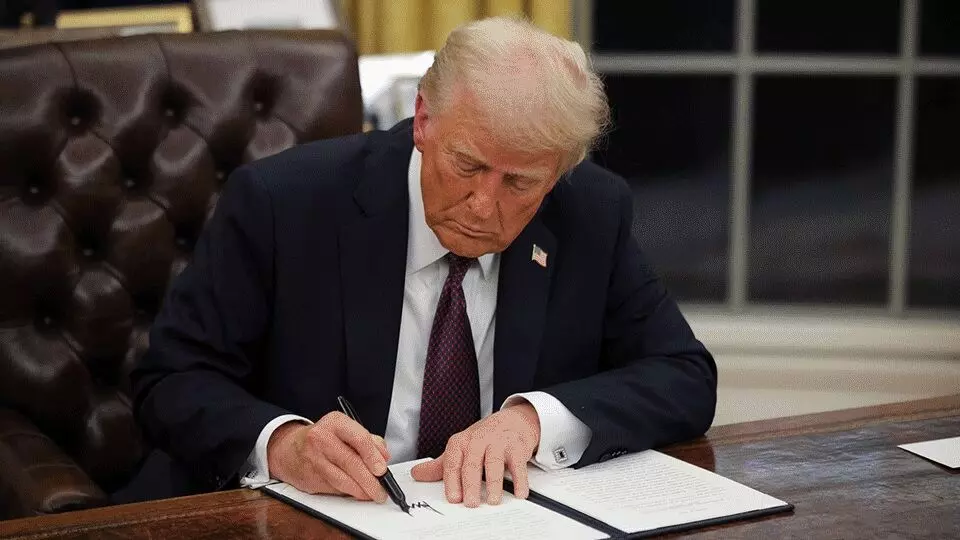

Washington, December 19. US President Donald Trump signed the National Defense Authorization Act (NDAA) for fiscal year 2026. This is a major defense law, which calls for increasing US military cooperation with India as part of Washington’s Indo-Pacific policy and deepening relations through the Quad. This law approves $890 billion for spending on national security. It directs the US to enhance cooperation with India, including promoting a free and open Indo-Pacific region through the Quad security dialogue.
While signing this law, Trump said that this will help his ‘War Department’ to work on the policy of “peace through strength”. He said that this law will keep the country safe from external and internal threats and will further strengthen the defense related industries. Along with this, this law will now give permanent legal form to many major decisions taken earlier by his government. The law calls for increased bilateral and multilateral military cooperation with India, greater participation in military exercises, increased defense trade, and closer cooperation on humanitarian assistance and disaster relief.
In this, maritime security has also been identified as a special area for US-India cooperation. The State Department must report to Congress within 180 days of the law becoming law and annually thereafter for five years. Under this law, America will investigate two main things in this report. The status of growing military cooperation and relations between India and Russia. Also, what impact are Russia’s military activities having on the Indo-Pacific and other regions of the world?
Additionally, the NDAA approves the establishment of an Ambassador-at-Large for the Indian Ocean Region within the State Department. This post will coordinate US diplomatic efforts in Indian Ocean countries and focus on countering China’s influence in the region. The law approves $1 billion for Taiwan’s security cooperation. Additionally, there are provisions to prevent Chinese military companies from using third countries to evade US sanctions.
In addition to strategic issues, the NDAA approved a 3.8 percent pay increase for US service members. Additionally, there are provisions for funding for housing, health care and child care, and protections for civilian Department of Defense employees.
This NDAA law has been passed every year for more than 60 years. It sets America’s defense policy and spending priorities. This time, in the FY 2026 law, increasing military, nuclear and regional cooperation with India has been formally made a part of the US defense law.

Comments are closed.