
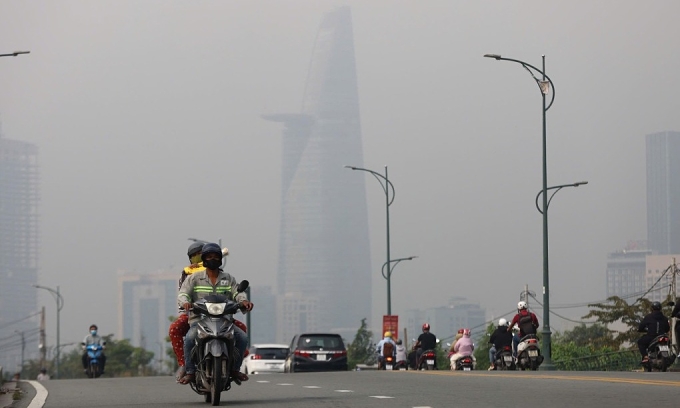

The findings were outlined in a report on the 2025 Environmental Quality, Water Resources Monitoring, and Emission Source Supervision Program, released by the Ministry of Agriculture and Environment.
The assessment was based on data from 118 monitoring locations across HCMC, including in the former provinces of Binh Duong and Ba Ria–Vung Tau, both of which have been merged into the city since July.
The report highlights a troubling increase in total suspended particulates (TSP) and PM10 concentrations, particularly in areas with heavy traffic, industrial zones, seaports, and mining sites. Conversely, residential areas largely avoided significant spikes, with some even showing lower dust levels.
The primary pollution sources were identified as transportation, industrial production, construction, and transboundary pollution drifting from neighboring provinces like Dong Nai and Tay Ninh (which now includes Long An).
Most alarmingly, PM2.5, ultrafine particles capable of penetrating deep into the lungs, exceeded national standards by 1.1 to 4.6 times at several traffic and industrial hotspots. This marks a sharp regression from the previous year, when PM2.5 levels remained within permissible limits.
Benzene, a known carcinogen, also surpassed safety standards at specific traffic locations. While noise levels dropped slightly, they continued to exceed allowable thresholds along major arteries and near waste treatment facilities due to high vehicle density and ongoing construction.
Other parameters, including SO2, NO2, CO, lead (Pb), and vibration levels, remained stable and within safety limits.
Despite the deteriorating indicators, the Department of Agriculture and Environment noted that the daily Air Quality Index (AQI) remained “good” for 56–87% of the year. Days rated as “poor” accounted for 4–11%, with only one day recorded at an “unhealthy” level and zero at “very unhealthy” or “hazardous.”
The city plans to install an additional 157 air monitoring stations to improve early warning capabilities.
Simultaneously, the construction sector has proposed a roadmap to make the city’s transportation network “greener”. Measures include expanding the use of electric vehicles, piloting low-emission zones, tightening motorbike emission controls, and enforcing stricter dust-reduction protocols at construction sites.

Comments are closed.