
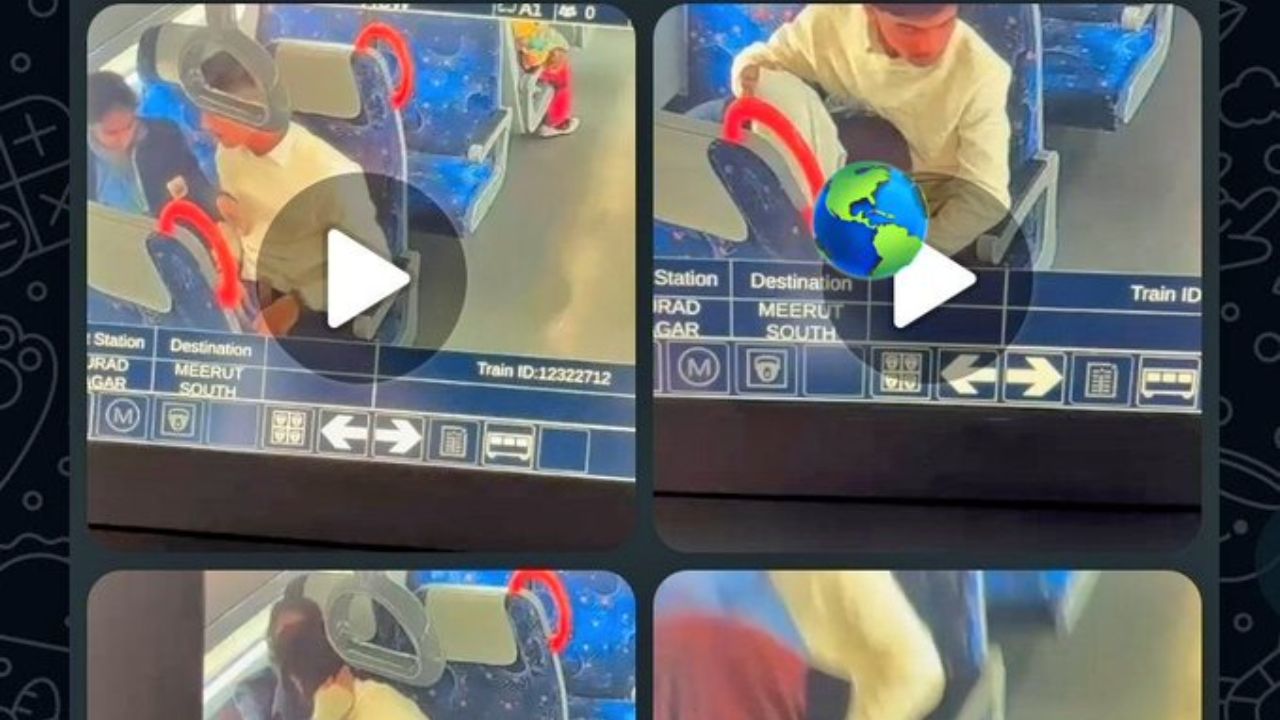
one minute 44 second viral obscene video on the Rapid Rail has raised eyebrows leading to a competition to request the link in the comments

social media In this era, every incident goes viral within minutes, but when recordings of private moments start spreading on public platforms, it becomes a serious question not only of ethics but of security, privacy and accountability of the system. In recent times, amid the abundance of deepfakes and fake content, some such cases are also coming to light, where actions taken in public transport reach the internet directly through CCTV footage.
In this series, a case related to Namo Bharat (Rapid Rail) running between Ghaziabad-Meerut is in the headlines. A video of a couple doing obscene acts inside a moving train went viral. After this, all three police, security agencies and railway administration have come under the scanner. This matter is also sensitive because in the video a girl student is allegedly seen in school dress, which has further increased the concern.
Read now on WhatsApp also, click to subscribe
When did the video go viral?
According to the information, the incident is said to have happened on 24th November. A young man and a girl boarded the Namo Bharat train from Duhai station in Ghaziabad and started performing obscene acts as soon as they sat on the seats. It was told that this sequence continued till Meerut South station. During this time, the number of passengers in the coach was less, but the CCTV cameras installed in the coach recorded the entire incident.
Multiple clips, growing sensation
Four different obscene videos surfaced on internet media. One of these clips is said to be about 1 minute 44 seconds long, while an already longer video was also being discussed on social media. As soon as the video went viral, there was a competition in the comment section asking for the “link”, due to which the matter became more objectionable.
School dress increased concern
The most serious aspect is that the girl seen in the video is seen in school dress. This raised questions about his age and people raised many issues ranging from parental responsibility to institutional monitoring. If it is confirmed that he is a minor, then the matter may fall into the category of legal offense and not just disciplinary.
How did the CCTV footage get leaked?
According to sources, this footage was taken from CCTV cameras installed in the train for the safety of passengers. It is being considered a major lapse of the system that the recordings of these cameras installed for security reach social media. The question also arose whether adequate protocols were in place regarding access and storage of CCTV data.
Action of police and security agencies
Considering the seriousness of the matter, Ghaziabad and Meerut police started a joint investigation. The Central Industrial Security Force (CISF), deployed for the security of Namo India, is also engaged in the investigation. According to SSP Dr. Vipin Tada, the authenticity, place and time of the video is being investigated by forming a team under the leadership of SP Crime.
the blame fell on the employee
Investigation revealed that instead of informing the higher authorities about the incident, an employee circulated the recording on the internet media. National Capital Region Transport Corporation (NCRTC) Chief Public Relations Officer Puneet Vats said that the guilty employee has been expelled and an internal investigation is underway.
Strong reaction on social media
After the video surfaced, there was anger on social media. Many users called it a failure of security and ethics, while some called the leaking of CCTV footage a privacy violation. At the same time, a section raised questions on generational behavior and demanded strict action.
Prevention and awareness are necessary
According to NCRTC, awareness campaigns will be conducted to prevent recurrence of such incidents and the handling process of CCTV data will be further tightened. This case shows that security in public transport is not ensured by mere installation of cameras, but by accountability, training and digital discipline. Further legal action will be decided based on the results of the investigation.

Comments are closed.