
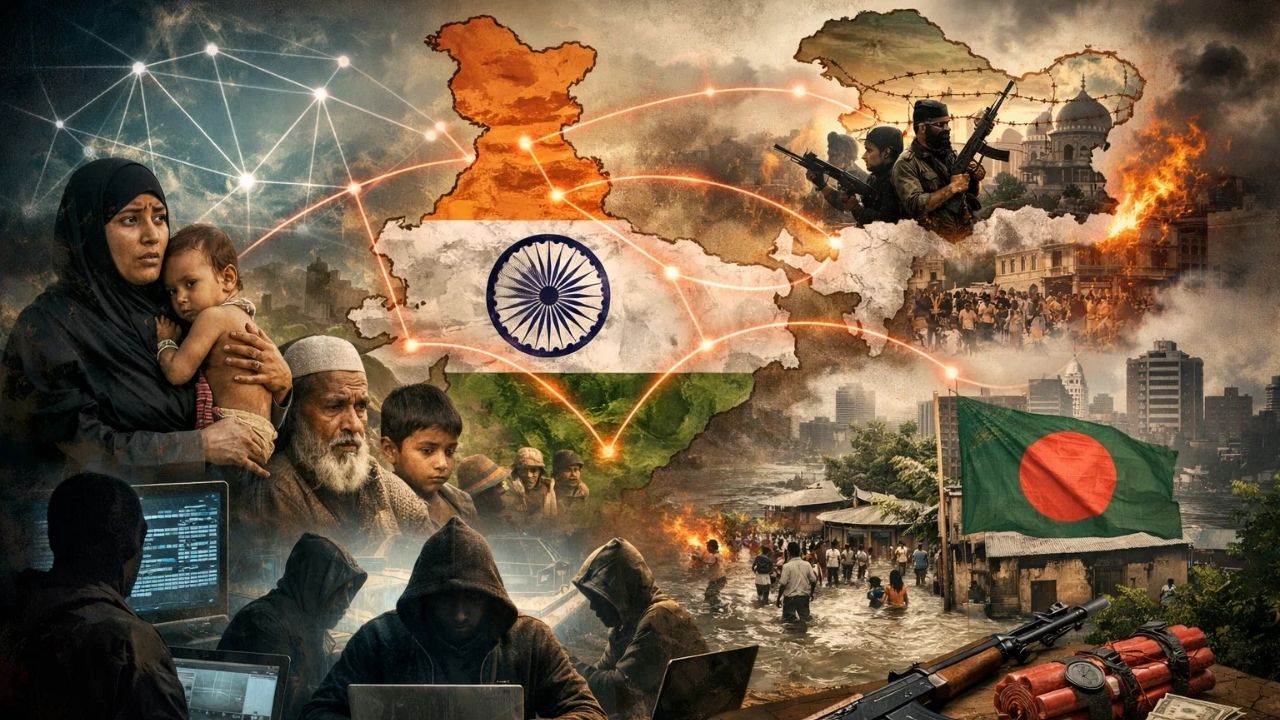
Attempt to spread Kashmir narrative in India through Rohingya network, conspiracy taking place under cover of Bangladesh crisis

Impact of ongoing political instability in Bangladesh now internal security of india But it is also becoming visible. Indian security agencies have warned that the Rohingya network is being reactivated by taking advantage of the current situation. This is not just a case of illegal infiltration, but is being said to be part of a well-planned narrative war, the center point of which is to present Kashmir as a symbol of “Muslim oppression” at the global level.
According to the report of News 18, amidst weak law and order and lax monitoring, this entire network is trying to establish a foothold inside India under the guise of humanitarian crisis. Security officials say that this strategy is to gradually increase influence rather than direct confrontation, so that pressure is maintained but major security alarms are not raised.
Read now on WhatsApp also, click to subscribe
Bangladesh unrest and new warning
According to Indian agencies, surveillance in refugee camps and border areas has weakened due to political turmoil in Bangladesh. Taking advantage of this situation, efforts to infiltrate new Rohingya groups into India have increased. It is estimated that 30,000–40,000 Rohingya are already present in India and efforts for new influx have intensified in recent months.
Further conspiracy due to illegal infiltration
Agencies say that current efforts are not limited to just shelter or employment. Its objective is to present Kashmir as an emotional issue, so that support can be garnered by linking it to the Rohingya displacement. It is believed to be an attempt to take this narrative out of the valley and to international forums.
Infiltration is happening through North East
According to security inputs, Rohingya infiltration is being carried out through the border routes of North-East India and eastern states. There is additional pressure on border management due to difficult terrain and limited resources. Organized networks are active in this entire process, which use local brokers and temporary bases.
Fake documents and local identity
After reaching India, the network helps in making fake Aadhaar cards, ration cards and voter IDs. Through these documents, local identity is established, which gives access to informal employment. Such as garbage collection, construction work, domestic work, delivery services and small factories.
ISI’s ‘low-cost, high-deniability’ strategy
Indian agencies assess that the Inter-Services Intelligence (ISI) sees the Rohingya network as a low-cost and high-deniability tool. They are used for logistics support and propaganda warfare rather than for major terrorist attacks, so that pressure is maintained but there is no direct military response.
Hawala and informal funding
Investigation has revealed that a large part of the funding comes through the Hawala network, which is connected to Bangladesh and West Asia. Small amounts of cash are spent on travel, documents and initial settlement. Some money also comes from unregulated charities and private donors, which is sent in the name of humanitarian aid.
economic support within india
Additionally, some criminal labor contractors present in India give advance money. The amount may be small, but regular flows keep the network active and difficult to track. According to agencies, this continuity is the biggest strength of this system.
Increased vigilance and challenges ahead
Security agencies are now focusing on better coordination across states and border areas, detection of document fraud and funding trails. Officials say that the challenge is not only to stop infiltration but also to neutralize the narrative war related to it. Due to regional instability, this issue may remain a big challenge for India’s internal security in the future.

Comments are closed.