
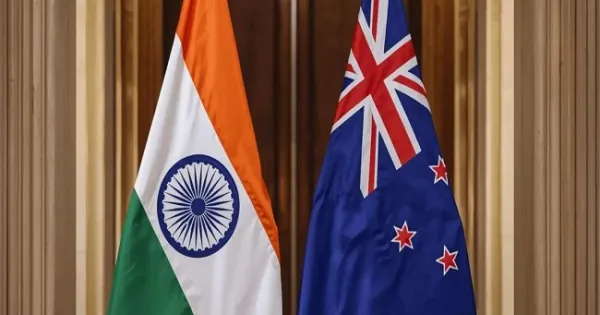

New Delhi: India and New Zealand on Monday announced the completion of talks on Free Trade Agreement (FTA). Its objective is to promote bilateral trade in goods and investments. New Zealand Prime Minister Christopher Luxon informed about the completion of negotiations on FTA with India. Negotiations on this agreement started in May this year.
India and New Zealand have signed a comprehensive, balanced and forward-looking Free Trade Agreement (FTA), which is a major economic and strategic milestone in India’s engagement with the Indo-Pacific region, the Ministry of Commerce and Industry said in a statement. This agreement is likely to be signed in three months.
The ministry said that the Free Trade Agreement between India and New Zealand is in line with the national vision of Developed India 2047. This is one of India’s fastest completed free trade agreements with a developed country. Its objective is to promote bilateral trade in goods and investment. Negotiations on FTA started in May this year.
According to the Prime Minister’s Office, completion of the talks that began during New Zealand Prime Minister Luxon’s visit to India in March 2025 in just nine months reflects the shared political will of the two countries and commitment to deepen bilateral relations.
This FTA will be helpful in promoting trade and investment, strengthening market access and giving new direction to strategic cooperation. It will also open new opportunities in various sectors for investors, entrepreneurs, farmers, MSMEs, students and youth of both the countries.
Prime Minister Narendra Modi described the India-New Zealand Free Trade Agreement as a historic achievement in the relations between the two countries and said that it will take the partnership to new heights. “The India-New Zealand partnership is about to reach new heights. The FTA paves the way for doubling trade between the two countries in the next five years,” Modi said at the X.
India welcomes investment of more than US $ 20 billion from New Zealand in various sectors. Our talented youth, strong startup ecosystem and reform-led economy lay a strong foundation for innovation and long-term partnerships. “At the same time, we will continue to strengthen cooperation in other areas such as sports, education and cultural ties.”
New Zealand’s Prime Minister Luxon said in an ex-post that negotiations on FTA with India have been completed. With this free trade agreement, duties on 95 percent of our products exported to India will be reduced or completely eliminated.
Luxon said it has been estimated that New Zealand’s annual exports to India could increase from US$1.1 billion to US$1.3 billion in the coming two decades. “I have just spoken to Indian Prime Minister Narendra Modi after the completion of negotiations on the New Zealand-India FTA,” he said.
Prime Minister Luxon said, “This agreement is based on the strong friendship between the two countries. “India is one of the fastest growing economies in the world and this provides New Zealand businesses with the opportunity to reach 1.4 billion Indian consumers.”
Main points of the agreement-
Zero duty market access on 100% of India’s exports. India has offered duty liberalization in 70 per cent of categories covering 95 per cent of India-New Zealand bilateral trade.
This market access enhances the competitiveness of India’s labour-intensive sectors such as textiles, apparel, leather, footwear, marine products, gems and jewellery, handicrafts, engineering goods and motor vehicles.
This free trade agreement, the fastest concluded with any developed country, ensures a great end to the year for all Indian exports including textiles, pharmaceuticals, leather, engineering goods and agro products.
A dedicated quota of 5,000 temporary employment entry visas for professionals and 1,000 working and holiday visas. New Zealand has committed to promote investment of US $ 20 billion in India in the next 15 years.
Establishment of Agricultural Productivity Partnership by New Zealand through Centers of Excellence for apples, kiwi fruit and honey to increase productivity. Duty free raw materials for India’s manufacturing sector: wood logs, coking coal, metal waste and scrap.
It has been agreed upon for cooperation in AYUSH, culture, fisheries, audio-visual tourism, forestry, horticulture and traditional knowledge systems. In addition to tariff liberalization, the free trade agreement also includes provisions to remove non-tariff barriers through better regulatory cooperation.
It is noteworthy that in the financial year 2024-25, bilateral trade between the two countries was about 1.3 billion dollars. In this, India’s export was 711.1 million dollars and import was 587.1 million dollars. New Zealand’s average import duty is only 2.3 percent, while India’s is 17.8 percent. 58.3 per cent of New Zealand’s duty ranges are already tariff-free. India’s exports to New Zealand are extensive, but fuel, textiles and medicines are the major contributors.

Comments are closed.