
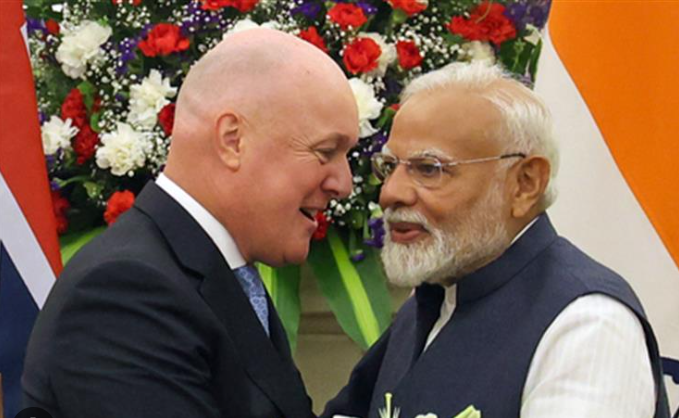
Trade deal: New Zealand to invest $20 bn in India over 15 years; they also conclude the FTA

Virendra Pandit
New Delhi: India and New Zealand on Monday announced the conclusion of free trade agreement (FTA) negotiations, aimed at boosting bilateral trade in goods and investments.
Their trade talks, which started in May, have been completed in seven months, the media reported.
New Zealand Prime Minister Christopher Luxon said on Monday that negotiations for an FTA with India have been concluded. “The deal reduces or removes tariffs on 95 percent of our exports to India.”
It’s forecast that New Zealand exports to India could increase from USD 1.1 billion to USD 1.3 billion annually over the coming two decades, Luxon said in a social media post.
“I’ve just spoken with India’s Prime Minister Narendra Modi following the conclusion of the NZ-India Free Trade Agreement.
“The agreement builds on the strong friendship between our two countries. India is one of the fastest-growing economies in the world, and this gives Kiwi businesses access to 1.4 billion Indian consumers,” Luxon said.
The two countries concluded negotiations for the FTA in a “record time” of nine months. It would provide zero-duty access to all Indian goods in the New Zealand market as soon as the pact becomes effective after legal vetting and procedural clearances.
The FTA, to be reviewed a year after it enters into force (expected sometime in 2026), will also facilitate New Land’s FDI worth USD 20 billion in India over the next 15 years. There will be a ‘rebalancing mechanism’ to suspend some FTA benefits if investments don’t flow.
“It (the FTA) will benefit farmers, MSMEs, workers, artisans, women-led enterprises and youth, while providing immense opportunities for labour-intensive sectors such as textiles, apparel, leather and footwear. Sectors like engineering and manufacturing, automobiles, electronics, machinery, plastics, pharmaceuticals and chemicals will also stand to benefit,” Union Minister for Commerce and Industry Piyush Goyal said.
India-New Zealand bilateral merchandise trade, at USD 1.3 billion in FY25, is expected to grow manifold after the FTA implementation, Goyal said.
Indian service providers such as AYUSH practitioners, yoga instructors, chefs and music teachers will benefit from a new visa pathway opened with quota of 5,000 visas at any time for stay up to three years. Service providers in sectors such as IT, engineering, healthcare, education and construction would also benefit, per the government.
New Zealand also agreed to concessions on student mobility and post study work visa with no numerical caps, locking in 20 hours/week work rights for Indian students. Post-study work visas for three years will be offered to science, technology, engineering, and mathematics (STEM) bachelors and masters, while doctoral students will get such visas for up to 4 years.
New Delhi shielded sensitive agriculture and dairy products from tariff cuts, including milk, cream, whey, yoghurt, cheese, onion, corn and edible oil, while offering New Zealand reduction in 70.03 percent of the tariff lines covering 95 percent of bilateral trade value over 10 years.
“We have protected all our sensitivities, like farmers interest in rice, wheat, dairy, soya and various other farm products, where we have not given any access. We have also been conscious of protecting our MSMEs and startups and innovators get big opportunities in New Zealand. It is a win-win..,” Goyal said at a media briefing.
Protected items also include sugar, artificial honey, animal, vegetable or microbial fats and oils, arms and ammunition, gems and jewellery, copper and aluminium.
Answering a question on one of the FTA side letters on consultations related to dairy sector in review of FTA, he said that it was to take care of New Zealand’s concerns that in case India ever gave dairy concessions to a country with a comparable economy (to that of New Zealand), it should also get an opportunity to discuss similar benefits.
“India is never going to open up dairy so that concern does not really matter. And it is only a consultation,” Goyal said.
While the dairy sector would not result in immediate gain for New Zealand, it will benefit from tariff elimination in wood, wool, sheep meat, leather-raw hides and tariff reduction in items like wine, pharma drugs, polymers, aluminium, iron and steel articles.
India has also offered New Zealand lower duties on a TRQ (tariff rate quota) basis for items such as honey, apple, kiwi fruit and albumins, including milk albumin.
Prime Minister Narendra Modi spoke to his New Zealand counterpart Christopher Luxon on Monday to jointly announce the deal agreeing that its early conclusion reflected the shared ambition and political will to further deepen ties between the two countries, the Ministry of External Affairs (MEA) said.
New Zealand Foreign Minister Winston Peters, however, criticized the pact and called it a “bad deal” giving away too much and delivering little in return for New Zealanders. He said his New Zealand First party (coalition partner) would vote against its enabling legislation when it comes before Parliament.

Comments are closed.