
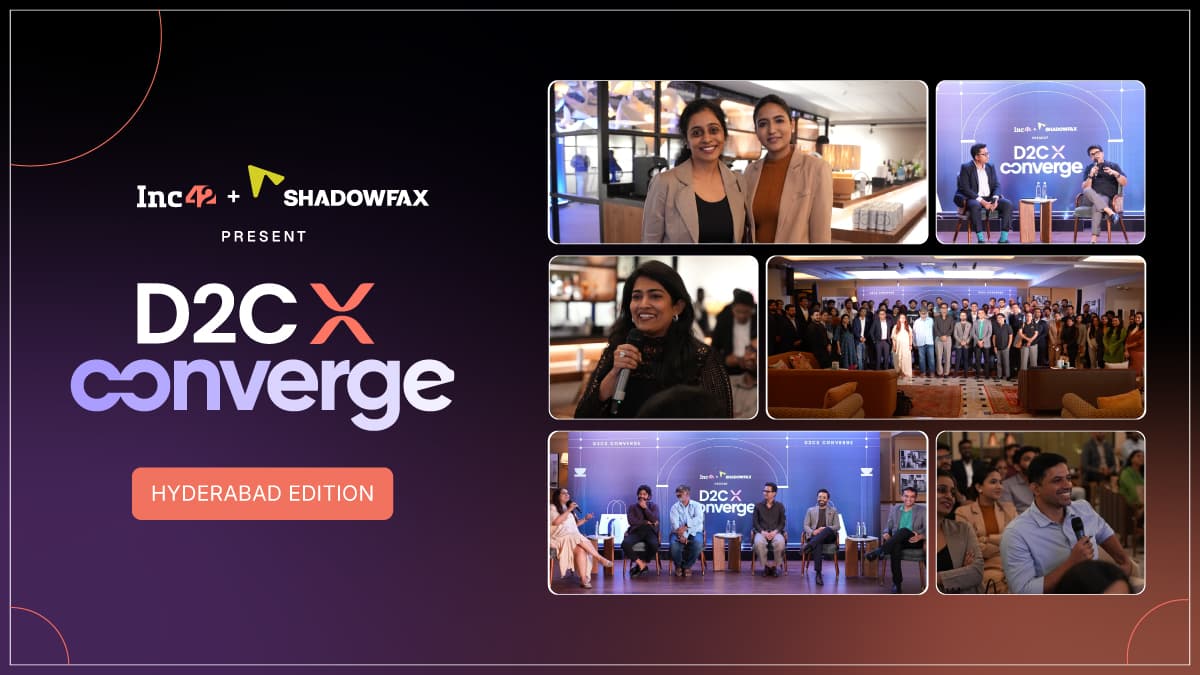

Inc42 and Shadowfax jointly kicked off the first edition of D2CX Converge in Hyderabad, bringing together over 50 early stage D2C founders to exchange their insights
In a fireside chat on Lahori Zeera, cofounder Nikhil Doda shared how mass-market resonance, sharp execution, and culturally rooted product thinking unlocked scale in the beverage market
A dynamic panel on INR 100 Cr playbook uncovered how D2C founders were navigating omnichannel growth, seasonality, and product focus
The direct-to-home (D2C) segment has emerged as one of the most formidable business forces cradled in the world’s third-largest startup ecosystem that’s expanding at 12-15% every year, backed by the fastest-growing economy globally.
With more than 800 brands vying for a slice of an estimated over $87.5 Bn market pie, India boasts of the second most-funded D2C sectortrailing behind the US and racing ahead of China. India’s $87.5 Bn D2C ecommerce market is on track to almost triple to $267.03 Bn by 2030 at a staggering 25% annual growth rate.
This shift reflects deeper changes in how Indian consumers discover and buy products, and how brands compete for retention.
Driven by more than 270 Mn online shoppersthe rapid adoption of digital payments, the proliferation of quick commerce, and the rise of premium, purpose-led consumer categories, the D2C sector has moved beyond its early experimental years into a decisive scale phase.
This surge in D2C space calls for sharper insight into product-market fit, distribution, omnichannel behaviour, and cost-disciplined execution.
Inc42 has teamed up with ShadowFax to support this next generation of consumer builders by launching D2CX Converge — a five-city founder meetup series designed to bring together India’s most promising early-stage D2C brands in an intimate and high-trust environment. The event is intended for builders who believe progress compounds in the community. Each stop gathers a curated room of early-stage D2C founders for compact, practical sessions led by successful operators.
A look at India’s D2C landscape shows Hyderabad emerging as a strong base for early-stage brands, supported by cost advantages, expanding digital infrastructure and a growing startup ecosystem. These factors made it a natural choice for Inc42 and Shadowfax to kick off the first chapter of D2CX Converge.
On November 13, more than 50 D2C brand founders across categories, including beverages, fashion, FMCG, ethnic wear, consumer retail, and lifestyle, converged on Hyderabad. There was clarity in the shared goal: Gather India’s most promising early stage operators in a city where momentum is palpable, ambition runs high, and the environment catalyses founders to test, refine, and scale their playbooks.
The evening featured a sessions, which brought together diverse perspectives from across the D2C landscape.
The D2C galaxy at the event included the likes of:
- Nikhil Doda, cofounder and COO of Lahori Zeera
- Indo
- Raju Bhupati, Founder and Ceo of Tro Good
- Praharsh Chandra, cofounder and CBO at Shadowfax
- Shashi Kumar, cofounder and CEO of Akshayakalpa Organic
- Rahul Dayama, founding partner at Urbanic
- Avnish Kumar, managing director at NEERU’S
- Karan Saraf, director of deals at PwC
Using Insight To Drive Mass-Market Growth
The fireside chat, themed ‘How Lahori Zeera Cracked India’s Mass Beverage Market’, featured Doda outlining how the brand identified unmet demand for familiar, desi flavours and built a scalable product around it. He discussed creating the INR 10 price point, shaping a distinct brand identity without celebrity marketing, and focusing on consistent execution — from taste to bottling partnerships — to compete in a crowded beverages category.
“Ethnic Indian drinks always existed in homes, in unorganised formats. What we realised early was that the category lacked freshness. The Indian beverage market is an INR 80,000 Cr industry, and our aim was simply to do justice to a product the masses loved and make it aspirational,” Doda said.
A major part of the discussion centred on distribution, where he stressed how Lahori Zeera went against the trend and built its foundation through general trade. With no initial brand pull, the team took bottles directly to retailers, manually placed the product, and let repeat demand speak for itself. Distributors who originally declined returned after witnessing traction on the ground, allowing the company to scale without offering credit – an unusual feat in the beverages space.
He also shared his views on how rising attention from large corporates and legacy beverage players was driving the overall market rather than threatening smaller innovators.
India’s Next Wave Of Consumer Brands
The panel discussion on the ‘D2C Brands’ INR 100 Cr Playbook’ went beyond surface-level growth tactics, diving into how brands must build emotional and operational moats to stay distinct and turn repeat cohorts into their strongest growth engine. The speakers also reflected on navigating seasonality, evolving consumer behaviour, and balancing product, pricing, and inventory complexity, offering the founders a rare inside view of the real decisions that pave the way to a revenue of INR 100 Cr and beyond.
Several founders showed that it is possible to reach INR 100 Cr without burning marketing dollars, provided the product resonates, and the platform algos reward it.
Tanwani of Indo Era explained how the brand built an INR 500 Cr business primarily through marketplaces without marketing spend. “We built our first INR 100 Cr without spending a rupee on marketing. The product did the work, and marketplaces gave us the traffic to prove ourselves,” she said.
Dayama shared insight into how a sharply defined influencer strategy helped Urbanic scale at an unprecedented pace. “We treated influencer marketing like a science – 11% of our GMV is directly traceable to creators because we score and track every collaboration.”
The discussion reflected the diverse paths founders took to reach the INR 100 Cr milestone – marketplace-first, D2C-first, and offline-first. Yet, the consensus was clear: India in 2025 demands an omnichannel presence, but the sequencing depends on category dynamics and founder capability.
As a legacy ethnicwear brand, NEERU’S Avnish explained the challenges of shifting from pure offline to an omnichannel model. “Offline taught us scale, but online taught us speed. Omnichannel isn’t a strategy anymore, it’s simply where the customer expects you to be.”
When the conversation shifted to Akshayakalpa Organic, Shashi explained why subscription was not dead yet, particularly in habitual-consumption categories like milk. “People say subscription is dead, but it powers 40% of our revenue — when a product enters daily life, retention becomes almost automatic,” he said.
The discussion then touched on a key challenge – how founders often feel pressured to broaden their catalogues early. The leaders reiterated that focus, and not breadth, drives the momentum. Whether beverages, fashion or food, SKUs have been central to unlocking scale.
“We sell one thing and one thing only – chikki. When the product is perfect, the market expands on its own,” said Bhupati of Troo Good.
The Hyderabad edition of D2CX Converge showed exactly what it was designed for: unfiltered learnings, founder-to-founder candour, and practical playbooks that are applicable.
In 2026, D2CX Converge will travel to Mumbai, Jaipur, Ahmedabad, and Bengaluru and will bring together D2C and retail brands who are building meaningful traction in their categories.

Comments are closed.