
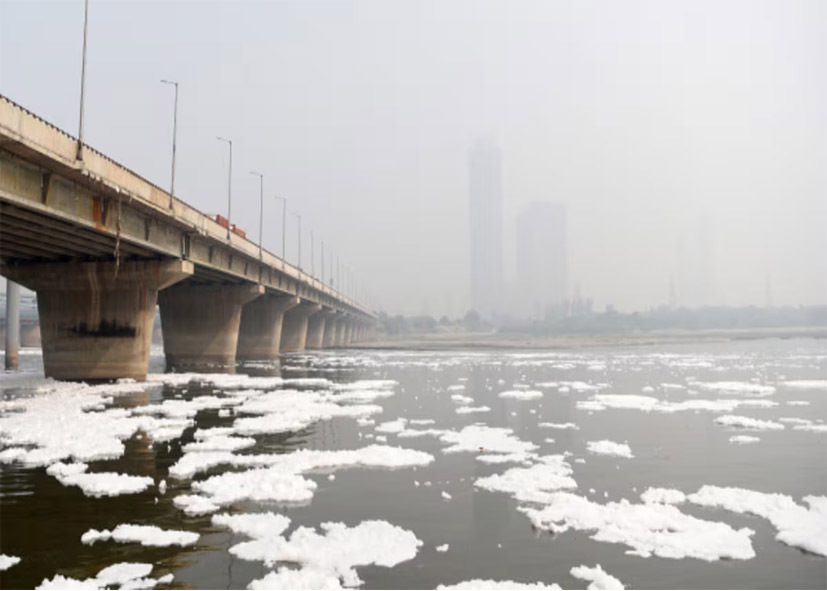

Data related to Yamuna river and Delhi’s sewage treatment plants (STPs), common effluent treatment plants (CETPs) and drains has not been updated for the last three months. According to the rules, this information should be made public at least once every month. The National Green Tribunal (NGT) had directed the Delhi Pollution Control Committee (DPCC) to upload the report every month. However, DPCC last shared data on water quality of these plants and drains in September itself. The most recent report available on the DPCC website about Yamuna and main drains is for October.
DPCC and Delhi government officials did not clarify whether water sampling had been stopped or why the data was not being published. The lack of current data is particularly worrisome as water flow in the Yamuna and drains decreases during the winter season and water quality can worsen as temperatures drop. Along with this, problems like frothing are likely to increase, due to which cleaning and monitoring of rivers and drains becomes more important.
In 2019, the National Green Tribunal (NGT) had ordered the Delhi Pollution Control Committee (DPCC) to prepare and make public water quality data every month to fix accountability. Regular reports were being provided for Yamuna river since January 2013, and for drains and treatment plants since 2019. To monitor water quality, samples are taken from eight different locations of Yamuna from Palla to Asgarpur in Delhi. In these, parameters like biochemical oxygen demand (BOD), dissolved oxygen, chemical oxygen demand, pH level and harmful bacteria (fecal coliform) are examined. Similar tests are also conducted for more than 25 main drains of the city, so that water quality can be monitored and pollution can be controlled.
The figures from the last available report of October 25 were extremely worrying. Despite the release of additional water from the Hathnikund barrage ahead of Chhath Puja, the biochemical oxygen demand (BOD) level reached 25 mg/l, almost eight times the safe limit of 3 mg/l. At the same time, the level of fecal bacteria (fecal coliform) reached 8,000 MPN against the standard limit of 2,500 MPN. The situation was even more serious in the initial report in October, with BOD recorded at 33 mg/l and bacteria levels at 21,000 MPN. For comparison, in December last year the BOD had jumped to 70 mg/l and bacteria levels had reached an alarming 8.4 million (84 lakh) MPN.
Experts say that transparency is very important at this time, so that it can be known what is the level of pollution when the river is in its most critical condition. Yamuna activist Pankaj Kumar, known as ‘Earth Warrior’, said, “It is not clear whether samples were not taken in November and December or they are not being shared. The water quality deteriorates further as the river flow decreases after the monsoon. We have been seeing anti-foam chemicals being sprayed in the river since October, but no one knows what effect it is having on the water quality.”
Activists and researchers warn that a lack of data undermines efforts to monitor the health of the Yamuna River. Bhim Singh Rawat, a member of the ‘South Asia Network on Dams, Rivers and People’ (SANDRP) and Yamuna activist, said, “We know that water quality deteriorates significantly in winter. Normally one can compare the data with last year’s data to see if there has been an improvement or not. The missing data sets a bad example for river governance.”
Follow the LALLURAM.COM MP channel on WhatsApp
Click to read big news of India and abroad
Click here to read Read.com news in English
Click here to read sports news
Click to read big entertainment news

Comments are closed.