
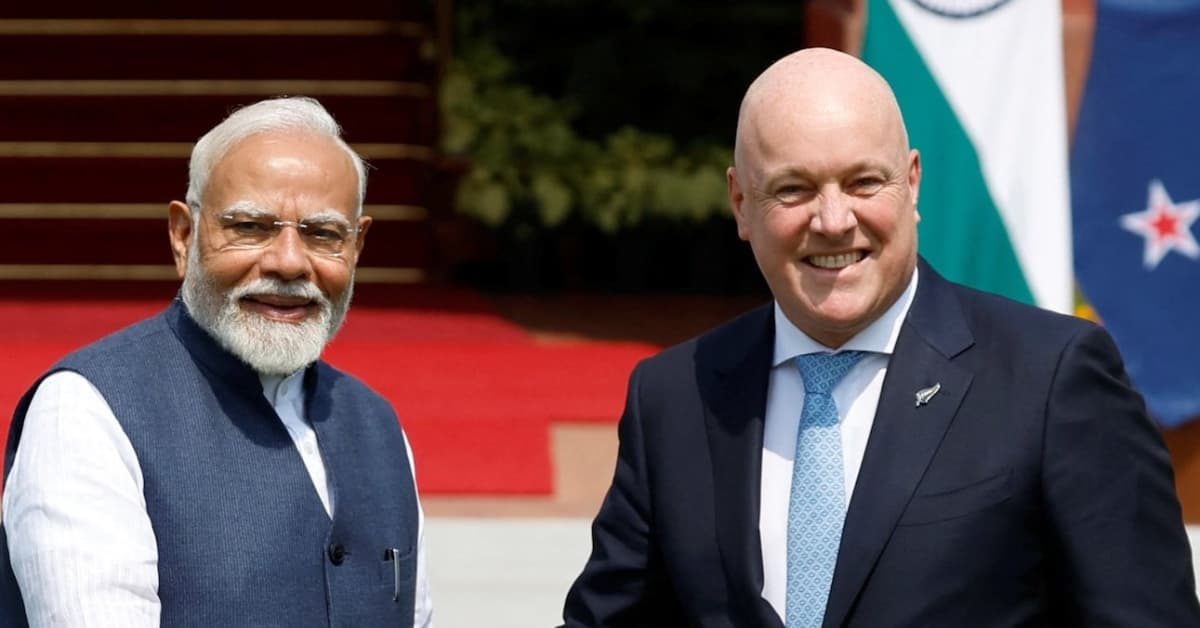

The pact will enable Indian “financial service suppliers” to establish cross-border digital operations in New Zealand, albeit under local data sovereignty and privacy protections
The two countries will also work on building an interoperable (and integrated) payments system to support real-time cross-border remittances and merchant payments
This came as the two countries concluded negotiations on the financial services annex of the FTA yesterday
India and New Zealand will work together to strengthen strategic collaboration in the fintech space under the recently concluded free trade agreement (FTA).
In an official statement, the finance ministry said that the pact will enable Indian “financial service suppliers” to establish cross-border digital operations in New Zealand. However, this will be bound by local regulatory control over data sovereignty and consumer privacy protections.
The two countries will also work on building an interoperable (and integrated) payments system to support real-time cross-border remittances and merchant payments. In effect, this is expected to pave the way for entry of homegrown digital payments platforms in the island nation.
“This provision (interoperable payments system) directly strengthens India’s digital payments ecosystem and fintech sector, enhances remittance flows from the Indian diaspora, creates market opportunities for Indian payment service providers and leverages India’s technological expertise in digital payment systems such as UPI and NPCI,” read the statement.
This came as the two countries concluded negotiations on the financial services annex of the FTA yesterday. Talks on annex began in May 2025 and evolved into a comprehensive framework comprising 18 articles.
Under the provisions of the annex, the two sides will also learn from each other’s regulatory sandbox and digital sandbox frameworks for cross-border applications. The move is expected to facilitate knowledge exchange, regulatory learning and collaboration opportunities for Indian fintech startups.
In addition, the annex will also “cushion” Indian financial institutions and financial service suppliers against any “discriminatory regulatory treatment” that could restrict their operational capabilities.
“… The agreement is forward-looking, balanced and designed to provide enhanced market access, regulatory clarity and cooperative frameworks that will benefit financial institutions and service providers from both countries”, read an official finance ministry statement.
This is the third FTA signed by the Indian government this year, following similar deals with the UK and Oman. The agreement with the Middle-Eastern nation will enable zero-duty access for nearly all Indian exports, including gems and jewellery, textiles, pharmaceuticals and automobiles.
Meanwhile, the Comprehensive Economic and Trade Agreement (CETA) gives duty-free access to 99% of Indian exports to the UK across products such as leather and footwear and auto parts.
As reported by Inc42 earlier this year, the India-UK FTA is expected to offer major tailwinds for homegrown D2C players on the back of their speed, quality, competitive pricing and brand-led storytelling. Food and cosmetics brands are also projected to get a boost in the long run, and open doors for offline retail and clinical partnerships in the UK.
In addition, the agreement with the former European Union (EU) member will also enhance market access, encourage technology collaboration and foster synergies in the automotive and EV components sectors.

Comments are closed.