
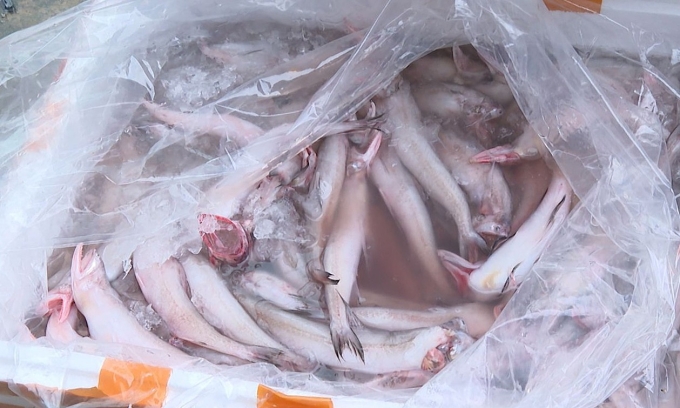
10 tons of Chinese fish preserved with toxic formaldehyde intercepted before reaching restaurants in Vietnam

More than 10 tons of noodlefish, containing very high levels of formaldehyde, were busted in Vietnam. Photo by Lam Son
More than 10 tons of frozen noodlefish imported from China and preserved with formaldehyde, a toxic chemical banned in food, have been seized by police in central Vietnam, authorities said.
The shipment was intercepted while being transported from Lang Son Province bordering China to multiple provinces for distribution to restaurants, police said on Dec. 23.
Police said the tractor-trailer was found carrying hundreds of boxes of noodlefish. Investigators determined the cargo had been imported from China through the Huu Nghi International Border Gate in Lang Son and was being delivered to seafood traders across several provinces in central Vietnam.
By the time the vehicle was stopped, more than two tons of the fish had already been delivered to three traders in the coastal city of Sam Son in Thanh Hoa Province, police said. Subsequent inspections at the receiving facilities led to the seizure of additional frozen fish, bringing the total volume confiscated in the case to more than 10 tons.
Samples were sent for testing to the National Institute of Food Safety and Hygiene under the Ministry of Health. Test results showed that all samples contained formaldehyde at concentrations ranging from 90 to 105 milligrams per kilogram.
Formaldehyde is a highly toxic industrial chemical that is strictly prohibited in food processing and preservation. Health authorities warn that consuming food containing formaldehyde can cause damage to the digestive tract, stomach ulcers, esophageal inflammation and other serious health risks.
Imported noodlefish from China are currently sold at significantly lower prices than domestically caught noodlefish, making them attractive to restaurants and traders despite food safety concerns, authorities said.
Police said the investigation is being expanded to determine responsibility and identify other parties involved in the distribution chain.

Comments are closed.