
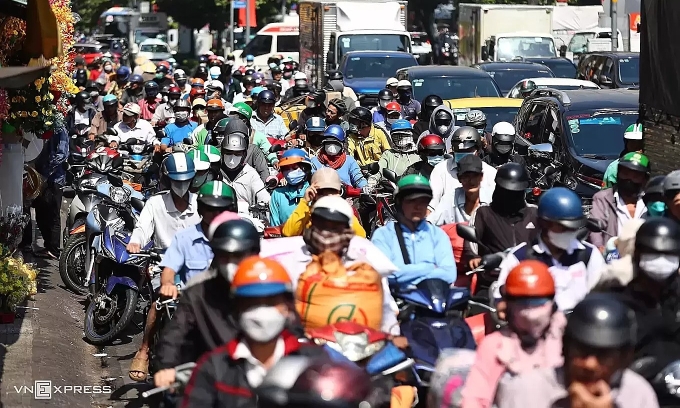

Under a draft vehicle emissions control plan now being finalized, the LEZ would cover areas with the highest population density and traffic volume, including the former Districts 1, 3, 5, 6, 8, 10, 11, and parts of Binh Thanh, Tan Binh, Tan Phu and Phu Nhuan. The zone would be defined by 15 bridges and 17 major arterial roads.
City data show the area is home to more than 3.2 million residents and handles roughly 9.2 million trips each day. Air quality monitoring indicates significantly higher concentrations of PM2.5, nitrogen dioxide (NO2), and sulfur dioxide (SO2) compared with other parts of Ho Chi Minh City, particularly in Districts 1, 3 and 5.
If implemented, cars that fail to meet Euro 4 emissions standards would be charged to enter the city center, with exemptions for ambulances, fire trucks, defense and police vehicles, and other special-purpose transport.
Motorcycles would be phased out more aggressively. Emissions inspections are expected to begin on July 1, 2027, followed by restrictions from September 2027 on motorcycles that do not meet Euro 2 standards during peak hours, from 6–9 a.m. and 4–7 p.m.
By 2028, the city plans to ban all gasoline- and diesel-powered motorcycles from the low-emission zone, except those used by people with disabilities. Cars that fail to meet Euro 4 standards would also be barred from entering the downtown area during peak hours, with limited exemptions.
The low-emission zone is expected to expand further by 2030 to include Ring Road 1 and major corridors such as Pham Van Dong, areas around Tan Son Nhat Airport, Cach Mang Thang Tam, Au Co, Luy Ban Bich, Kinh Duong Vuong and Vo Van Kiet, as emissions controls are tightened in stages.
To enforce the rules, the city plans to install automatic license plate recognition cameras at LEZ entry points, linked to vehicle registration and emissions databases. Authorities would issue warnings during the first month of implementation, with fines applied from the second month onward.
Before rolling out the policy citywide, Ho Chi Minh City plans to pilot large-scale green transport transitions in Con Dao and Can Gio. In Con Dao, officials aim to complete the switch from gasoline and diesel vehicles to electric and green-energy vehicles by the end of 2026, with limited exceptions. Can Gio is expected to follow a similar path by 2028.
The proposal also includes extensive financial incentives to encourage the shift to cleaner transport. Individuals and households would receive partial subsidies for new vehicle purchases and exemptions from initial fees such as registration, inspection and road maintenance charges. Poor and policy beneficiary households in Con Dao and Can Gio could receive full support within set limits.
Ride-hailing motorbike drivers would be eligible for subsidies of up to VND5 million ($190) per vehicle, along with fee and tax exemptions through 2028. Taxi, passenger transport and freight operators would also receive phased financial support.
At the same time, the city plans to expand electric charging infrastructure, offer incentives for charging station investments, and accelerate the rollout of electric buses and public transport.
Ho Chi Minh City currently has more than 14 million residents, over one million cars and more than 10 million motorcycles, along with large volumes of transient traffic. Road transport accounts for nearly 90% of fine particulate emissions from transportation.
City officials say the plan aims not only to cut air pollution, but also to reduce congestion in the city center by gradually curbing private vehicle use as cleaner alternatives become more accessible.

Comments are closed.