
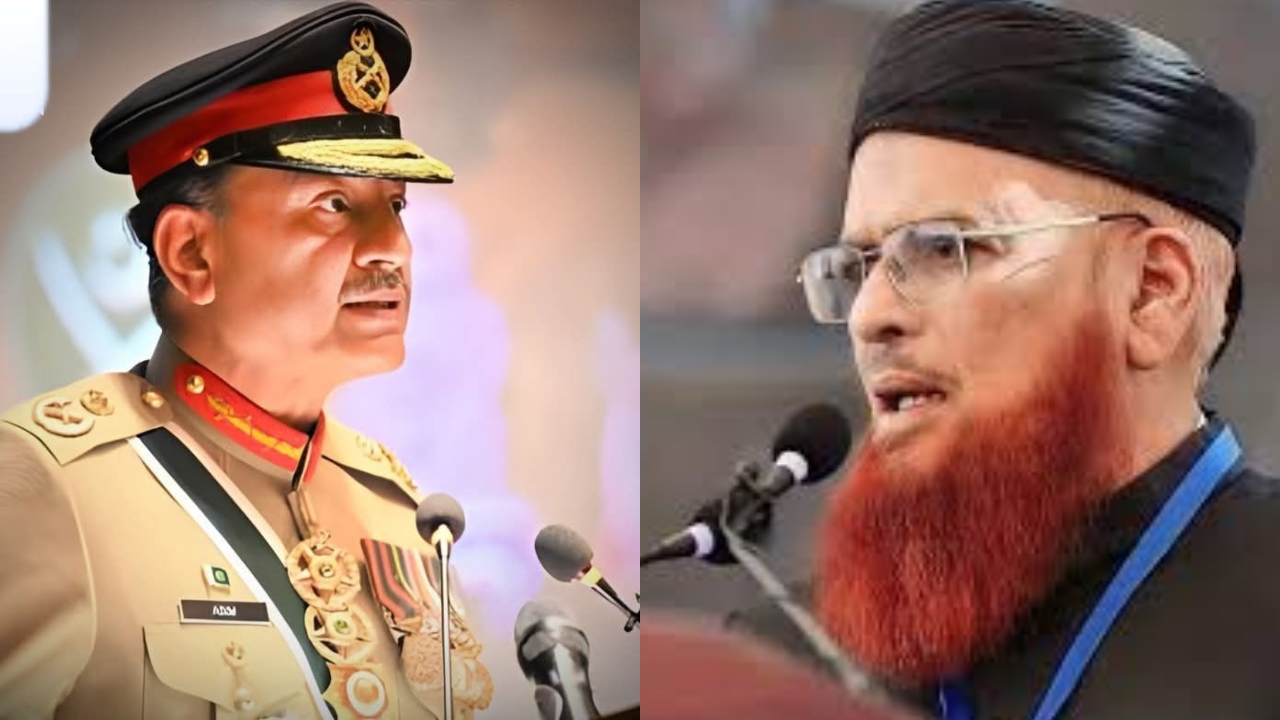
‘Asim Munir gets lifetime exemption ‘Haram’, Islamic scholar’s debate on Shariat vs power fight in Pakistan, no one beyond accountability

Pakistan The politics of India once again seems to be moving towards the conflict between the army, government and religious leadership. Prime Minister Shehbaz Sharif is already struggling with economic crisis, opposition attacks and international pressures. Meanwhile, the statement of a senior Islamic scholar has made the situation more complicated. JUI-F’s Mufti Taqi Usmani has publicly questioned the moral and religious basis of granting lifelong immunity to Asim Munir, terming it ‘un-Islamic’.
Read now on WhatsApp also, click to subscribe
Challenge to Pakistani power structure
According to the report of News18, the scholar has described the alleged ‘lifelong legal, constitutional immunity’ given to Pakistani Army Chief General Asim Munir as against Islamic principles and termed it as ‘haram’. This statement is not just a religious comment, but a direct question on the power structure of Pakistan, where the army is often considered above the democratic and constitutional limits. The question is also arising that if the religious leadership starts openly objecting to the decisions of the army, then why will the Shahbaz Sharif government have to bear the direct political loss?
In a sign of growing discontent in Pakistan, a senior Islamic scholar of Jamiat Ulema-e-Islam-Fazal (JUI-F) has publicly questioned on moral and religious grounds the decision to grant lifelong immunity to Field Marshal Syed Asim Munir under the 27th Constitutional Amendment. He has said that giving such exemption to anyone including Asim Munir is an un-Islamic step.
On 27 November, Munir took over as Pakistan’s first Chief of Defense Forces, or CDF, a post created by the controversial 27th Amendment of the 1973 Constitution. This amendment has paved the way for a clear constitutional immunity for Munir, giving him lifelong immunity from criminal prosecution or civil proceedings for acts committed while in office, unless Parliament itself first withdraws this immunity.
Allies of the Pakistan Democratic Movement (PDM) are reportedly not in favor of the blanket immunity given to Asim Munir under the 27th Amendment. JUI-F’s Mufti Taqi Usmani said that according to the Quran and Sunnah, no ruler, general or Caliph is above accountability. He said that such security for rulers or military chiefs is prohibited in Islam.
PDM was an alliance of major political parties that was formed in 2020 to challenge the government of then Prime Minister Imran Khan, which was accused of poor governance and mismanagement of the economy. This alliance was led by Shehbaz Sharif’s Pakistan Muslim League-Nawaz (PML-N) and included Bilawal Bhutto’s Pakistan Peoples Party (PPP) and JUI-F. However, the JUI-F later broke out of the PDM and announced a protest movement in 2024, alleging that the elections were rigged.
Shahbaz government on target
According to sources close to JUI-F, the party feels that it was used to show strength on the streets and for religious recognition, but in the end it was not given the right to take real decisions. The party has accused the Shehbaz Sharif government of violating the principles of the Quran by giving life-long exemption to Munir.
According to sources, JUI-F chief Maulana Fazal-ur-Rehman also considers the civilian government to be just a show. Whereas the real power lies with the Army Chief. This has given rise to the impression that the seat distribution and post-poll arrangements were made in favor of the ruling PML-N and Bilawal Bhutto’s Pakistan Peoples Party (PPP).
Crisis on the legitimacy of hybrid government
Meanwhile, lower-level Deobandi clerics are putting pressure on Rehman to distance himself from the alliance which is largely considered ‘un-Islamic’. Top intelligence sources told CNN-News18 that open opposition like Taqi Usmani has created a deep crisis of legitimacy for Pakistan’s hybrid government.
Moreover, the growing rift between the JUI-F and the Shehbaz Sharif government weakens the stability of the alliance. It also increases dependence on the army. By citing Islamic principles, critics make Rawalpindi’s repression even more difficult.
Why did Shahbaz Sharif’s troubles increase?
Shahbaz government is already accused of working under the influence of the army. Now the support of the religious class is not with the hybrid government. Whereas the support of the religious class is considered very important in the politics of Pakistan. As the opposition of the Ulemas increased, pressure from the streets to the Parliament started to oppose the constitutional amendment. This has become a new issue for the opposition to attack the government.
Why the controversy over Asim Munir getting ‘lifetime exemption’?
Critics of giving unlimited powers to Asim Munir claim that the extraordinary legal protection given to the army chief is wrong. No one is above accountability in Islam. Due to this, the debate of Shariat versus power structure has also intensified in Pakistan.

Comments are closed.