
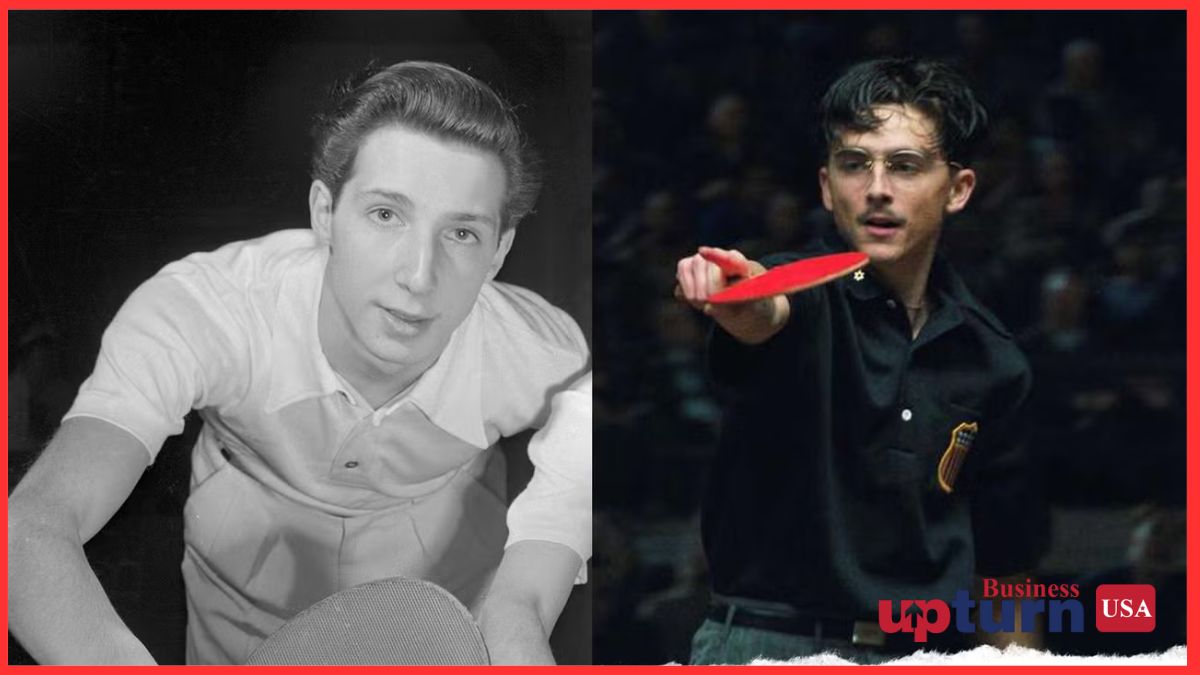

Timothée Chalamet takes center stage in Josh Safdie’s new film Marty Supremeportraying Marty Mauser, a New York hustler with a gift for table tennis. While Chalamet’s emo-heartthrob persona is disguised with a ratty mustache, round glasses, and a lank haircut, his character embodies a desperation reminiscent of classic hustlers like Dustin Hoffman’s Ratso Rizzo in Midnight Cowboy. Unlike Rizzo, however, Marty has advantages: he is young, relatively attractive, and blessed with an extraordinary Ping-Pong talent. Yet both characters share a relentless drive to pull off that “one big score,” giving the film a kinetic energy that keeps audiences on edge.
The character of Marty Mauser is loosely inspired by Marty Reisman, the postwar American Ping-Pong champion, and draws from Reisman’s memoir The Money Player. While Safdie introduces several fictionalized elements, Mauser mirrors Reisman’s obsession with the game, love of the hustle, and unwavering self-belief. Both the real and fictional Marty sharpen their skills in a bustling Broadway basement club, hustling unsuspecting customers—a table-tennis echo of The Color of Money’s Vincent Lauria or The Hustler’s Fast Eddie Felson.
Fact vs. Fiction: Koto Endo and the Championship Thrills
One of the film’s most intriguing characters is Marty’s nemesis, Koto Endo, a deaf Japanese champion whose focus and composure challenge Mauser at every turn. Endo is fictional, yet his character draws inspiration from Koto Kawaguchi, a real-life deaf table-tennis champion, and Hiroji Satoh, the Japanese player who defeated Reisman at the 1952 World Championships. While Satoh revolutionized the game with a foam-covered racket, the movie simplifies Endo’s equipment, making the rivalry more about personal skill and psychology than technical innovation.
Another memorable sequence shows Marty talking his way into a luxurious hotel suite, impressing and persuading a former Hollywood star. While Reisman did manage hotel upgrades during his own championships, he was not as scrappy an outsider as Mauser, nor did he engage in the farcical exploits shown on screen. These embellishments highlight Safdie’s choice to prioritize narrative excitement over historical accuracy, yet the film still captures the spirit of Marty Reisman’s audacious ambition.
Marty Supreme mixes fact and fiction with flair, offering audiences a thrilling portrait of table-tennis hustling, high-stakes ambition, and the chaotic energy of postwar New York. Chalamet’s portrayal is a compelling tribute to the audacity and showmanship of a true sporting icon.

Comments are closed.