
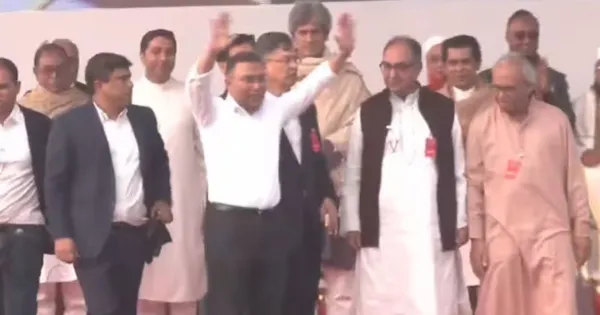
BNP leader Rahman returns home after 17 years of self-exile, appeals to create inclusive Bangladesh

Dhaka. Bangladesh Nationalist Party (BNP) working president Tariq Rahman returned to Dhaka on Thursday to a warm welcome after being in self-exile for more than 17 years. Rahman, a leading contender to become the country’s next Prime Minister, symbolically marked his return to the country’s politics by standing barefoot on Bangladeshi soil soon after arriving at Shahjalal Airport. Hours later, Rahman, the 60-year-old son of former Prime Minister Khaleda Zia, addressed his supporters, called for maintaining peace and stability in the country and presented a comprehensive plan to create an “inclusive Bangladesh”.
He said, now the time has come that we all together build the country. We want to create a secure Bangladesh. In Bangladesh, whether a woman, man, or child, they should have the right to go out of their homes safely and return safely. Rahman’s return comes at a time when the assassination of prominent youth leader Sharif Usman Hadi has created unrest and political instability that has engulfed the whole of Bangladesh. Hadi played an important role in removing former Prime Minister Sheikh Hasina from power. Referring to American civil rights activist Martin Luther King’s famous quote “I have a dream,” Rahman said, “I have a plan for my people and my country.” In his address at Dhaka’s July 36 Expressway, Rahman said he wanted to create an inclusive Bangladesh, where people of every caste, race and religion can live in a peaceful environment.
He said, there are people from hilly and plain areas in our country. There are Muslims, Hindus, Buddhists and Christians. We want to create a safe Bangladesh, where every woman, man and child can leave their homes safely and return safely. BNP Secretary General Mirza Fakhrul Islam Alamgir and other party leaders welcomed Rahman at Hazrat Shahjalal Airport in Dhaka amid tight security. Rehman was also accompanied by his wife Zubaida Rehman and daughter Jaima Rehman. Rahman was living in London since 2008. He has been effectively leading the BNP since 2018 after Zia’s health deteriorated. The BNP has emerged as a major contender to regain power in the elections to be held in February as former prime minister Hasina’s party, the Awami League, is banned from contesting the elections. Jamaat-e-Islami, which was an ally of the BNP during its tenure from 2001 to 2006, is now considered its main rival as the interim government has banned the Awami League from contesting elections through an executive order under the country’s stringent anti-terrorism law.
When the BNP announced Rahman’s plans to return from London, Rahman said, “Just as a child wants to be near his seriously ill mother in her time of distress, I want to return to Bangladesh.” Rahman’s return to Dhaka comes at a time when Bangladesh-India relations are deteriorating rapidly. However, he did not make any direct mention of India in his address. The BNP leader left the airport in a bulletproof bus. Before leaving the airport, Rehman thanked interim government head Muhammad Yunus in a phone conversation. Yunus had expressed support for the arrangements made for their security and the organization of their homecoming programs. In a video shared by BNP, Rahman was seen saying, “On behalf of myself and my family, I express my gratitude to you. In particular, I express my gratitude for the steps taken for my safety.
Rahman also mentioned the establishment of Bangladesh in 1971. Referring to the fall of the Hasina-led government last year, he said, “Just as in 1971, people from all sections of society came together to protect the independence and sovereignty of this country, similarly in 2024 too people came together and ousted the Sheikh Hasina government from power.” Around 4,000 army personnel, paramilitary Border Guard Bangladesh (BGB), policemen equipped with riot control equipment and plainclothes policemen were deployed in Dhaka to ensure Rehman’s security. There have been violent protests in Bangladesh following Hadi’s death. India-Bangladesh relations have once again become tense due to his murder. India on Tuesday demanded a full investigation into Hadi’s death. Unverified allegations of India’s involvement in Hadi’s assassination have led to negative sentiments against India in Bangladesh. Relations between India and Bangladesh became tense after the fall of Hasina government and the formation of an interim government led by Muhammad Yunus. India has expressed concern over attacks on minorities, especially Hindus, in Bangladesh.

Comments are closed.