
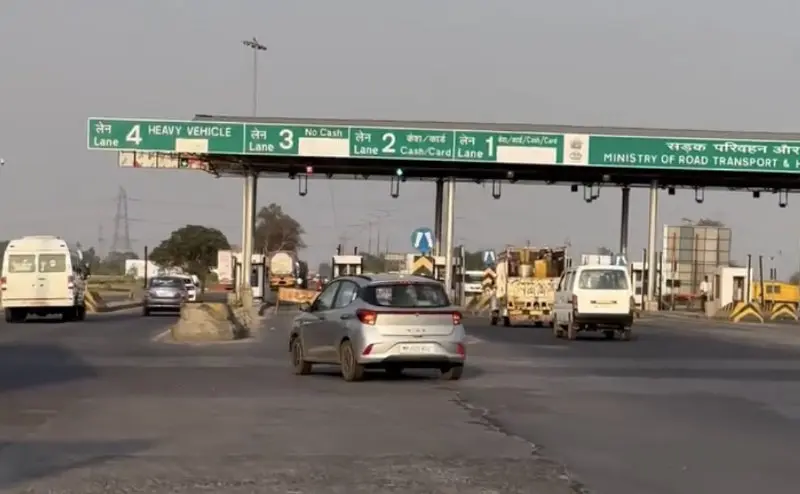
Toll tax rules will change as pollution increases in Delhi, there will be strictness on entry of heavy vehicles

Now the Municipal Corporation (MCD) is preparing to take a big step to stop the increasing air pollution in the capital Delhi. In the coming time, toll tax collected from vehicles entering Delhi can be directly linked to the GRAP system. This means that as the level of pollution in the air increases, the rules for collection at toll points will also become stricter. In the affidavit filed in the Supreme Court, MCD has admitted that it is considering making major changes in the system of entry and toll collection of heavy vehicles during Grap-3 and Grap-4.
When the air quality of Delhi-NCR reaches ‘severe’ category, even after the toll is cut, commercial vehicles will not be able to enter the city.
Under the proposal, when the air quality in the capital and surrounding areas reaches ‘very poor’ or ‘severe’ levels and Grap-3 or Grap-4 restrictions are imposed, commercial vehicles can be stopped at toll points located on the border. Till now, vehicles used to get entry after paying toll, but this will not happen in the new system. The Supreme Court has also given strong suggestions in this direction. The court believes that when the pollution level (AQI) crosses 450, then only vehicles providing essential services should be allowed entry. There should be a complete ban on other heavy vehicles so that the pollution caused by vehicle smoke can be reduced.
MCD earns more than Rs 900 crore annually, but the court asked – why there is no strict action against those who spread pollution?
MCD earns more than Rs 900 crore every year through toll tax. However, the Supreme Court has raised the question that when heavy trucks and commercial vehicles are one of the biggest sources of pollution, why are they not strictly banned when GRAP is implemented? Now it is being emphasized that if the Delhi government adjusts a part of the toll collection to the state revenue and spends the remaining amount on pollution control and improving road infrastructure, then the court’s objections can be removed to a great extent.
Due to toll plaza on Wazirpur border, there is huge traffic jam, trucks stand for hours and the cloud of smoke increases.
The ground reality is that due to toll collection, many times there is a long traffic jam at the border. For example, vehicles often get stuck due to the MCD toll plaza on the Wazirpur border. When trucks and heavy vehicles stand in queues for long periods, the smoke and dust emitted from their engines further increases the pollution levels. On this, the Supreme Court has commented that if the toll plazas themselves are becoming the cause of jam and pollution, then the system of these toll plazas will have to be changed when GRP-3 or 4 is implemented. This could include promoting e-toll, creating separate lanes or temporarily removing checkpoints.
Due to increase in pollution in winter, heavy vehicles will be charged so much ‘green-cess’ that they will adopt bypass route instead of Delhi.
After the hearing in the court, now there is hope that MCD, Delhi Government and Central Pollution Control Board will together prepare a new and strict policy. In this policy, toll rates and collection rules can be made based on AQI (Air Quality Index). If this model is implemented, then during the winter months when pollution is at its peak, heavy trucks will either be banned completely or ‘green-cess’ will be imposed on them so heavy that they will prefer to go through bypass routes outside Delhi instead of passing through Delhi.

Comments are closed.