
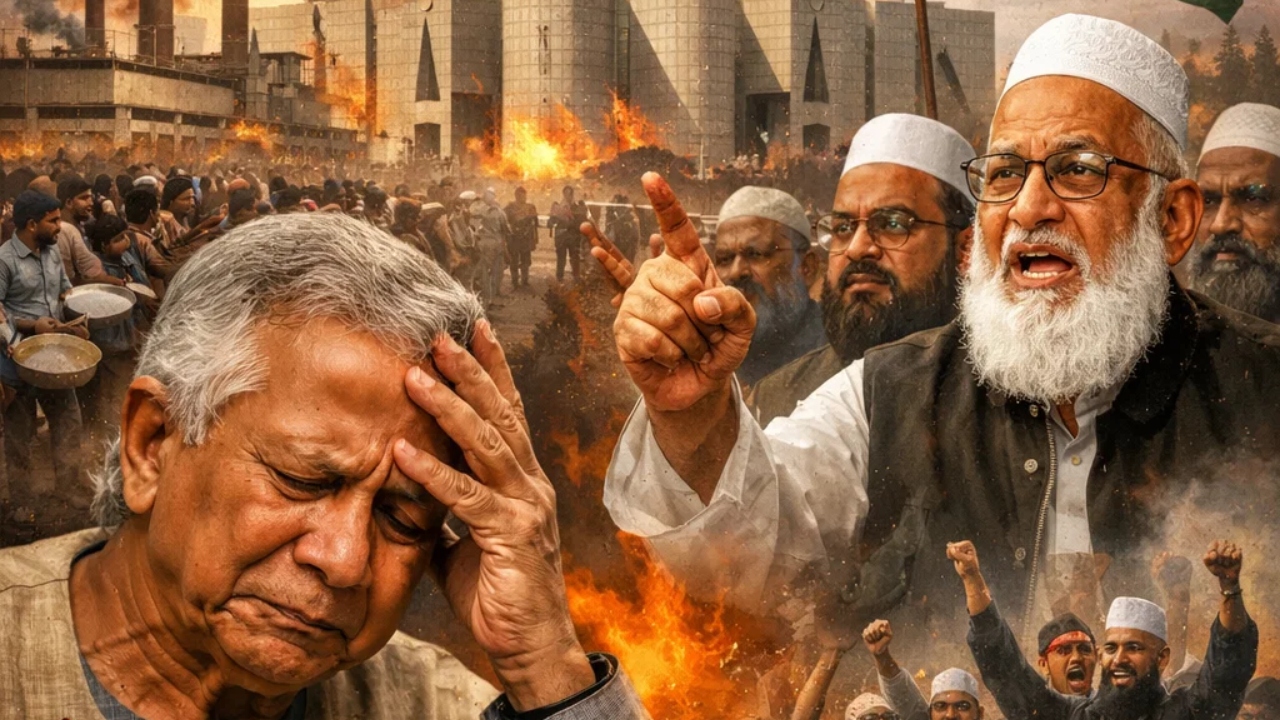

bangladesh in the politics of Mohammad Yunus Was considered the face of democracy, human rights and development for a long time, but history is witness that even a ‘principled softness’ in politics can sometimes keep the entire country burning for decades. An example of this is Nobel laureate Mohammad Yunus’s decision to lift the ban on extremist party Jamaat-e-Islami. This is because since then the violent incidents in Bangladesh and the spewing of venom against Sheikh Hasina, Hindus and India have started, which is finding it difficult to calm down even after the election announcement.
Read now on WhatsApp also, click to subscribe
Bangladesh Jamaat-e-Islami is currently headed by Dr. Shafiqur Rahman, who is a prominent leader of the party and has commented on India-Bangladesh relations and internal affairs in 2024, and remains a prominent face for the party. Even though the party has faced legal and political challenges in recent years.
Jamaat is anti India
Yunus’s advocacy of lifting the ban on Jamaat-e-Islami and considering it a part of the democratic process proved to be a mistake, which has given a new lease of life to radical Islamic politics there. Now the same Jamaat has become the face of attacks on minorities, anti-India agenda, glorification of 1971 war criminals and Sharia politics in the name of democracy. The question is not just about Bangladesh. The question is, has a failed ‘liberal experiment’ pushed South Asia back towards a 1971-like situation?
Court’s decision added ‘ghee’
Before the court verdict on Sheikh Hasina in Bangladesh, widespread violence and unrest has spread in four major cities including the capital Dhaka. Torch processions have been taken out, vehicles have been set on fire and government properties have been damaged. The protesters have also set fire to the railway track, which has disrupted traffic. Two Hindu youths have been brutally murdered. Hindu houses and establishments are being burnt.
Violent protests also continue against Sheikh Hasina, who faces serious charges of crimes against humanity, including more than 1,400 murders. Army has been deployed in Bangladesh and in some areas there are orders to shoot at sight the protesters.
After all, what is Jamaat-e-Islami?
Jamaat-e-Islami Bangladesh is an Islamic political party, which has been advocating Sharia-based Islamic governance in Bangladesh. This organization considers itself a religious-political movement and not just a party.
Jamaat-e-Islami was founded in 1941 by Maulana Abul Ala Maududi in British India. Jamaat had supported Pakistan during the Bangladesh Liberation War in 1971. Opposed the independence of Bangladesh. During this period, Jamaat along with Pakistani Army was accused of genocide and war crimes.
Serious allegations were made. This history of Jamaat became the biggest curse for it in future. The Jamaat believes that the constitution, laws and governance should be subject to Islamic principles, which conflicts with the secular structure of Bangladesh.
When was the ban imposed?
After 1971, Sheikh Mujibur Rahman had banned religious politics including Jamaat. The strictest action was taken against Jamaat in 2013–2016. Under the War Crimes Tribunal, its top leaders were sentenced to death and life imprisonment.
In 2013, the High Court had canceled the registration of the Jamaat. In the year 2016, the political activities of the party were banned. Jamaat was accused of committing treason in 1971. Violence and fundamentalism were promoted.
Why was the ban imposed?
There are several main reasons for the ban on Jamaat-e-Islami. These include treason in the Bangladesh Liberation War, crimes against humanity, politics based on religion and alleged links with violence and extremism. The government’s argument was that Jamaat’s politics was against the national identity and constitution of Bangladesh.
Why did Mohammad Yunus lift the ban?
When the role of Nobel laureate Mohammad Yunus increased in the interim government,
So political restrictions were reviewed in the name of democratic inclusion. After that Yunus banned Jamaat-e-Islami. It was argued on behalf of the Yunus administration that in a democracy, the fight against ideologies should be done through elections and not through restrictions.
Why is Bangladesh disturbed?
Extremist leaders interested in Islamic politics became active again in Bangladesh. Jamaat and its affiliated organizations started carrying out violent incidents against Hindus there. The murder of Hindu youth Deepu Dao and one other by the mob is the result of that. The feeling of insecurity has increased in the Hindu, Buddhist and Christian communities. Political activities started again in madrassas. The result of this is that Bengal has been burning for more than a year and it is not certain whether the elections will be held on time or not.
The concern of the Awami League and the secular class is that if fundamentalism gets legitimacy, they will try to rewrite the crimes of 1971. There is the deepest dissatisfaction regarding this in the Sheikh Hasina supporter camp.
The concern of India and western countries has also increased. Being a neighboring country, India is worried that pro-Pakistan and anti-India factions will strengthen in Bangladesh. The debate between fundamentalism versus democracy has intensified in western countries also. This situation could be a risk to the stability of Bangladesh.
The important question is whether Bangladesh can accept Jamaat without compromising with the 1971 past? Or will this decision once again lead the country towards ideological conflict?

Comments are closed.