
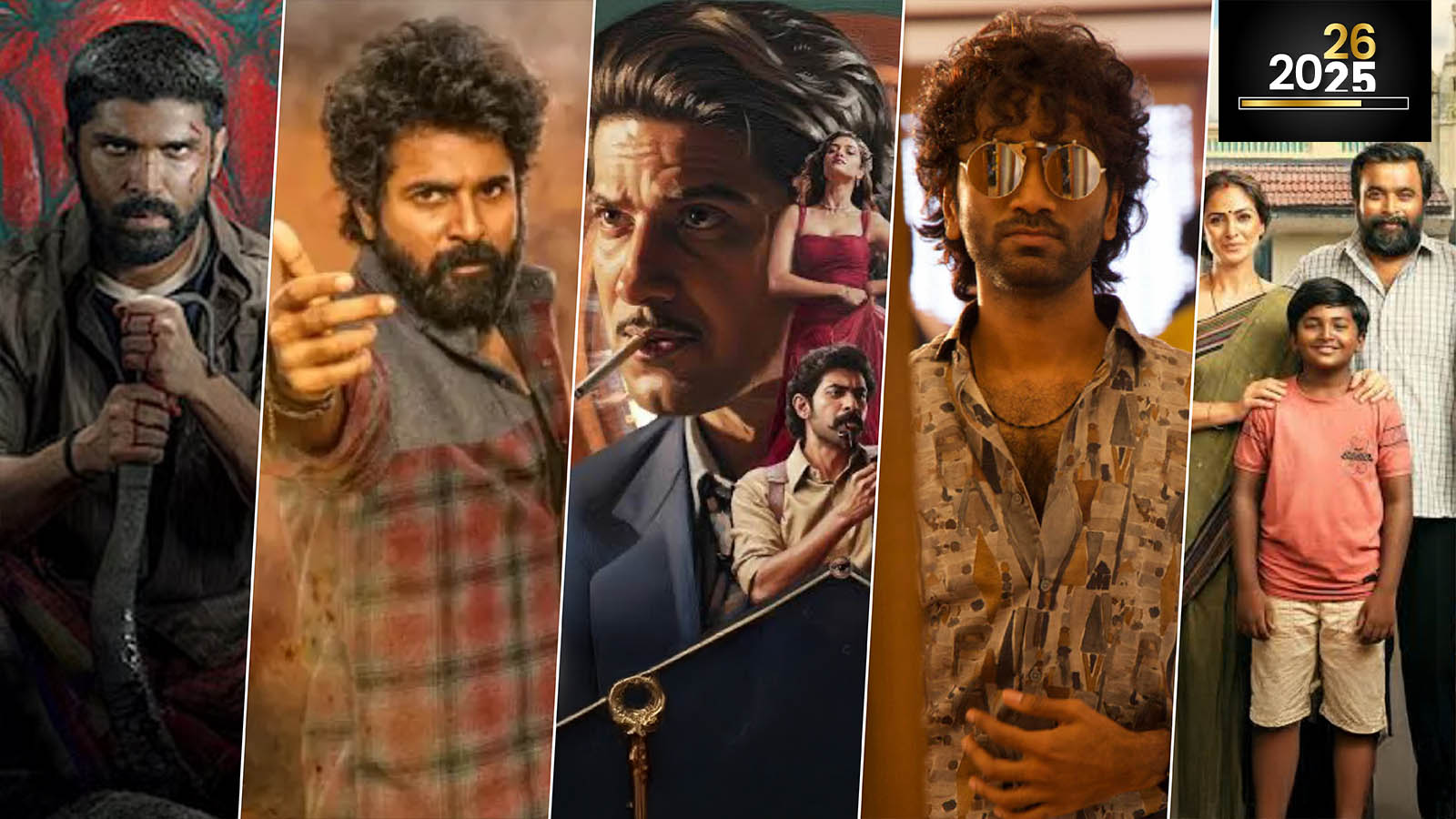

In 2025, Tamil cinema witnessed a wave of debutant directors who stormed the silver screen with stories of every kind and hue, even as two ageing superstars managed to draw massive collections at the box-office. It also saw gender debates stirred up by ‘feminist’ films, emergence of young stars edging out the likes of Surya, Vijay and Vikram, and the grand exit of a prominent star from the industry.
Tamil cinema’s first release of 2025 was Bioscope, a film about creating movie magic with tight constraints and without lavish budgets. In many ways, Bioscope embodies the paradox of the Tamil film industry: while big stars, big budgets, and celebrated directors often squander opportunities, smaller films brimming with heart and creative spark continue to struggle to reach out to audiences.
In this scenario, Rajinikanth and Kamal Haasan notched up big box-office numbers with Coolie and Thug Life, grossing nearly Rs 600 crore and Rs 100 crore respectively. Yet, despite the gloss and the huge commercial success, both films fell short of expectations, as gratuitous violence overshadowed cohesive storytelling, character development, and meaningful takeaways.
Dependable, steady heroes Dhanush and Ajith, too, continued to forge distinct paths, each sustained by a loyal fan following. Ajith experimented with breaking his hyper-masculine image in Vidaamuyarchi and partially succeeded; however, he courted controversy in Good Bad Ugly for using Ilaiyaraaja’s songs without permission, which gained more traction than the thin storyline. Yet, this Adhik Ravichandran’s fan-fiction was a hit. Dhanush, meanwhile, tackled class divides in Kubera and focused on regaining and fulfilling lost family legacies in Idli Kadai. Both made an impact on the box-office.
As the year draws to a close, what stands out is the sheer diversity of voices that has found space in Tamil cinema. Once dominated by a handful of perspectives, the industry now brims with fresh narratives, inventive storytelling, and bold new directions. This surge of creativity has infused Tamil cinema with renewed energy, making it more dynamic and inclusive than ever before.
Debutant directors’ wave
Tamil audiences were treated to surprise packages in 2025 as a new wave of directors hit the Tamil screens with stories that broke fresh ground. For example, Abishan Jeevinth’s Tourist Family tops the list as it made an impact with understated performances from Sasikumar and Simran; Sri Ganesh’s 3 BHK on aspirations of owning a home, and Rajeshwar Kaliswamy’s Kudumbasthan on budgetary dilemmas of a middle-class man, echoed sentiments of Balu Mahendra and Visu’s family dramas, but set in a contemporary milieu.
We also had Krishnakumar’s Oho Endhan Baby, which borrowed the familiar VTV format; Kishen Das’s Aromaley, tracing a young man’s love stories across different stages of life, and Shanmugam Muthusamy’s Diesel explored mafia wars and political corruption.
Also read: Cinema yearender 2025: Low-budget, small regional films scored big at the box office
Ilayaraja Perumal’s Ten Hours experimented with a real-to-reel narrative progression; Lokesh Ajls’s Eleven delved into the chilling tale of a serial killer targeting twins. Ravindra Madhav’s Thanal, Hari Mahadevan’s Yellow, Vaali Mohan Das’s Madraskaaran, Nikesh’s Rebel and Vikarnan Ashok’s Mask, had interestingplots and performances.
The takeaway: The fact that so many films in 2025 were debut works by young men and women — ranging from stories rooted in lived experiences to those emerging organically from contemporary settings, and even the bizarre and offbeat — signals the vitality of a robust industry.
Tamil cinema is clearly making space for newcomers who challenge established names to raise their game. Their fresh ideas encourage experimentation with genres, narrative styles, and treatments. It is clearly a refreshing shift for an industry that had long sunk into predictable gangster sagas and retro themes, with ageing stalwarts relying on new-generation directors to revive their careers.
Feminist attempts
The male and female gazes collided with Varsha Bharath’s Bad Girl, which portrayed a girl-woman’s reflective journey from a woman’s perspective, while Kalaiarasan Thangavel offered the male viewpoint, exploring the travails of a man struggling to come to terms with a ‘modern’ girl’s ‘irrational behaviour’ in Aan Paavam Pollathathu.
Keerthiswaran’s Dude leverages Pradeep Ranganathan’s sexist boy-next- door image in a story that purports to critique honour killings. The film, however, was panned for its inconsistent patchy writing, and misogynistic tone.
The takeaway: Tamil cinema appears to be still grappling with the meaning of feminism, and interpreting it often from fixed binary positions.
On the one hand, we have Bad Girl, a film that reinforces many of the stereotypes people hold about feminism and drives home that women are misusing the very freedoms fought for by feminists, and activists.
(from left) Rajnikanth in Coolie; Kamal Hassan in Thug Life; Ajith Kumar in Vidaamuyarchi; a still from Idli Kadai, and poster of Bioscope
On the other hand, we have Aan Paavam Pollathathu, which reinforces the stereotype of the ‘empowered’ woman, as someone who exploits or manipulates men. In both cases, negative stereotypes are perpetuated —whether by male or female filmmakers — ultimately reinforcing sexist ideas and suggesting that feminism is not necessarily a positive force.
Most Tamil films end up amplifying problematic portrayals, offering little clarity on feminism, gender intersections, or the broader movement for women’s empowerment and liberation from domestic confines. Some filmmakers, striving to project themselves as progressive, weave in social messaging, addressing issues such as honour killings, as in Pradeep Ranganathan’s films, but it doesn’t seem to work.
Tamil cinema is primarily driven by male protagonists, but this year, however, several women took the lead and scored high with audiences and critics alike. Jaidev’s The Door, a horror thriller, was a comeback vehicle in Tamil for Bhavna; JK Chandru’s Revolver Rita had Keerthi Suresh in a comedy caper; Bad Girl’s Anjali Sivaraman made waves and found takers in Europe and film festivals; Damayanthi’s Kaayal put a spotlight on Gayathri Shankar, suicide and activism; Vipin Radhakrishnan’s Angammal brought accolades for Geetha Kailasam and Semmalar Annam’s Mayilaa premiered at Rotterdam featuring Melodi Dorcas as a women struggling for independence and self-respect.
Pradeep Ranganathan, exit of Vijay and actors in between
Actor and director Pradeep Ranganathan, with his boy-next-door image and highly-relatable factor, rose in the popularity charts this year. However, Sivakarthikeyan, who only had one or two few outings this year still appears to be a natural successor to Tamil cinema’s bigger stars, who appear to be on the way out.
With actor Vijay purportedly making his grand exit after his upcoming Jana Nayagan, Sivakarthikeyan’s clout in the Tamil film industry and among audiences are growing, with media and analysts marking him out as the next big star in the Tamil film industry. Sivakarthikeyan, who made a deep impression, essaying the role of Major Mukund Varadarajan in biographical drama, Amaran, also drew accolades for AR Murgadoss’s comeback film Madharaasi, in a well-written and mounted action film that also holds an emotional core. Meanwhile, Surya tried to revive his presence with Kartik Subburaj’s Retro that played on the foundling who is a born leader trope cleverly. It was ambitious but felt incomplete though that did not stop audiences from lapping it up.
The takeaway: Pradeep Ranganathan, who is not a powerful actor, is not in a position to overshadow Sivakarthikeyan or Dhanush. He is probably the Dhanush of this generation — however, he wears his wokeism as a sort of cloak but his films and characters are actually misogynistic and sexist. He talks about the man woman relationship in an immature and simplistic fashion and then says that he is just projecting what this generation is experiencing, in terms of relationships and negotiating identities. He may just end up as a three-film wonder. The audiences may well get tired of this young man spouting his views on masculinity.
Meanwhile, Sivakarthikeyan, who is very self-conscious and self-aware when it comes to building his image, may just take the top slot. The media has created this grand stand-off between Vijay and Sivakarthikeyan but that may not be a fact. Sivakarthikeyan has been saying right from the beginning that he is not competing with anyone, and he’s doing his own thing.
On Vijay’s exit, it is clear that the star sees himself more as a politician than an actor and he is on his way out. However, his last few films were so similar and predictable that his charm was beginning to fade. His film career is poised for a fade-out.
Dhruv Vikram became the darling of critics after Mari Selvaraj’s sports drama Bison: Kaalamaadan, signalling the emergence of a new order — a crop of new young actors. The breakout star delivered a remarkable performance, portraying the journey of a kabaddi star. Yet, there is a looming risk of him being typecast into only anti-caste, message-driven films. Without a wider range of roles, his impact may fade quickly, leaving him as a fleeting sensation rather than a lasting force. To establish himself as an actor of real substance, Dhruv will need to pursue credible storylines and showcase greater versatility across genres.
Murder mystery genre flourished
The murder mystery genre thrived in Tamil cinema in 2025. The genre found a pair of safe hands in debutant editor-turned-director Leo John Paul with his Maargan that lives up to Vijay Anthony’s reputation of bringing offbeat story ideas to life. This film combined the resurfacing of a retired jaded cop to investigate serial killings, with the help of a young man with a spiritual connection to water and stored memories, extremely effectively.
Also read: From Ghibli to time travel, top AI trends of 2025 that went viral
Crime stories played with insurance fraud, medical fraud, extortion and corruption in the services, were all effectively told in films such as Mu Maaran’s Blackmail with GV Prakash, and Athiyan Athirai’s Thandakaaranyam, starring Dinesh and Kalaiyarasan. The suspense thriller genre took a new high with Navin Kumar Kadaisi Thotta, a murder mystery set in a resort; while Nelson Venkatesan’s DNA centred around baby switching and a medical condition.
Selvamani Selvaraj pulled off a retro crime drama in Kantha with Dulquer delivering an authentic period act. A Raghavendra’s Maayakoothu saw strong reception with its blend of crime drama, fantasy, surrealism, reflexive art conversations and realistic characters, underscoring the acceptance of audiences to new ways of visual storytelling.
Romantic films in different forms
Romance played out in many forms on the Tamil screen, like a misogynistic story written and performed by Ranganathan in Aswath Marimuthu’s Dragon; a coming-of-age film on break-ups and moving on in Dhanush’s Nilavukku en mel ennadi kobam; Kadahalikka Neramillai saw Ravi Mohan in a comedy of errors directed by Kiruthiga Udayanidhi; Raghav Mirdath’s Bun Butter Jam focused on disillusionment with the institution of marriage; Shanmugha Priyan’s Love Marriage delved into the societal pressures that force young people into marriage. While Sherief’s Gandhi Kannadi is a warm film on dialling down materialistic attitudes in life and love.
Curtains drop on 2025
It was a strong year for Tamil cinema in the end. Superstar releases like Rajnikanth’s Coolie and Kamal Haasan’s Thug Life grossed nearly Rs 600 crore and Rs 100 crore but drew criticism for prioritising violence over storytelling. Meanwhile, steady performers Ajith and Dhanush pursued distinct paths: Ajith experimented with softer roles in Vidaamuyarchi but faced controversy over Good Bad Ugly, while Dhanush explored class divides in Kubera and family legacies in Idli Kadai. Both maintained strong box-office presence through loyal fan bases.
The year opened with Bioscope, a modest yet creative film that clearly underscored the industry’s paradox — small, heartfelt projects struggle for reach while big-budget ventures often waste potential. That’s what stood out this year.

Comments are closed.