
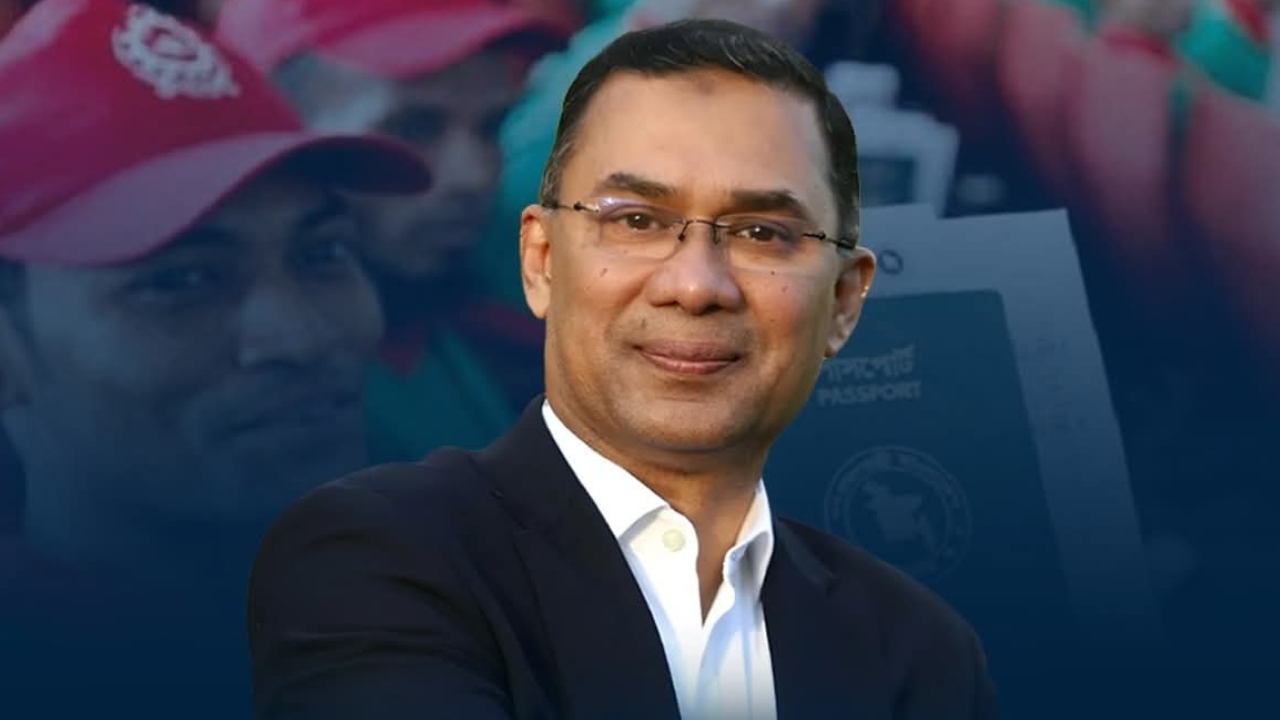
What will be the impact of Tariq Rahman on Bangladesh politics? Line drawn in the very first speech on returning home

BNP acting chairman Tariq Rahman’s return to Bangladesh’s politics after 17 years from London on Thursday has shaken the balance of power. On one hand, her supporters are calling it a sign of restoration of democracy, while on the other hand, Sheikh Hasina government is considering it as a new script of political instability. Whereas it has posed a big challenge to Jamaat-e-Islami. Now it has become difficult for Jamaat to come to power. Meanwhile, the real question is whether Tariq Rahman’s presence will increase the power-opposition conflict or will it lead Bangladesh towards a stable and competitive political system?
The return of Tariq Rahman, son and political heir of former Prime Minister Khaleda Zia and acting president of Bangladesh Nationalist Party (BNP), has come at a time when his country is at a crossroads. The people of Bangladesh are hopeful that they will be successful in giving a new direction to the country and getting it out of the crisis. Tariq Rehman’s party is leading in the elections proposed in February 2026. Rehman himself has indicated that he will draw a new line if he returns to power this time.
In fact, in May, Tariq Rehman had questioned Yunus’s mandate to take long-term foreign policy decisions, stressing the need for elections and reforms. The important question before the people of Bangladesh is that Tariq Rahman himself decides the priorities on behalf of the party.
This is the reason why the return or activism of Tarique Rahman is being considered a big turning point in the politics of Bangladesh. His impact will not be limited to BNP only, but will be visible in the balance of power, military-political relations and India-Bangladesh equation. Understand what will be the impact of Tariq Rehman’s return in future?
1. Bangladesh First Policy
Tariq Rehman made it clear that Bangladesh does not want close relations with Rawalpindi or Delhi but will put Bangladesh first. At a massive rally in Dhaka’s Naya Paltan area, he declared, “Neither Delhi, nor Pindi, Bangladesh first,” and appealed to supporters to repeat the slogan.
This is very different from the foreign policy that Muhammad Yunus has made for Bangladesh without any elected mandate. Yunus has taken a completely opposite path in terms of foreign policy direction to that adopted by ousted Prime Minister Sheikh Hasina. Yunus has advocated closer ties with Pakistan at the expense of the historical relations between India and Bangladesh.
Hasina forged close ties with India and balanced Bangladesh’s interests vis-à-vis China and India. Also maintained a safe distance from Pakistan.
Tariq Rahman’s Bangladesh Nationalist Party has been highly critical of the government led by Sheikh Hasina, as it has faced fascism and a decline in democracy under her rule. He also had differences with the interim government led by Yunus on many issues.
In fact, Bangladesh watchers believe that Mohammad Yunus had to declare elections in February under pressure from BNP, which had clashed with the Yunus government over holding elections. BNP and Jamaat-e-Islami Bangladesh have been in alliance before, but no one knows the impact of Bangladesh’s violent political history better than Tariq Rahman. Tariq Rahman’s BNP is at the center of Bangladesh politics after Muhammad Yunus banned Sheikh Hasina’s party, Bangladesh Awami League, from taking part in the elections.
2. Factor that brings life to BNP
There was a leadership void in BNP after Khaleda Zia’s illness and limited activism. The strategic return of Tariq Rehman will generate enthusiasm among the party cadre. The party’s election campaign will get a new direction. Preparation of organization in election mode
It will be fast. BNP no longer just wants to oppose but wants to become a strong contender for power.
3. Alarm bells for Awami League!
Sheikh Hasina’s Awami League has been in power for a long time, but anti-incumbency has increased due to issues like inflation, unemployment, human rights allegations, questions on electoral fairness, etc. Tariq Rehman can convert this dissatisfaction into a political wave in favor of the party.
4. Equation of army and power
The role of the army has always been decisive in the politics of Bangladesh. Tariq Rehman may get the support of a section of the army. There is also hope of getting tacit sympathy from the old network of bureaucracy. If this happens, then
The path to change of power may become easier.
5. What will change in electoral politics?
The opposition alliance will be strong. Instead of election boycott, the strategy of confrontation will be encouraged. International pressure will increase that the elections should be fair. Tariq Rehman’s influence will not allow the election to remain one-sided.
6. Game changer or risk?
Tariq Rehman can prove to be a game changer for BNP. He has become the biggest challenge for the Awami League. Rahman’s return could be strategically risky for India. For Bangladesh, it may prove to be a symbol of political instability versus change of power. The election result will decide whether Bangladesh will move towards stable democracy or return to the unstable politics of the 1970–90s.
7. What will be the impact on India if BNP comes to power?
Raunak Jahan, author of ‘Political Parties’, a book on Bangladesh politics, has written that BNP has traditionally adopted an anti-India stance. Whereas Awami League has maintained a soft stance. The ideology of Awami League is inclined towards secularism and socialism. Whereas BNP emphasizes Bangladeshi nationalism and Islamic identity.
While contesting the Prime Ministerial elections for the first time in 1991, Khaleda Zia had claimed that if Awami League won, India would capture Bangladeshi cities up to Feni. He had described the India-Bangladesh Friendship Treaty as a ‘Treaty of Slavery’.
Here he has also mentioned that BNP has historically been close to anti-India extremist groups in Bangladesh. In 1991, it formed the government with the support of Jamaat-e-Islami.
India’s biggest concern during the BNP rule was separatist violence in the Northeast, with Bangladeshi territory allegedly being used to support insurgent groups. During this period, Pakistan’s ISI also tried to destabilize India’s North-East through Bangladesh.
If BNP returns to power, India may face challenges related to border security, security of Hindu minorities in Bangladesh and the political trust built during Sheikh Hasina’s tenure.
8. India is taking every step cautiously
India has adopted a cautious approach. On 1 December, Prime Minister Narendra Modi tweeted about Khaleda Zia’s health. In response, Tariq Rehman said that the support of global leaders is a great source of strength. On 8 December, senior BNP leader Ishtiaq Aziz Ulfat said that India had taken the right step and described Modi’s message as a very positive step.
It will ultimately be good for India if a stable BNP government is formed through peaceful elections under the leadership of Tariq Rehman. Relations may not improve immediately, but stability in Bangladesh will force Tariq to improve relations with India. Bangladesh cannot depend on China and Pakistan indefinitely.
9. Rahman’s challenges
Tariq Rehman has the task of uniting the country. If his party wins the elections and he becomes the Prime Minister. Rahman has already prepared the outline of a campaign. Many programs have been announced, which BNP will implement after being elected.
Rehman has presented himself and his party as champions of democracy and the return of elected government. Addressing a BNP gathering earlier this month, Rahman said, “Only democracy can save us from this and you, every single member of the Bangladesh Nationalist Party, can strengthen the foundation of that democracy.
10. Radicalism and the shadow of the past
This is the biggest dispute between India and Bangladesh. Tariq Rehman is accused of corruption and 2004 grenade attack. There have been allegations of leniency from extremist organizations. India and western countries fear that if BNP comes to power, Islamic fundamentalism and pro-Pakistan faction may become stronger again.
11. India-Bangladesh relations
Sheikh Hasina has been India’s most trusted partner. Anti-India statements kept coming during BNP rule. The terrorist network was encouraged. There was tension in border security. The strength of Tariq Rehman could be a matter of strategic concern for New Delhi. But, after returning to Bangladesh, Tariq Rahman addressed a public meeting, which was slightly different from his earlier stance. Know how?
- BNP leader Tariq Rahman had said in a public meeting after returning to Bangladesh from London on December 25 that the democratic institutions in Bangladesh have become weak and their biggest fight is to bring back democracy.
- He clearly said that “until fair, free and acceptable elections are held, the political crisis will not end.” This indicated that BNP is now ready for electoral conflict.
- Tariq Rehman alleged that the administration, police, judiciary are being used in the interest of power. He said that political cases will be withdrawn after coming to power. The policy of intimidating opposition leaders will end.
- Attacking inflation, dollar crisis and unemployment, he said that bread is disappearing from the plates of the common people and the people in power are happy with the figures. He had also said that for the stability of Bangladesh, the army will have to remain within the constitutional limits. This statement is being considered as a message for both the army and the government.
- Tariq Rehman said that religion should not be used as a weapon of politics. This statement is being considered as an attempt at damage control for India and western countries. He said that BNP will respect democracy, human rights, international rules and will not promote conflict with the world.
- Without taking the name of India directly, he said that there will be respectful and equal relations with the neighbours. This is an indication that BNP does not want open confrontation.
- Overall, this speech of Tariq Rehman is not just an announcement of withdrawal, but a political script for electoral struggle, change of power and gaining international trust. He has talked about moving away from his earlier stand and taking Bangladesh forward. It is clear from this that Bangladesh politics is moving towards a direct fight between Sheikh Hasina vs Tariq Rahman.

Comments are closed.