
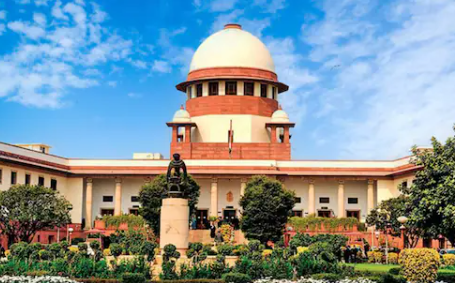
Big decision of Supreme Court: Transfer of land cannot be refused only on the basis of registered will, clear instructions to revenue officers

The Supreme Court has given a historic and clear decision, giving great relief to common citizens in matters related to land and property. The apex court has said that Mutation entry of land cannot be refused merely on the ground that the claim is based on a registered will.This decision will impact lakhs of cases where revenue officials have been avoiding transferring names on the basis of will for years,
The Supreme Court bluntly said that the purpose of revenue records is not for final determination of ownership, but for tax assessment and administrative convenience. In such a situation, it is legally wrong to reject the application filed on the basis of will at the initial stage.
This case was related to agricultural land in a rural area of Madhya Pradesh. original owner of land Rhoda alias Rodilal Died away in the year 2019. Before his death, in the year 2017, he filed a petition regarding his property. registered will Had prepared. On the basis of this will, a person named Tarachandra asserted his rights on the land and applied for transfer of name in the revenue records.
Entry made in revenue records at initial stage, but later Madhya Pradesh High Court canceled the transfer saying that inheritance of land cannot be registered on the basis of will alone. This decision of the High Court was challenged in the Supreme Court.
hearing of this case Justice Sanjay Karol and Justice Manoj Mishra The division bench did. While canceling the order of the High Court, the court said that-
a testamentary transfer of property valid and valid legal means Is.
Revenue officials cannot decide whether the will is true or false.
If there is a dispute on the validity of the will, its settlement civil court It will be in the tehsil and not in the tehsil or collector office.
The court also clarified that making a mutation entry does not give anyone the final right of ownership, but it is only an administrative record.
Supreme Court in its decision Section 109 and 110 of Madhya Pradesh Land Revenue Code, 1959 Cited. According to these sections, land rights can be acquired through several legitimate means, including—
deed of sale
gift card
inheritance
And Will
Are included. The court also said that the rules implemented in 2017 clearly accept the will as a valid document for mutation.
Through this decision, the Supreme Court has given a clear message to the revenue administration that-
Nomination application filed on the basis of will should not be rejected merely on the basis of conjecture or doubt.
It is not the jurisdiction of the revenue authorities to decide the validity of a will.
If in future there is a different decision regarding ownership by the Civil Court, the revenue records can be amended as per that decision.
It has also become clear that the revenue record Conclusive Proof Are not.
The biggest benefit of this decision will be given to the common land owners and heirs. Now-
If there is a will, you will not have to wander for years for name transfer.
Unnecessary delays and corruption in revenue offices will be stopped.
The legal process in property disputes will be more clear and simple.
Experts believe that this decision will play an important role in reducing property disputes in both rural and urban areas.
According to law experts, this decision of the Supreme Court further strengthens the interpretation of Indian property law. This proves that Scope of revenue records is limitedand it is only the civil court’s job to decide the real rights.
This decision of the Supreme Court is one in the matters related to land and property. milestone Will be proved. The court has made it clear that Refusal to transfer land on the basis of registered will is illegalThis decision not only correctly interprets the law but also protects the rights of common citizens,
In the times to come, this decision will play an important role in making the revenue and judicial processes across the country more transparent and equitable.

Comments are closed.