
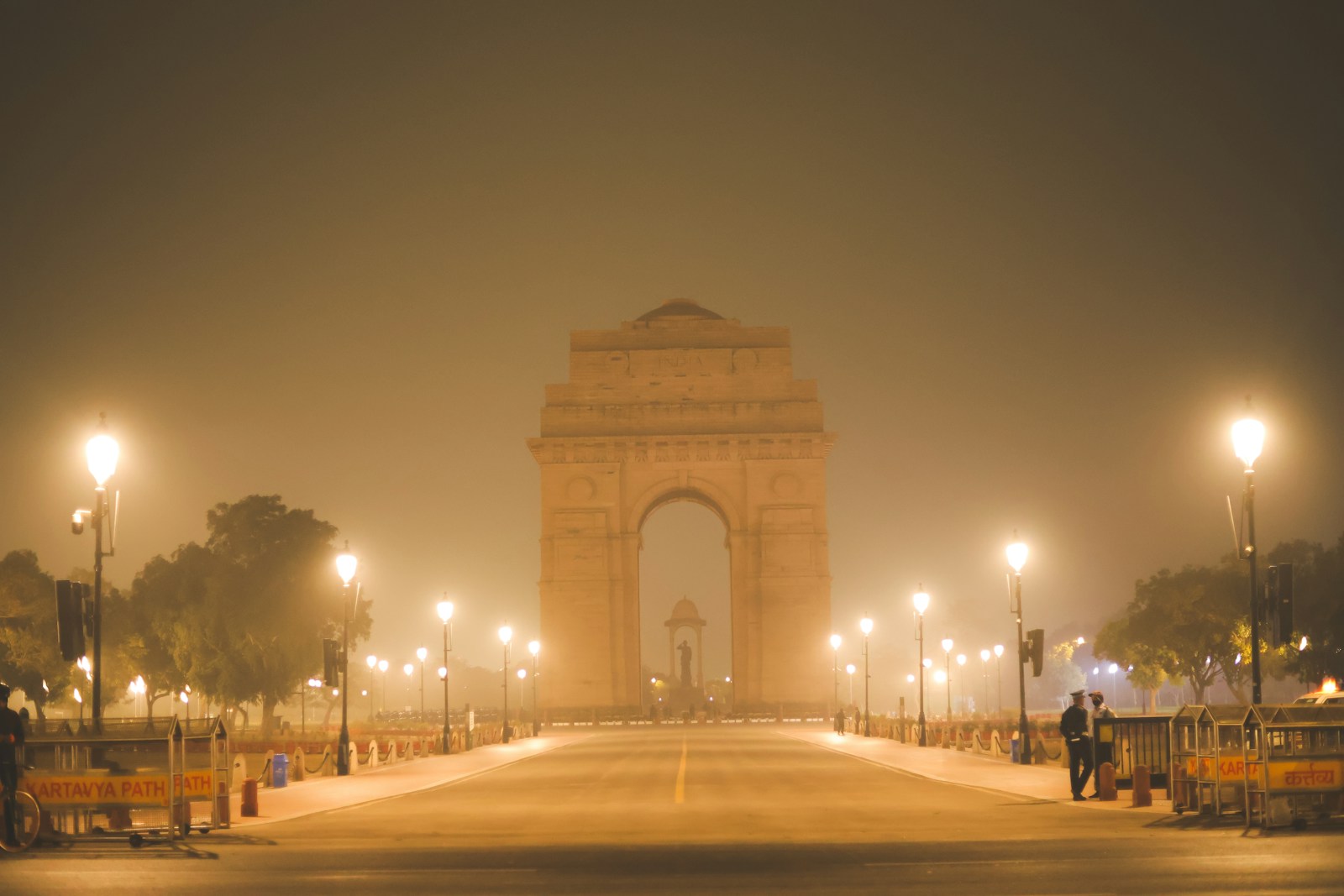

Air quality in Delhi worsened once again after two days of marginal improvement, with the city’s average Air Quality Index slipping into the very poor category. Official data showed that pollution levels rose sharply on Friday, raising fresh health concerns for residents.
According to figures released by the Central Pollution Control BoardDelhi’s 24 hour average AQI stood at 332 at 4 pm on Friday. This marked a significant deterioration from an AQI of 234 recorded on Thursday and 271 at the same time a day earlier. The city has now returned to conditions considered harmful for prolonged outdoor exposure.
Out of 38 functional air quality monitoring stations across the capital, eight reported severe pollution levels with AQI readings crossing 400. These stations included Anand Vihar, Bawana, DTU, Jahangirpuri, Narela, Nehru Nagar, Rohini, and Vivek Vihar. Twenty stations fell in the very poor category, while nine reported poor air quality, based on data from the CPCB’s SAMEER application.
Pollution source analysis from the Decision Support System for Air Quality Management indicated that vehicular emissions were the single largest contributor to Delhi’s pollution load, accounting for nearly 20 per cent. Industrial sources in Delhi and its surrounding regions contributed just over 10 per cent, while residential emissions made up close to 5 per cent of the total load.
Among districts in the National Capital Region, Jhajjar in Haryana emerged as the biggest external contributor to Delhi’s pollution, responsible for about 20 per cent of the load. It was followed by Sonipat, Panipat, and Gurugram at roughly 4 per cent each, and Rohtak at just over 2 per cent.
Forecasts from the Air Quality Early Warning System suggest little immediate relief, with Delhi’s air expected to remain in the very poor category for the next six days. The India Meteorological Department reported that the city recorded a maximum temperature of 22.3 degrees Celsius, slightly above normal, while the minimum dipped to 7.7 degrees Celsius. Relative humidity ranged from 66 per cent to 100 per cent, and dense fog is expected to persist over the coming days, potentially worsening pollution dispersion conditions.

Comments are closed.