
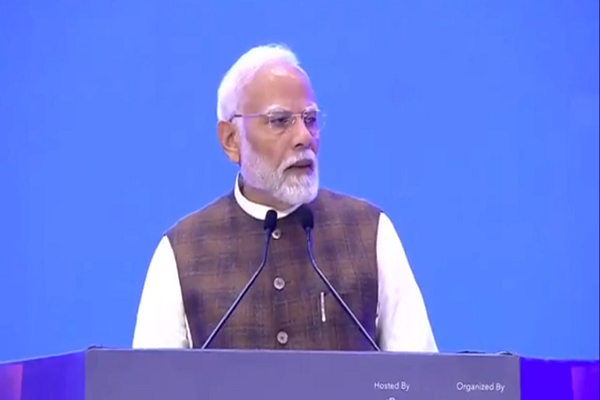

New Delhi: Prime Minister Narendra Modi today inaugurated the International Telecommunication Union – World Telecommunication Standardization Assembly (WTSA) 2024 at the Bharat Pavilion in New Delhi. PM Modi also inaugurated the 8th edition of India Mobile Congress 2024 during this program. He had observed the demonstration displayed on this occasion. Welcoming the dignitaries of ITU, PM Modi thanked and praised them for choosing India for the first WTSA meeting. PM Modi had said, “When it comes to telecom and its related technology, India is one of the best performing countries.”
Enumerating India’s achievements, PM Modi had said that, in real time, India has more than 40 percent of the world’s mobile phone user base of 120 crore to 1200 million, 95 crore to 950 million internet users and digital transactions. He further said that India had demonstrated how digital connectivity has become an effective tool for last mile delivery. He congratulated everyone for choosing India as the venue to discuss global telecommunication standards and the future of telecom as a global interest.
Emphasizing the importance of the joint organization of WTSA and India Mobile Congress, the Prime Minister had said that the objective of WTSA is to work on global standards, while the role of India Mobile Congress is related to services. He had said that today’s event brings global standards and services on a single platform. Emphasizing India’s focus on quality service and standards, the Prime Minister had said that the WTSA experience will provide new energy to India.
The Prime Minister emphasized that WTSA empowers the world through consensus and India Mobile Congress empowers the world through connectivity. That is why Shri Modi had said that this program involves consensus and connectivity. He stressed the need for coordination in today’s conflict-ridden world and said that India is living through the immortal message of Vasudhaiva Kutumbakam. He mentioned the G-20 summit organized under the chairmanship of India and talked about giving the message of ‘One Earth One Family One Future’.
The Prime Minister had emphatically said that India is busy bringing the world out of conflict and uniting it. The Prime Minister had said, “Be it the ancient Silk Road or today’s technology route, India’s sole mission is to connect the world and open new doors of progress.” The Prime Minister had said that, in such a situation, this partnership of WTSA and IMC is a great message, in which the benefit of local and global connectivity will not only be available to one country, but to the entire world.
PM Modi had said, “India’s mobile and telecom journey in the 21st century is a subject of study for the entire world.” He further said that, mobile and telecom are seen as a convenience all over the world, but telecom is a medium of connectivity as well as a medium of equity and opportunities in India. The Prime Minister had noted that, at present, telecom as a medium is helping in bridging the gap between villages and cities, rich and poor.
Recalling his presentation on Digital India Vision a decade ago, PM Modi had said that India has to move forward with a holistic approach as opposed to a piece-meal approach. PM Modi had listed the four pillars of Digital India – low-cost devices, wide reach of digital connectivity in every nook and corner of the country, easily available data and ‘digital first’ goals, which were identified and worked upon together, yielding good results.
The Prime Minister highlighted India’s transformational achievements in connectivity and telecom reforms and emphasized how the country has built a strong network of thousands of mobile towers in interior tribal, hilly and border areas, ensuring connectivity to every household. He said that the government has created a strong network of mobile towers across the country. The Prime Minister highlighted the significant progress made in infrastructure, including rapid installation of Wi-Fi facilities in public places like railway stations and connectivity of islands like Andaman-Nicobar and Lakshadweep through undersea cables.
He added that, “In just 10 years, India has laid optical fiber, which is eight times more than the distance between the Earth and the Moon.” PM Modi had also drawn attention towards the rapid adoption of 5G technology in India and said that 5G technology was launched two years ago and now almost every district is connected, which makes India the second largest 5G market in the world. He further said that India is already moving towards 6G technology, which ensures a future-ready infrastructure.
While discussing reforms in the telecom sector, the Prime Minister had taken note of India’s efforts to reduce data costs. He had said that, compared to many countries of the world where one GB data is 10 to 20 times more expensive, the price of internet data in India is now as low as 12 cents per GB. He said, “Today every Indian uses an average of 30 GB data every month.” PM Modi had noted that all such efforts have been taken to a new foundation by the fourth pillar i.e. the spirit of Digital First. He asserted that India had democratized digital technology and created a digital platform, where innovations on this platform had created millions of new opportunities. Highlighting the transformative power of JAM trinity – Jan Dhan, Aadhaar and mobile, Shri Modi said that it has laid the foundation for innumerable innovations.
He mentioned Unified Payments Interface (UPI), which has provided new opportunities to many companies, and also talked about ONDC, which will revolutionize digital commerce. The Prime Minister had drawn attention to the role of digital platforms during the COVID-19 pandemic in ensuring seamless processes like financial transfers to the needy, real-time communication of guidelines, vaccination drives and submission of digital vaccine certificates. Referring to India’s success, the Prime Minister expressed the nation’s desire to share the digital experience of public infrastructure globally. The Prime Minister had said that India’s digital talent can advance welfare schemes across the world, which India had emphasized on digital public infrastructure during its presidency of the G-20. He stressed that the country is happy to share its DPI knowledge with all countries.
Emphasizing the importance of women’s network initiatives during the WTSA, PM Modi had emphatically said that India is working very seriously on women-led development. He had added that G-20 had come to take forward this commitment during India’s presidency. The Prime Minister had emphasized that India is working towards the goal of making the technology sector all-inclusive by empowering women through technology platforms. She highlighted the important role of women scientists in India’s space missions and the increasing number of women co-founders in India’s startups. The Prime Minister also noted that female students constitute 40 percent of STEM education in India and India is creating many opportunities for women in technology leadership.
PM Modi also highlighted the government’s NaMo Drone Didi program to promote the drone revolution in agriculture, which is being led by women from India’s villages. He added that India had also started the Bank Sakhi program to bring digital banking and digital payments to every home, which led to digital awareness. Referring to the important role of Asha and Anganwadi workers in India’s primary healthcare, maternity and child care, PM Modi said that at present these workers are monitoring all the work through tabs and apps.
He had added that, India is also running Mahila e-Haat program, an online marketing platform for women entrepreneurs. He further added that it is unimaginable that today Indian women are working on such technology in every village. PM Modi had expressed the hope that in the future, India will increase its scope, in which every city of India will be a leader in the field of technology.
The Prime Minister stressed the importance of establishing a global framework for digital technology. He emphatically said that India had raised this issue during its presidency of G-20 and appealed to global organizations to recognize its importance for global governance. PM Modi said, “The time has come that global organizations should accept the importance of global governance.” Emphasizing the need to formulate global ‘Dos and Don’ts’ for technology, the Prime Minister highlighted the borderless nature of digital tools and applications and called for international engagement to counter cyber threats and collective action by global organisations.
He drew parallels with the aviation sector, whose structure is already well established. PM Modi has called for WTSA to play an active role in creating a secure digital ecosystem and a secure channel for telecommunication. In an interconnected world, security cannot be an afterthought. “India’s data protection laws and National Cyber Security Strategy reflect our commitment to creating a secure digital environment.” The Prime Minister urged Assembly members to develop standards that are inclusive, secure and fit for future challenges, including ethical AI and data privacy standards that respect the diversity of countries.
The Prime Minister stressed the need for a human-centric approach to the ongoing technological revolution and appealed for responsible and sustainable innovation. He said that the standards set today will determine the direction of the future and stressed that the principles of safety, respect and equality should be at the center of our discussions. He said that our aim should be that no country, no region and no community is left behind in this digital transformation and stressed the need for innovation balanced with inclusion. He urged to ensure that the future is technologically sound as well as ethically sound with innovation and inclusion. In concluding the address, the Prime Minister had congratulated and also extended support for the success of WTSA.

Comments are closed.