
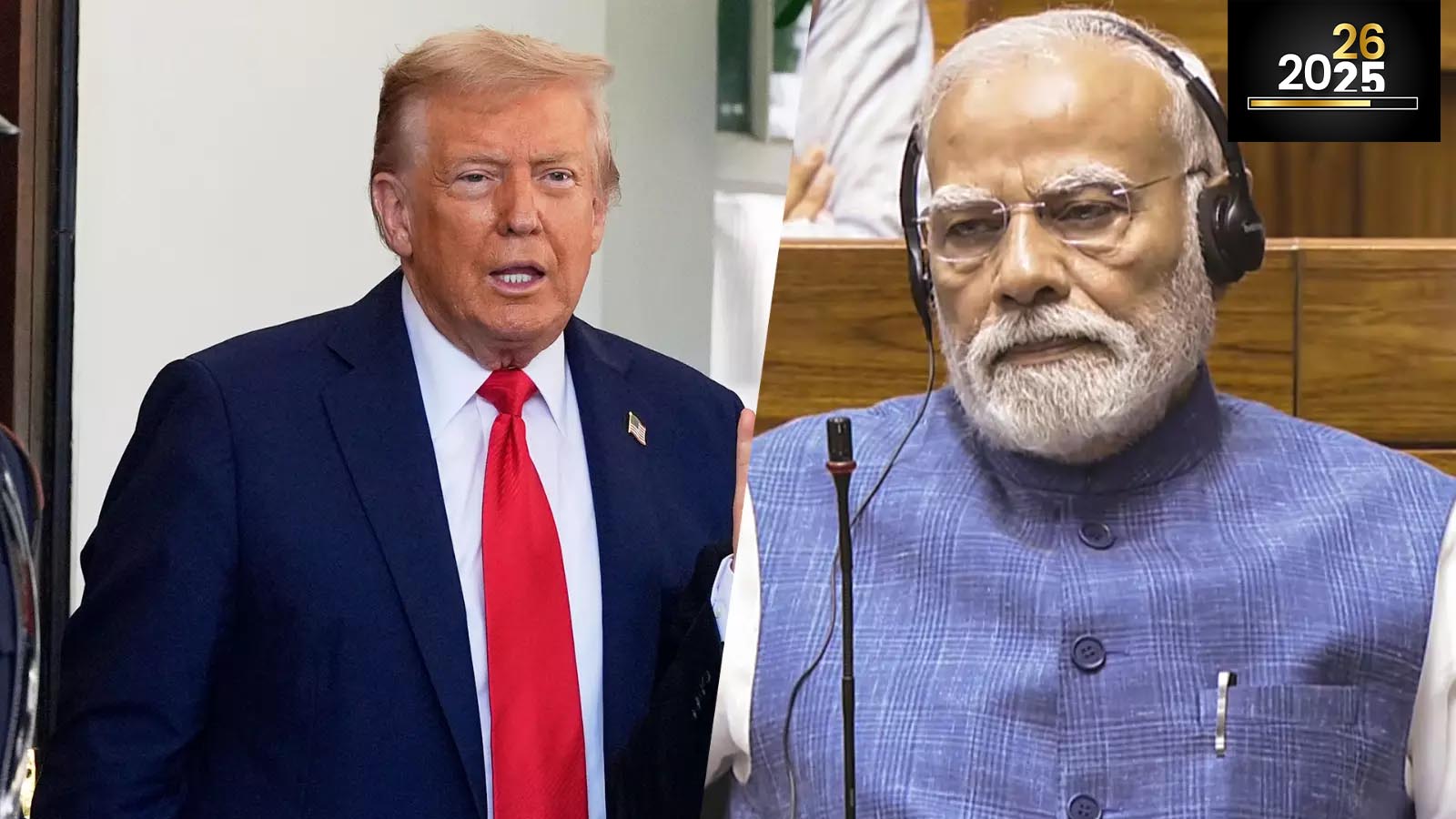

In 2016, Prime Minister Narendra Modi had declared in the US House of Representatives that the two nations had “overcome the hesitations of history”. Even when a mercurial Donald Trump became the President of the US for the first time, the Modi government never looked at a loss of confidence in dealing with an unpredictable administration.
During his US visit In 2019, Modi was even seen ‘campaigning’ for the Republican leader for the 2020 elections, saying “This time Trump government” (“It’s Trump administration once again”).
No Trump 1.0 extension
Trump lost that round to Joe Biden, but made it back to the White House in 2025. The Indian establishment expected it would be a cakewalk again, for Modi was dealing with the fourth successive American presidency.
But, as they say, politics is unpredictable. Just a few months after the tycoon-politician took over the White House, something extraordinary started unravelling.
Also read: Wordly Wise | Trump to woo India with ‘Core 5’ membership?
There were enough reasons for experts to believe that Trump 2.0 would be an easy extension of Trump 1.0 for India since the two leaders were not too different in their styles and worldviews. But it took just a few weeks after the Republican assumed the White House for the second time that the myth got busted, for the first time.
Deportation of Indians in shackles
As the new administration made mass deportation of undocumented foreign nationals from American soil a key policy, India found no exception. The US claimed to have identified nearly 18,000 Indian nationals who it believed to have entered its territory illegally. In the first week of February, an American deportation flight brought back about 100 such Indians to Punjab.
While the US’s deporting Indians is not new and happened when the Democrats were in power as well, the allegations that the deportees sent back in February were handcuffed throughout their 40-hour flight sparked massive criticism.
The government tried to project standard procedures had been followed during the deportation flight, women and children were not subjected to restraint, and it was working with the Trump administration to see that Indians were not mistreated during deportation, the Opposition were not convinced and said it was nothing but an insult to the dignity of the country and its people. Yet, a similar instance of throwing out Indians from the US in shackles, for trying to enter or stay there illegally, was repeated in October.
Union External Affairs Minister Subrahmanyam Jaishankar told Parliament in the recently concluded winter session that the US deported over 3,200 Indian nationals since January 2025, the highest for any year since 2009, and next only to Saudi Arabia that deported 11,000.
On Sindoor and Trump
An even worse turning point in the India-US equation in 2025 came after India and Pakistan had a four-day air conflict in May.
While the Modi government and its supporters were busy preparing how to project the arch-rival’s ‘meek surrender’ under Operation Sindoor before the country’s ‘nationalistic’ media, Trump made a declaration that the two nuclear neighbours had arrived at a ceasefire.
Also read: US National Strategy is naked self-interest, shorn of any commitment to collective good
Subsequently, he continued to tom-tom his contributions towards saving the world from what could become a disastrous conflict between two nuclear powers.
All this happened much to India’s chagrin, and it openly rejected the US president’s claim of brokering the peace, something he did to enrich his resume as a messiah of peace to bag the Nobel Peace Prize.
Tariff fiasco hit soon after
The worst was yet to come. As Trump continued with his zeal to put America’s interests first and reworked trade ties with the rest of the world, India was not spared.
Trump had already been resenting India’s tariff regime, saying New Delhi had some of the world’s highest rates, and one would have expected that something was coming despite the mercurial leader using superlatives about India and Modi time and again.
On July 30, he announced a 25 per cent tariff on India, effective in two days, along with an unspecified “penalty” over the latter’s receiving energy and military aid from Russia. Less than a week later, he walked the talk, doubling the tariffs on Indian imports to 50 per cent, leaving the friendly nation flabbergasted.
Also read: ‘Pax Silica’ minus India: Another US snub to India to gain wider market access?
The peculiarity with Trump throughout the first year of his second term is that his India policy and Modi policy remained de-hyphenated. On the one hand, he kept praising the Prime Minister with terms such as “killer”, “great-looking guy”, “great man”, “great friend”, “Modi loves me” (even to the extent of saying that he did not want to destroy the PM’s political career) and so on.
But on the other hand, he used strong words on India, such as saying trade ties have been “a totally one-sided disaster”, “a dead economy” or that “it stopped buying Russian oil” under his directive. Some of Trump’s top officials, such as Treasury Secretary Scott Bessent and trade aide Peter Navarro, have also accused India time and again of buying oil from Russia and profiteering.
‘Love’ for Pak, ‘hate’ for India
What made India’s Trump story worse this year is that the US president hosted the top leadership of Pakistan, including the country’s newly promoted Chief of Defence Forces Asim Munir and Prime Minister Shehbaz Sharif, at his Oval Office.
Both sides showered lavish praise on each other during these meetings, and Pakistan even nominated Trump for the Nobel Peace. Trump also remarked while announcing a US-Pakistan deal to develop its oil reserves, that someday, Islamabad might sell oil to New Delhi.
Modi’s countermoves
Modi did not take things lying down. In August, the month which perhaps saw the bilateral ties between the two democracies touching the lowest point in 2025, a German daily claimed that the prime minister refused to take calls made by Trump at least four times and interpreted it as the former’s “anger” and “caution” in response to US pressure on his government to halt importing crude from Russia.
Also read: Modi-Trump call: Friendly talk or strategic alarm? | Capital Beat
At August end and early September, Modi went to China to take part in a Shanghai Cooperation Organisation (SCO) summit, where he met the presidents of China, Russia and Iran, none of whom are considered Trump’s friends. It was his first visit to China in seven years and was a clear message to Washington that India is not out of options.
A few days later, the US’s former national security adviser, John Bolton, who was once close to Trump but fell out later, remarked that the top leaders of the US and India historically enjoyed a good rapport, but it has become a thing of the past now.
In an interview to a British media portal, he said, “It’s (Modi-Trump fallout) a lesson to everybody…that a good personal relationship may help at times, but it won’t protect you from the worst.”
Even as Modi and Trump continued to make remarks in between that seemed conciliatory (just days after Modi’s China visit, Trump said his country shares a special relationship with India and there was nothing to worry about and the PM responded by saying he “deeply appreciates and fully reciprocates”) and also had a few phone calls post the hike in US tariffs in August, the clouds never vanished from the horizon.
H1-B visa fee hike
As India prepared for its festive season in October, Trump inked an executive order imposing a steep hike in the fees for the H1-B visa under which American companies hire skilled foreign workers. Since India has long been the largest beneficiary of the H-1B visa, this move caught several thousand of Indians off guard as they were prepared to head home for the festivities.
Also read: Explained: What US social media vetting rules mean for Indian H-1B applicants
Restrictions on the premium visa and other strategies to curb immigration have been popular in Trump’s MAGA circles, and Indians have found themselves at the receiving end of such ploys.
The Indian government said such a move to hike the visa fees would result in “humanitarian consequences”, while the country’s trade body Nasscom said the immediate deadline (the order came into effect on September 21, a day after Trump signed it) created uncertainty for businesses, professionals and students globally.
Things did not end there either. In December, Indian H1-B visa holders who travelled home to renew their US work permits were left stranded for a long time after their appointments were abruptly scrapped by the US consulate officials and rescheduled after months.
The delay was linked with social-media-based security checks. Whatever be the official reasons, there was no doubt that the H1-B confusion has delivered yet another blow to the reliability of the US under Trump, in the eyes of Modi’s India.

Comments are closed.