
No Relief For Delhiites As City Suffers With Poor Air Quality; AQI Touches 391 Amid Dense Smog | India News

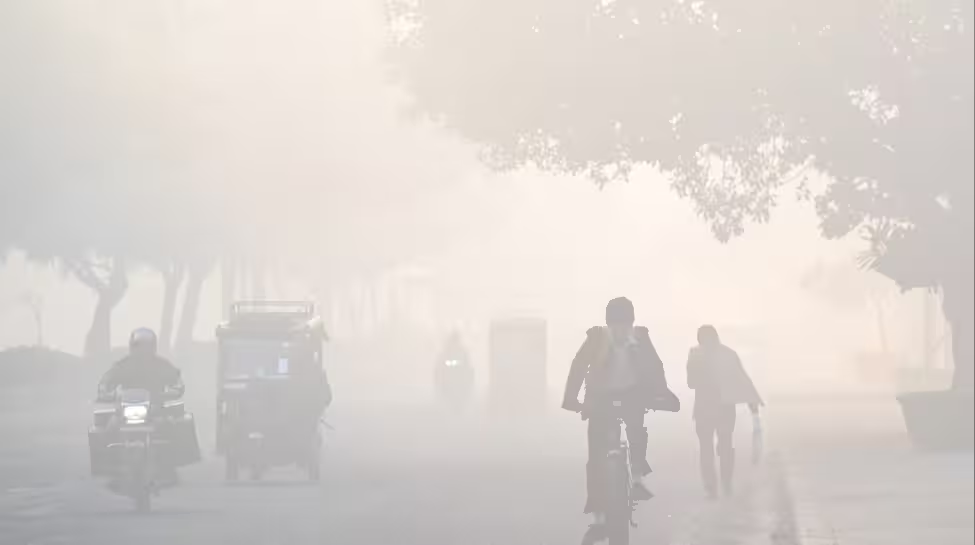
Delhi remained engulfed in heavy pollution on December 28 as air quality hovered on the brink of the ‘severe’ category, with the city’s overall Air Quality Index (AQI) recorded at 391 early in the morning, according to the Central Pollution Control Board (CPCB).
Large parts of the national capital woke up to dense smog, which significantly reduced visibility. Visuals from areas such as Akshardham showed thick haze, where the AQI touched 445, categorized as ‘severe’. Similar conditions were reported near India Gate, with an AQI of 378, placing it in the ‘very poor’ category. Anand Vihar, a known pollution hotspot, again recorded a ‘severe’ AQI of 445.
Data from CPCB monitoring stations indicated widespread pollution across the city. Anand Vihar registered an AQI of 445, ITO 403, Wazirpur 433, Rohini 424, and Patparganj 424, reflecting consistently poor air quality levels.
Add Zee News as a Preferred Source
According to the CPCB classification, an AQI between 301 and 400 is considered ‘very poor’, while readings above 400 fall under the ‘severe’ category. On December 27, most parts of Delhi remained within the very poor to severe range, highlighting the persistence of winter pollution.
Weather Conditions Worsen Pollution
Cold and foggy weather further aggravated the situation. The temperature in Delhi was recorded at 7.6 degrees Celsius at 7 am. The India Meteorological Department (IMD) forecast dense fog during the morning hours on December 28, with the maximum temperature expected to reach around 22 degrees Celsius and the minimum likely to dip to 7 degrees Celsius. Moderate fog is expected to persist from December 29 to December 31, although no formal warnings have been issued for these days.
The IMD issued a yellow alert for Sunday morning, warning of dense fog and cold wave-like conditions, which experts said would restrict wind movement and prevent dispersion of pollutants.
“The wind speed was very low on Saturday. The average speed was around 4–5 kmph, with wind speeds reaching 8–9 kmph only briefly in the afternoon before dropping again by evening. As a result, Delhi saw a spike in pollution,” Mahesh Palawat, Vice President at Skymet, was quoted as saying. He added that similar conditions were likely to persist until January 1 due to the influence of a western disturbance.
NCR Also Affected
Pollution levels remained high across the National Capital Region. In Ghaziabad, Indirapuram recorded an AQI of 394, while Vasundhara stood at 429. Noida reported ‘severe’ air quality, with Sector 125 at 414 and Sector 1 at 443. In Gurugram, Sector 51 recorded an AQI of 355, while Vikas Sadan stood at 304.
According to data from the CPCB’s Sameer app, 20 of Delhi’s 39 active monitoring stations reported ‘severe’ air quality on Sunday morning. These included Anand Vihar (445), Chandni Chowk (415), Jahangirpuri (430), Shadipur (443), and Wazirpur (443). All other stations recorded ‘very poor’ air quality, except NSIT Dwarka, which showed a ‘poor’ AQI of 214.
Outlook And Restrictions
The Air Quality Early Warning System for Delhi (AQEWS) said air quality was likely to remain in the ‘very poor’ category over the coming days.
“The air quality is likely to be in the ‘very poor’ category from Sunday to Tuesday. The outlook for the subsequent six days is that the air quality is likely to remain ‘very poor’,” the bulletin said.
Despite the deteriorating conditions, no additional restrictions were imposed under the Graded Response Action Plan (GRAP). Stages one to three remain in force after Stage four curbs were lifted last Wednesday.
With slow winds and persistent fog forecast, residents across Delhi-NCR are expected to continue facing difficult air quality conditions in the days ahead.

Comments are closed.