
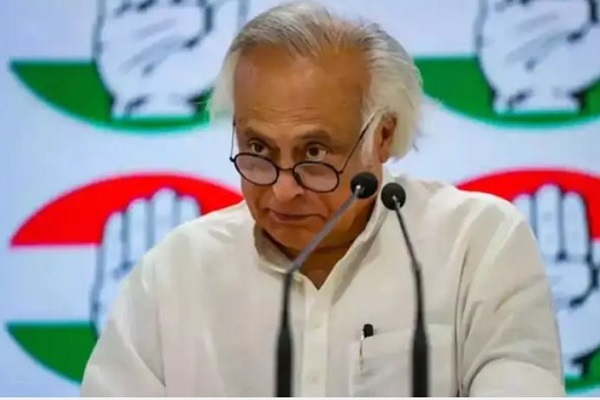
Jairam Ramesh wrote a letter to the Union Environment Minister, raised questions on the ‘new definition’ of Aravalli hills.

New Delhi, 28 December. Senior Congress leader and Rajya Sabha MP Jairam Ramesh on Sunday wrote a letter to Union Environment Minister Bhupendra Yadav regarding the issue of Aravalli hills. He expressed his concerns regarding the new definition of Aravalli hills and asked four questions to the Union Environment Minister in this regard.
Jairam Ramesh said there are a lot of concerns about the new definition of the Aravalli hills, which limits them to landforms 100 meters or more in height. Through the letter, he asked Union Minister Bhupendra Yadav, “Is it not true that the definition of the Aravalli Hills and Range in Rajasthan since 2012 was based on a report of the Forest Survey of India (FSI) dated August 28, 2010?”
Referring to the report, Jairam Ramesh said, “It said that all areas having a slope of 3 degrees or more would be treated as hills. A uniform 100 meter wide buffer would be added on the sloping side to take into account the potential spread as per the hill height of 20 metres. The flat areas, tabletops, depressions and valleys falling within these areas would also be treated as hills.” The Congress leader also referred to an FSI communication dated September 20, which stressed the ecological importance of the small hills.
Quoting FSI Communication, he wrote, “The small hilly structure of Aravali acts as a natural barrier to prevent the formation of desert by trapping heavy sand particles. Thus protecting Delhi and the surrounding plains from sand storms. Since the effect of the barrier against wind-blown sand increases directly with its height, even small hills of 10 to 30 meters act as a strong natural wind break.”
Jairam Ramesh has also questioned the Union Environment Minister citing a report of the Central Empowered Committee (CEC) formed by the Supreme Court. He finally wrote, “Is it not true that this new definition will eliminate many small hills and other land forms and will also break and weaken the geographical and ecological unity of the entire Aravalli hills and ranges spread over four states?”

Comments are closed.