
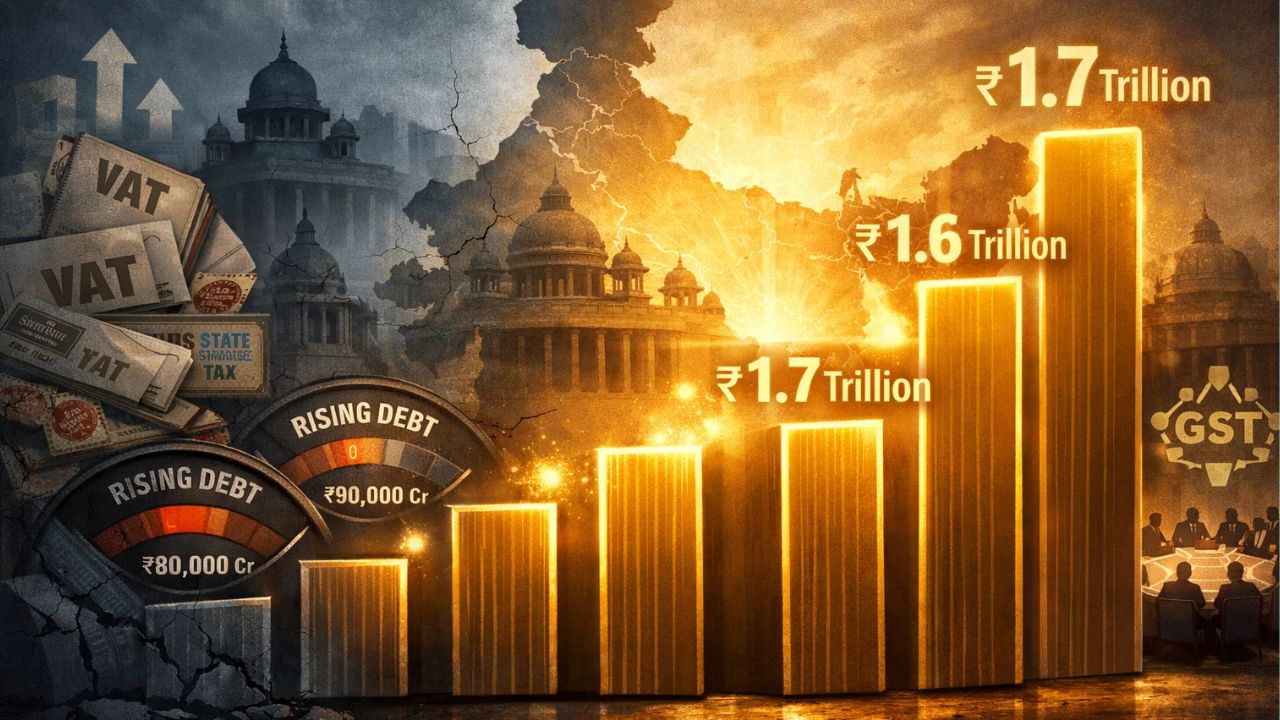

It has been more than eight years since GST was implemented in India. Every month the central government counts new records of GST collection. Sometimes Rs 1.6 lakh crore, sometimes more than Rs 1.7 lakh crore. These figures are said to be proof of the ‘strength’ of the Indian economy. But behind this bright picture there is another, less visible truth and that is that the financial condition of the states is under more pressure than before.
The question is that when tax collection is increasing, then why is the state government short of money? Why is the debt of states increasing? And why are they repeatedly demanding compensation or a higher share from the Centre? The answer lies in the framework of GST and the financial structure changed thereafter.
Also read: ‘Will field 110 Hindus and 90 Muslims’, Humayun Kabir told his election plan
What before GST?
Before the implementation of GST, states had many independent means of increasing their income. VAT, entry tax, purchase tax and local sales tax used to be the backbone of the states’ revenue. According to RBI’s State Finances Report, between 2012–13 and 2016–17, the Own Tax Revenue of the states was growing at an average rate of 14 to 17 percent annually.
During this period, VAT alone contributed 55–60 percent of the states’ tax revenue. States could change tax rates if necessary. That means, if expenditure increased, the states also had a way to increase income. This was the reason why the states were able to carry out their development work by taking relatively less loan.
promise of compensation
While implementing GST on July 1, 2017, states were assured that if their revenue suffers loss due to this new tax system, the central government will guarantee 14 percent annual growth. For this, arrangements were made for GST Compensation, which was to last for five years.
In the initial years, this compensation acted as a security blanket for the states. But during this time it also became clear that the tax growth of the states under GST was not the same as before.
What after GST?
Data from PRS Legislative Research shows that after the implementation of GST, the Own Tax Revenue Growth of the states declined to 7–9 percent. For many years this growth remained close to the inflation rate, due to which real revenue became almost stable.
According to PRS, the revenue to states from taxes subsumed in GST was about 6.5% of GDP in 2015–16, which declined to about 5.5% in 2023–24. This decline is not trivial. If seen in proportion to GDP, the tax hold of the states has weakened.
Big shock of abolition of VAT
Before GST, VAT was the fastest growing tax. In many states, VAT growth was 18–20 percent. After GST, VAT was completely abolished and SGST came in its place, whose growth was on average around 8–10 percent.
That means states lost a high-growth tax and got a low-growth revenue source in its place. This was a structural loss, which was being compensated only by compensation.
Compensation ends, pressure begins
Between 2017–18 to 2021–22, the central government gave approximately lakhs of crores of GST compensation to the states. Even when the states’ expenditure suddenly increased during Covid, this compensation remained their lifeline.
But this arrangement ended in June 2022. After this the bitter truth came before the states. Now they have to depend on the GST system without any guarantee. Whereas earlier 14 percent growth was assured, now actual growth is limited to 8–9 percent.
If the tax base of a state is Rs 1 lakh crore, then at 14% growth it would get Rs 14,000 crore whereas at 8% growth it would get only Rs 8,000 crore. That means there will be a direct loss of about Rs 6,000 crore every year.
Tax collection increased, but whose?
GST collection may be setting records, but its benefits are not distributed equally. The central government has rapidly increased the use of cess and surcharge in the last few years. In 2023–24, their share in the total taxes of the Center will reach 18–20 percent.
The problem is that states do not get any share in these taxes. According to experts, if these taxes were shared like normal taxes, states could have got an additional ₹2–3 lakh crore every year. This reinforces the perception that the tax system is becoming more centralized.
lack of financial independence
Before GST, the share of Own Tax Revenue in the total revenue of the states was 48–50 percent. After GST it came down to 40–42 percent. That is, the dependence of the states on transfers and borrowings from the Center increased.
This decline is not just of statistics, but also of freedom of policy-making. Now states cannot make tax policy according to their needs.
Expenses increased, not resources.
The responsibilities of the states did not reduce after GST. Expenditure in areas like health, education, social security, agricultural assistance and law and order has increased continuously. The Covid pandemic increased this pressure manifold.
But due to limited sources of income, states started taking loans. According to RBI, the debt-to-GSDP ratio of many states has reached above 30–35 percent.
Voice of states suppressed
The GST Council was touted as a platform for cooperative federalism, but the experience of many states has been different. States have limited options in decisions like changing tax rates or removing exemptions. The voices of small and financially weak states are often suppressed.
Also read:‘We are not safe’, Unnao case victim said on stay on Kuldeep Sengar’s sentence
In this way GST simplified the tax system, there is no doubt about it. Tax evasion decreased and the formal economy increased. But it is also true that after GST, the financial position of the states has not become stronger but has become more fragile.
Tax collection has increased, but the pace of income of the states has slowed down. Compensation has been eroded, control over tax policy is limited and the expenditure burden is increasing.
Unless states are given more flexibility in the GST structure or a new system of compensation or share on Cess-Surcharge, the question will remain whether GST strengthened or weakened India’s federal structure.

Comments are closed.