
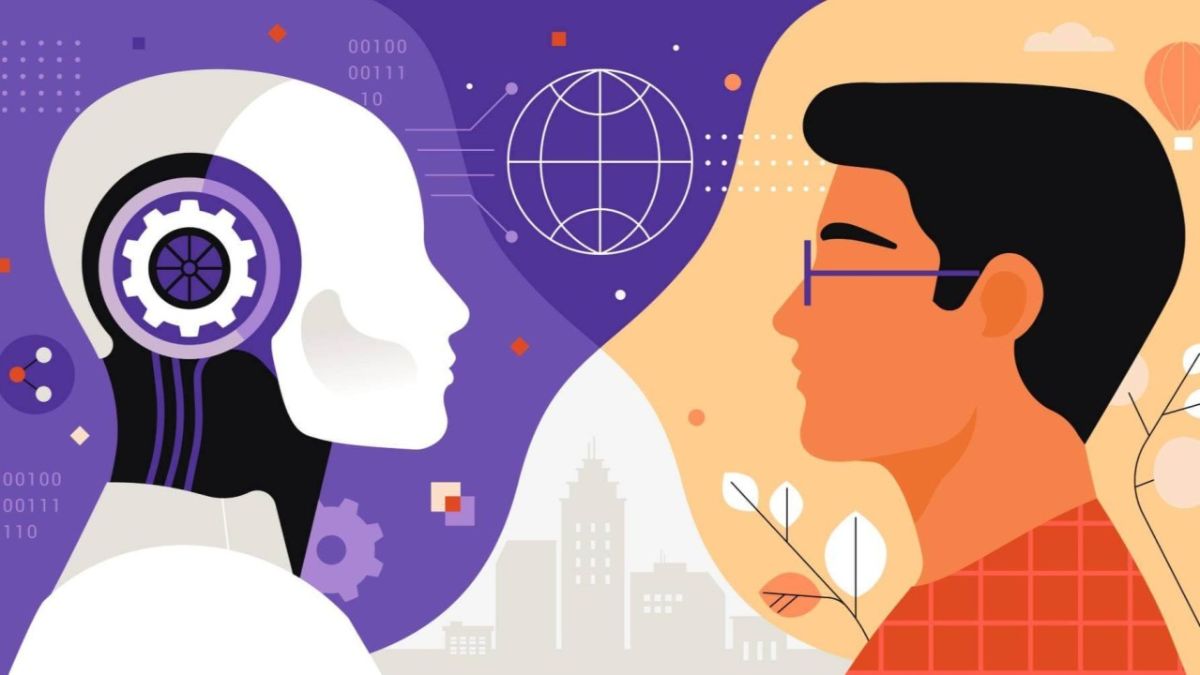

Ever wondered how artificial intelligence stacks up against the real thing—human intelligence? You’re not alone. With AI becoming smarter by the day, it’s natural to ask: can machines think like us? Are they catching up, or are humans still way ahead?
Let’s walk through the key concepts, differences, and how both forms of intelligence play a role in today’s world.
Meaning
Let’s start with the basics—what each really means.
Human intelligence is the natural ability of the human brain to learn, reason, solve problems, use language, and adapt to new situations. It comes from biology, evolved over millions of years.
Artificial Intelligence (AI) is the simulation of human intelligence in machines, allowing them to perform tasks like decision-making, learning, and problem-solving—usually based on large amounts of data.
In simple terms: one is organic, the other is programmed.
Learning
Humans learn through experience, observation, emotion, social interaction, and even failure. It’s a mix of logic, memory, intuition, and feelings.
AI learns from data. Tons of it. Through methods like machine learning and deep learning, AI systems identify patterns and make predictions or decisions.
| Feature | Human Intelligence | Artificial Intelligence |
|---|---|---|
| Learning style | Experience + emotion | Data + algorithms |
| Speed | Slower but deeper | Fast but limited to inputs |
| Flexibility | Highly adaptable | Task-specific (mostly) |
Humans can switch between tasks, think creatively, and know context. AI? Not so much—at least not yet.
Memory
Humans have long-term and short-term memory, and we often forget things. Our memory is linked to emotion and meaning.
AI has near-perfect memory—as long as it has storage. It can recall massive datasets instantly, but it doesn’t “know” the information like we do. It remembers, but it doesn’t truly know.
Emotions
This one’s easy: humans have them, AI doesn’t.
Emotions affect how we think, react, and make decisions. While AI can be trained to detect or mimic emotions (like chatbots sounding empathetic), it doesn’t feel anything.
That’s a big difference. Emotions guide human ethics, creativity, and relationships—areas AI still can’t touch.
Creativity
Humans create music, art, poetry, and new ideas from scratch. That spark of originality is deeply tied to emotion, culture, and consciousness.
AI can generate content too—images, songs, and even stories. But it’s based on what it’s already seen or been trained on. So, is it truly creative or just remixing?
Right now, AI is more like an advanced collage artist than a true visionary.
Decision
Humans make decisions based on logic, emotion, intuition, ethics, and social norms. We consider abstract ideas like morality and future consequences.
AI makes decisions based on pre-defined rules or learned patterns in data. It’s rational and fast—but lacks context and ethics unless we build it in.
This is why AI can struggle with ethical dilemmas or nuanced human situations.
Limitations
Here’s a quick look at some limitations of both:
| Factor | Human Intelligence | Artificial Intelligence |
|---|---|---|
| Speed | Slow processing | Processes data instantly |
| Emotions | Can cloud judgment | No emotion, purely logical |
| Memory | Imperfect, forgetful | Accurate, unlimited (mostly) |
| Fatigue | Needs rest | Runs 24/7 |
| Creativity | Original, abstract | Mimics existing patterns |
| Adaptability | Extremely flexible | Task-specific, less general |
Both sides have strengths and weaknesses. Together, they can be a powerful combo.
Future
AI is evolving fast. We now have models that can write code, have conversations, drive cars, and even generate human-like images. But they still lack consciousness, emotion, and true general intelligence.
The future will likely see AI as a tool—not a replacement. Think of it as your smart assistant, not your twin.
Humans bring judgment, values, and creativity. AI brings speed, data, and automation. Together, they’re redefining how we work, learn, and live.
While AI may outperform humans in specific tasks, it still can’t match the depth, emotion, and complexity of human thought. And honestly, that’s a good thing.
FAQs
Is AI smarter than humans?
AI is faster in tasks but lacks human depth or emotion.
Can AI feel emotions?
No, AI can mimic but not truly feel emotions.
Do humans learn better than AI?
Humans learn through experience; AI learns from data.
Will AI replace human intelligence?
AI complements, not replaces, human intelligence.
Who is more creative: AI or humans?
Humans are more original; AI imitates patterns.

Comments are closed.