
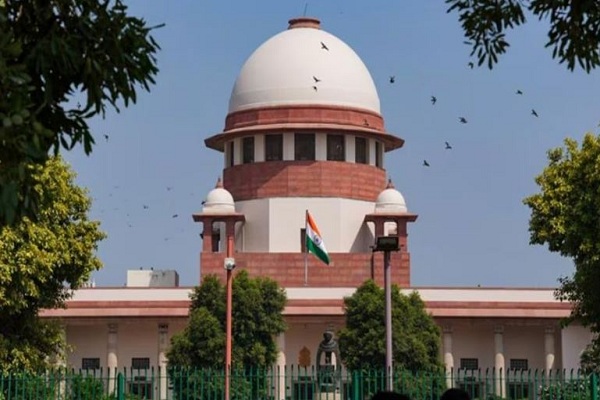
Supreme Court takes suo motu cognizance of Aravali Hills case, CJI led bench will hear on Monday

New Delhi, 28 December. The Supreme Court has taken suo motu cognizance of the concerns raised by the recent change in the definition of Aravalli Hills. There is a fear that uncontrolled mining could lead to serious environmental damage. The vacation bench of the Chief Justice of India (CJI) Justice Surya Kant, Justice JK Maheshwari and Justice AG Masih will consider the case on Monday.
Environmental experts expressed concern
The apex court’s intervention comes after public protests and environmental concerns over the changed definition of the Aravalli hills. The area is known for its ecological importance and its role in preventing desertification and maintaining groundwater levels. Environmental experts and civil society organizations have raised concerns that the change in definition could legalize mining and construction activities in already protected areas.
SC had given a new definition on the recommendations of the committee constituted by the Central Government.
Last month, the Supreme Court had approved the October 13 proposal to redefine the Aravalli range. Under this definition, only landforms 100 meters or more higher than the surrounding land will be considered part of the Aravalli Hills. Apart from this, if two or more hills are located within a radius of 500 meters of each other, then they will also be considered part of the Aravalli range.
New political controversy erupted after the definition decided by the Supreme Court
This definition was given by the apex court on the basis of the recommendations of a committee constituted by the central government, after which a new political controversy has arisen across the country. The opposition claims that this move will lead to unhindered mining and environmental damage in the 650 km long hill range from Delhi to Gujarat. There are movements across the country to save Aravali.
It is noteworthy that due to different definitions of Aravalli hills and mountain ranges in the states of Delhi, Haryana, Rajasthan and Gujarat, regulatory deficiencies and illegal mining were taking place. To resolve this, the Supreme Court had earlier formed a high-level committee.
Subsequently, in its judgment delivered in November, a bench of then Chief Justice BR Gavai and Justices K Vinod Chandran and NV Anjaria had accepted the operational definition suggested by the committee of the Ministry of Environment, Forest and Climate Change for the Aravalli hills and mountain ranges in the context of mining.

Comments are closed.