
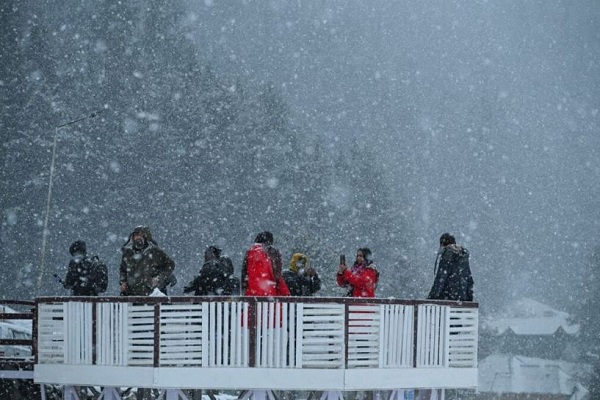

Srinagar, 28 December. There is a possibility of light rain and snowfall in many parts of Jammu and Kashmir from December 30 to January 1. The Meteorological Department has given this information in a bulletin issued on Sunday. In this sequence, it is expected to remain cloudy till Monday. Light rain/snowfall at many places and moderate snowfall over central and northern parts of Kashmir Valley are expected on December 31 and January 1.
Minimum temperature above zero in Srinagar city on Sunday
Meanwhile, the minimum temperature in Srinagar city went above zero on Sunday. The minimum temperature was 0.8 degrees Celsius in Srinagar, minus 2.2 in Gulmarg and minus 1.8 degrees Celsius in Pahalgam. At the same time, the minimum temperature was 8.1 degrees Celsius in Jammu city, 8.2 in Katra, 6.9 in Batote, 4.5 in Banihal and 1.6 degrees Celsius in Bhaderwah.
,‘Chillai Kalan’ 30 till january, Reservoirs fill with heavy snowfall
The 40-day period of severe cold, known locally as ‘Chillai Kalan’, began on December 21 and will end on January 30. It is the heavy snowfall at Chillai Kalan that fills Jammu and Kashmir’s perennial water reservoirs in the mountains. These perennial reservoirs feed many rivers, streams and lakes during the summer months. No snowfall during Chillai Kalan is a disaster, as it indicates drought during the summer months.
Excitement of snowfall in the valley on New Year, hotels full
During ‘Chillai Kalan’ people eagerly wait for snowfall. Since people celebrating New Year’s Eve are coming to the valley these days, all the hotels in Srinagar, Gulmarg and Pahalgam are fully booked. People are eagerly waiting for good snowfall on New Year’s Eve to make their holidays memorable.
Those long nights… when roads remained closed for days due to heavy snowfall
The elders of Kashmir still remember those long nights of Chillai Kalan, when they would wake up in the morning to see heavy snowfall outside. The snowdrops hanging from the edges of the roof created an iridescent sight as the sunlight passing through those drops split into different colors. In those days, roads remained closed for several days due to heavy snowfall and the local people depended on vegetables grown in their homes, eggs from small chickens present in every house and milk from the cows reared by themselves.

Comments are closed.