
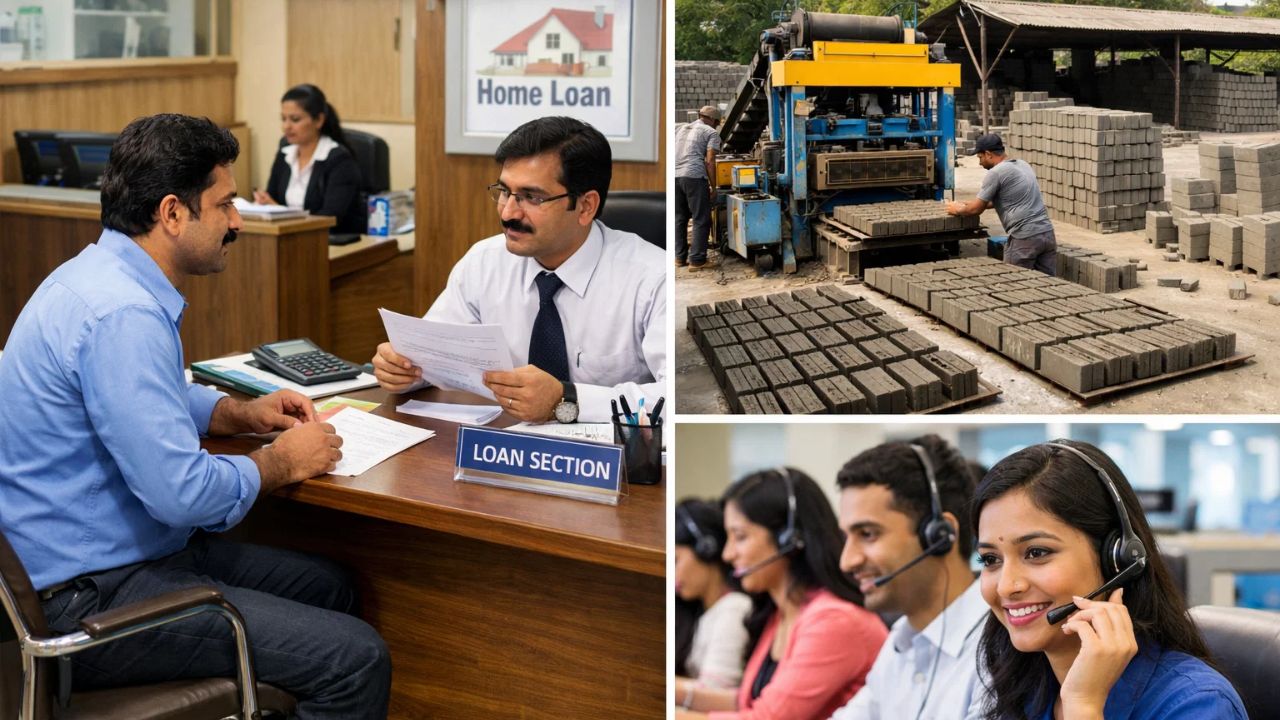

Unemployment in India is not only an economic problem but also a cause of social imbalance. Every year, a large number of youth complete their education and enter the labor market in search of a job, but due to limited opportunities in the government and private sector, not everyone gets permanent employment. Keeping this challenge in mind, the Government of India promoted self-employment based schemes, so that the youth can not only earn their livelihood by becoming entrepreneurs themselves but can also provide employment to others. Prime Minister’s Employment Generation Program i.e. PMEGP is the practical form of this thinking. The basic objective of this scheme is to help unemployed youth and traditional artisans to set up micro enterprises i.e. micro industries by providing financial assistance, thereby creating employment opportunities in both rural and urban areas.
PMEGP scheme was started in the year 2008. It is implemented by the Khadi and Village Industries Commission under the Ministry of Micro, Small and Medium Enterprises of the Central Government. This scheme was created by combining the already running Pradhan Mantri Rozgar Yojana and Rural Employment Generation Programme, so that the policies related to self-employment can be integrated and made effective. The biggest feature of PMEGP is that the government does not provide direct cash assistance, but provides support to the beneficiary through a subsidy model linked to bank loan. In technical language it is called credit-linked subsidy scheme.
this also Read: How to get the money lying in the account of deceased parents? know the method
What is the purpose?
The main objective of this scheme is to encourage the establishment of new micro enterprises in the country. The government believes that small and micro industries have the potential to generate more employment with less capital as compared to big industries.
Through PMEGP, special emphasis has been laid on setting up industries in rural areas using local resources and skills, so that migration of rural population to cities is reduced. Along with this, social inclusion is also promoted by giving priority to Scheduled Castes, Scheduled Tribes, Other Backward Classes, women and disabled people.
Which enterprises out?
Under PMEGP, enterprises can be set up in both manufacturing and service sectors. The manufacturing sector includes industries like food processing, incense sticks, candles, furniture, readymade garments, soaps, detergents, paper products, plastic products. In the service sector, businesses related to mobile repairing, computer centre, beauty parlor, transport service, dhaba, cafe, tailoring unit and other local needs are allowed. However, due to social and moral reasons, businesses like liquor, tobacco, pan-masala, gambling and betting have been kept out of the scheme.
What is the eligibility?
Talking about eligibility, to apply under PMEGP, the minimum age of the applicant should be 18 years and no maximum age limit has been fixed, so that people of older age can also avail its benefits. Generally, there is no requirement of any special educational qualification, but if a person wants to invest in a project worth more than Rs 10 lakh in the manufacturing sector or a project worth more than Rs 5 lakh in the service sector, then it is necessary for him to have at least 8th pass.
Under this scheme, individual entrepreneurs, self-help groups, cooperative societies and trusts can also apply with certain conditions. However, people who have previously availed subsidy under any other government self-employment scheme are not eligible.
this also Read: ‘Anil Ambani, Rana Kapoor has YES Bank applied 3300 Cr Of Lime‘, ED made allegations
Loan up to how many lakhs will be available?
Under the PMEGP scheme, it has also been determined that a total project worth up to how many lakhs can be set up? The maximum project cost in the manufacturing sector has been capped at Rs 50 lakh, while in the service sector this limit is Rs 20 lakh.
Machinery, raw materials, working capital and other necessary expenses are included in the project cost. A part of this cost has to be borne by the beneficiary himself, which is called beneficiary contribution. This contribution is fixed at 10 percent for general category and 5 percent for special categories.
How much subsidy will you get?
The most important aspect of this scheme is its subsidy structure. General category beneficiaries in rural areas get subsidy up to 25 percent of the project cost and 15 percent in urban areas. Whereas Scheduled Castes, Tribes, Other Backward Classes, women and disabled beneficiaries are provided subsidy up to 35 percent in rural areas and 25 percent in urban areas.
This subsidy is not given directly to the beneficiary, but is adjusted in the loan account sanctioned by the bank, so that it is used only for enterprise establishment. That means, if a woman, Scheduled Caste/Tribe, Other Backward Class takes a loan of Rs 50 lakh, she will get a subsidy of up to Rs 16-17 lakh.
How to apply?
The application process is completely online, due to which an effort has been made to increase transparency. Interested applicants have to apply by visiting the official website of Khadi and Village Industries Commission. A detailed project report has to be uploaded along with the application, giving complete details of the nature of the business, cost, potential income and the type of employment to be done.
The application is then scrutinized by the District Industries Center or KVIC. Once the investigation is complete, the applicant is interviewed and field verified. Entrepreneurship development training has also been made mandatory before the loan is sanctioned by the bank, so that the beneficiary can have a basic understanding of business operations.
More loans in rural areas
If we look at the figures, the scope of PMEGP scheme has been quite wide. Since 2008, lakhs of micro industries have been established under this scheme and crores of people have got direct and indirect employment. According to government estimates, each PMEGP unit employs three to four people on an average. The share of this scheme in rural areas has been higher as compared to urban areas, which makes it clear that this scheme has become an important medium of rural employment generation.
there are some challenges too
Although PMEGP has many benefits, it also comes with some challenges. Many times there is delay in loan approval at the bank level, which causes problems to the beneficiaries. In some cases, businesses do not prove to be sustainable due to poor quality of project reports. Moreover, many units close down in the initial years due to lack of market linkages and marketing support. Training programs are also often described as theoretical, lacking practical guidance.
Despite this, the role of PMEGP is quite important in the context of Self-reliant India campaign. The scheme promotes local production, economically empowers small entrepreneurs and contributes to social sustainability through employment generation. If the banking process is further simplified, training is made more practical and stronger market linkage mechanisms are developed, PMEGP can become a strong model of self-employment based development in India.
Also read: Shares rose 38% as soon as it was listed, which is this company that made it rich?
In this way PMEGP scheme provides a real opportunity for those who want to start their own business despite limited resources. Due to subsidy in this scheme, it has proved to be a big incentive for the youth and entrepreneurs. There are definitely some practical problems but yes, if they are resolved and implemented at the ground level, it will prove to be very convenient and beneficial.

Comments are closed.