
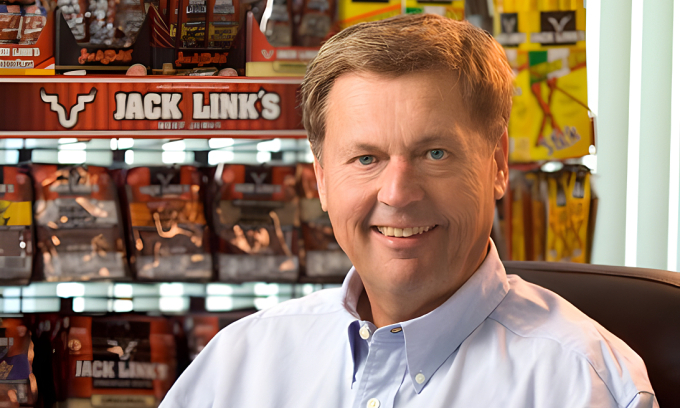

On a hunting trip with his teenage sons in 1985, Jack Link stopped at a convenience store in Wisconsin and was struck by the high price of jerky.
‘Wow, that’s quite a lot of money,’” Jack Link, now 79, tells Forbes.
Jack Link, founder and chairman of Jack Link’s. Photo courtesy of the company |
Jack Link soon realized he could make jerky himself, using ovens that were still sitting idle at the shuttered plant of his family’s meatpacking operation that had previously gone bankrupt.
“So we laid some jerky in there and it came out just wonderfully,” he says. “And that’s where it all began.”
Using a recipe passed down from his German immigrant great-grandfather in the 1880s, Link’s jerky took off.
Today, Jack Link’s is the top-selling jerky brand in the United States, with an estimated $2 billion in annual revenue and about 34% of the U.S. meat snacks market, enough to make its founder a billionaire.
“The jerky was there all the time to save me,” says Link, who still lives in the same Wisconsin home where his children were raised.
Jack Link’s products are now sold in more than 200,000 stores across the U.S. and in 55 countries, with annual production exceeding 800 million packages.
The company dominates the $9 billion global meat snack market, which has drawn roughly $1 billion in investment over the past decade, along with several nine-figure acquisitions.
Jack Link, however, worked hard to ensure the business remains family-owned. In 2013, leadership passed to Jack’s younger son, Troy, now 53, who became CEO as his father took on the chairman role.
Competition is fierce, Troy says, but growth opportunities remain. “Believe it or not, we still have a lot of opportunity.”
One private equity investor notes that it is “a business you would love to own, but you wouldn’t want to buy it based on what the owners think it’s worth.” Forbes estimates its value at $4 billion.
With meat costs rising, Troy says: “We’re able to hold our breath… They’re not going to stay this way forever. The question is, how long can we hold our breath and how purple will our face get?”
 |
Jack Link (L) and his son Troy Link, CEO of Jack Link’s. Photo courtesy of the company |
After graduating from the University of Wisconsin–Stout, he returned to a profitable but still regionally focused business in 1993.
A key breakthrough came in the early 1990s, when Jack Link’s marketed beef sticks alongside cheese sticks, triggering demand that outpaced production.
Minong, Wisconsin – home to about 500 people – soon became dotted with other Link family businesses, including dealerships and retail stores. The family also owns significant ranch and farmland in the area, and Jack still maintains a cattle herd.
Troy later transformed the business by pushing into bagged beef jerky, a concept few believed would work.
“No one thought a $5 item could sell,” he recalls. Despite concerns over capital, Troy devised a low-cost launch, and in 1997 Jack Link’s became the first brand to sell jerky in resealable bags. Sales surged as Walmart and Target took on the product.
“From the moment we had it, we couldn’t produce enough,” Troy says.
Bagged jerky now accounts for more than half of total revenue, boosting profitability and enabling broader distribution, including at Costco and Bass Pro Shops.
Troy became president in 2003, and the following year his older brother, Jay, left the company amid disputes that led to protracted litigation. Despite the legal turmoil, sales continued to climb.
By the time Troy became CEO in 2013, revenue had topped $1 billion annually.
“We’ve got more competitors and better competitors than ever before,” Troy says.
To keep pace, Jack Link’s expanded further, acquiring Unilever’s meat snack division and pushing into Europe. Some rivals struggled – Krave later had to be rebuilt under its founder – while others, such as Stryve, faltered after going public.
“There’s been a lot more people that have come in and failed than people that have come in and succeeded,” Troy says. “Now we have to produce more revenue with less space.”
Among fast-growing challengers are Chomps, with an estimated $400 million in annual revenue, and Archer, projected to reach $300 million this year.
Troy believes that meat snacks are “more relevant today than they’ve ever been,” with the industry expected to grow about 11% annually over the next five years.
To attract younger consumers, Jack Link’s this year partnered with YouTube star MrBeast on meat stick products, drawing many first-time buyers, according to Bloomberg.
The company has also invested heavily in meat sticks, including a $450 million factory in Georgia dedicated solely to sticks of meat and cheese, capable of producing up to 820,000 units a day.
Looking ahead, Troy says Jack Link’s will stay in family hands, with the next generation potentially joining the business.
As for Jack Link’s own vision of the future, he puts it simply: “Well, bigger is better.”

Comments are closed.