
Threat To US Dominance? Here’s How China’s Low Cost, High Tech Stealth Fighters Are Challenging American F-35, French Rafale Supremacy | world news

China Stealth Fighter Jets: Beijing is changing the global fighter jet market with a strategy that combines affordability, flexible financing and almost no political strings. While the United States, France and Russia continue to dominate, China is positioning itself as a serious contender, which I trying to become a major exporter of combat aircraft.
The Pentagon admitted in its annual report to Congress on China’s military. The report was released on December 23, 2025. It says that China is marketing three of its advanced aircraft for export, targeting countries looking for capable jets without the geopolitical baggage attached to Western systems.
According to the report, China ranked as the fourth-largest arms supplier in the world as of December 2024, leveraging state-run companies such as the Aviation Industry Corporation of China (AVIC) and the North Industries Corporation (NORINCO) to reach buyers worldwide.
Add Zee News as a Preferred Source
“Arms transfers are a component of China’s foreign policy and complement assistance and initiatives that are part of the Belt and Road Initiative,” the report said.
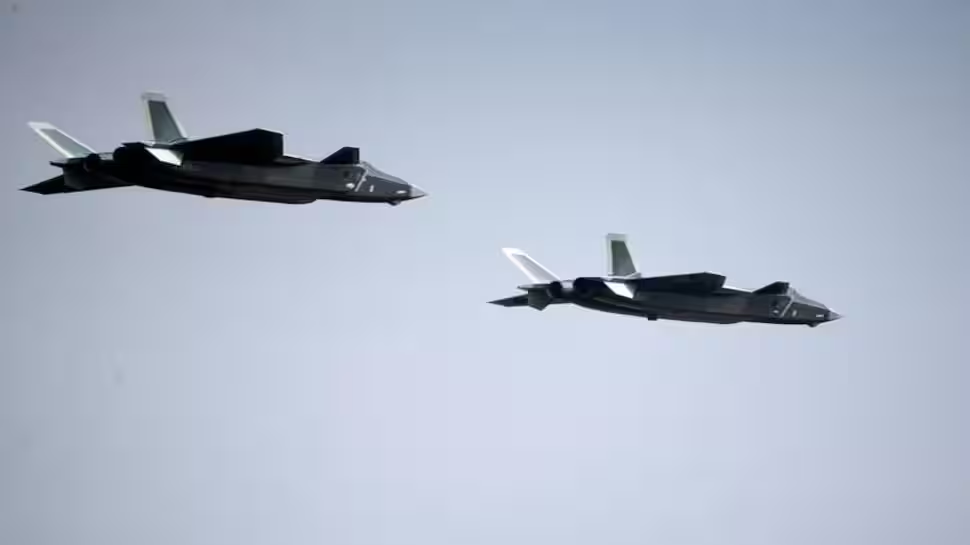
China’s fighter fleet already includes some of the most advanced aircraft globally. It includes the stealthy J-20 and J-35, the J-16 flanker touted as among the world’s best and the homegrown J-10 series. Prototypes of sixth-generation fighters, the J-36 and J-50, are also in flight testing.
Despite this, China’s export focus has been limited, with drones achieving far greater international sales.
For exports, the country is promoting the fifth-generation FC-31, the fourth-generation J-10C multirole fighter and the co-produced JF-17 light combat aircraft with Pakistan. The FC-31 has generated global attention, particularly after reports suggested Pakistan would soon begin receiving the stealth fighter, although official confirmations are absent.
Meanwhile, the J-10C has been delivered in part to Pakistan, with about 20 of 36 aircraft received as of May 2025. The JF-17 has reached Azerbaijan, Myanmar and Nigeria, with ongoing discussions in Iraq.
China’s strategy is to offer advanced aircraft at 40-50% lower costs than Western equivalents, provide quick delivery timelines and remove political conditions that often accompany the United States or French sales.
Analysts point out that countries like Egypt and Iran are especially receptive, with long-standing delays from Russian suppliers leaving gaps China is keen to fill.
Priced at $40-50 million per unit, the J-10C is being positioned as a competitive alternative to the US F-16, France’s Rafale and the Eurofighter Typhoon. Chinese marketing efforts even highlight its supposed success in past conflicts, including claims during the May 2025 Indo-Pakistan clashes that J-10Cs engaged and downed Rafale jets, an assertion India disputes.
For nations unable to access the F-35 due to US export controls, the Chinese J-35 (FC-31) is offered as a stealth-capable alternative. The report highlights potential buyers in the Middle East, where American restrictions have angered nations like the United Arab Emirates (UAE), prompting them to turn to France and China for advanced fighters.
While the United States continues to dominate the fighter export market with the F-35, F-16 and F-15, China’s low-cost and high-tech offerings are eroding market advantages, particularly in politically sensitive or cost-constrained regions.
By offering competitive pricing, rapid delivery and minimal restrictions, China is building a new path to influence global air forces and potentially changing the balance of power in the fighter jet market for decades to come.

Comments are closed.