
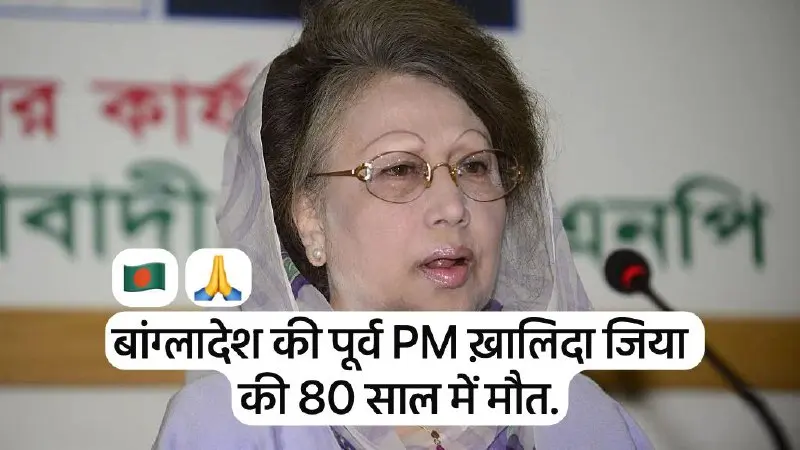

An important chapter of Bangladesh politics ended today. The country’s former and first woman Prime Minister Khaleda Zia has passed away at the age of 80. He breathed his last at 6 am on Tuesday. Khaleda Zia’s life is an extraordinary story of her rise from an ordinary housewife to the most powerful political position in the country. She was the head of the Bangladesh Nationalist Party (BNP) and held the post of Prime Minister twice in her political career.
The journey from ‘shy housewife’ to taking charge of the party after the murder of her husband.
Khaleda Zia’s husband Ziaur Rahman was one of the leading leaders of Bangladesh’s independence struggle, who became the country’s President in 1977. During that period, Khaleda Zia was far away from politics and was known as a ‘shy housewife’ who was completely dedicated to raising her two sons. But destiny had decided something else for him. In 1981, some army officers murdered her husband Ziaur Rahman in Chittagong. Circumstances brought Khaleda Zia, who had no interest in public life till the death of her husband, to the center of politics. After the death of her husband, she became a member of BNP and later took over the leadership of the party.
Fighting for democracy against military dictatorship and becoming the second female ruler of a Muslim country.
In the year 1982, a period of military dictatorship began in Bangladesh which lasted for nine years. During this period, Khaleda Zia fought from the streets to the Parliament for the restoration of democracy. The army conducted elections from time to time, but Khaleda kept her party away from these elections, alleging rigging. Due to her tough stance, she was also put under house arrest, but she did not give up and kept gathering public support through rallies. Ultimately the army had to bow down. Khaleda Zia’s party emerged as the largest party in the fair elections held in 1991 and she became the first woman Prime Minister of Bangladesh. She was the second woman in the world to lead any Muslim country.
Historic steps taken to improve education and empowerment of women
After assuming power, Khaleda Zia made many major changes in the system of the country. He strengthened the parliamentary system while reducing the powers of the presidency. In his first term, he took the historic decision to make primary education compulsory and free for all. However, five years later, she lost the election to her rival Sheikh Hasina’s Awami League, but made a strong comeback in 2001. By forming an alliance with Islamic parties, they captured two-thirds of the seats in Parliament. In his second term, laying emphasis on women empowerment, he introduced a constitutional amendment to reserve 45 seats for women in Parliament and launched a special campaign to increase women literacy.
Jail sentence on corruption charges and legal relief after 2024 rebellion
Khaleda Zia’s last political phase was full of turmoil. In October 2006, he stepped down before the elections, but as violence broke out in the country, the military had to intervene and the elections were postponed. The interim government formed after this started taking strict action against corruption. A year later, Khaleda Zia was arrested on charges of extortion and corruption. He spent several years in prison and house arrest. However, following the massive mass uprising in Bangladesh in 2024 that ousted Sheikh Hasina from power, all charges against Khaleda Zia were dropped.
Story of birth in West Bengal and marriage with an army officer at the age of 15
Begum Khaleda Zia was born in 1945 in West Bengal, undivided India. After the partition of 1947, his family moved to East Pakistan (now Bangladesh). At the age of just 15, she was married to Ziaur Rehman, who was a young army officer at that time. In 1971, Ziaur Rahman rebelled against the Pakistani army and declared the independence of Bangladesh. Later in 1977, while serving as Army Chief, he declared himself President and re-established political parties and media in the country. Carrying forward her husband’s legacy, Khaleda Zia left her indelible mark in Bangladesh politics.

Comments are closed.