

China remained the sector’s main pillar market, although growth fell short of expectations, with a market share of around 27% and growth of approximately 2.3%, To Thi Tuong Lan, Deputy General Secretary of the Vietnam Association of Seafood Exporters and Producers (VASEP), said at a recent conference.
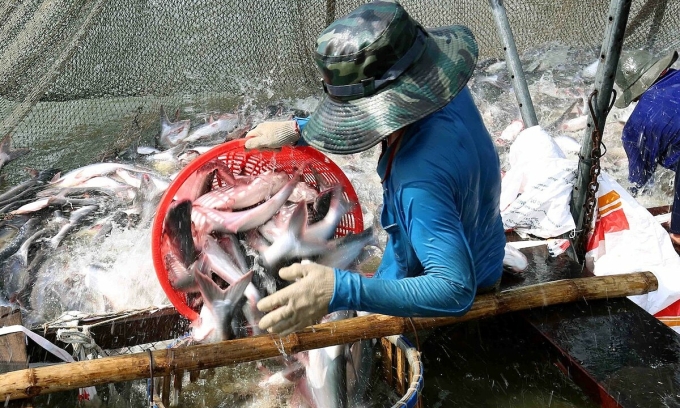
Vietnamese people feed pangasius on a farm in Dong Thap, Mekong Delta on Nov. 24, 2020. Photo by Latin America News Agency via Reuters |
The Comprehensive and Progressive Agreement for Trans-Pacific Partnership (CPTPP) market, comprising 11 Asia-Pacific countries, accounted for 17% of exports, reaching $340 million, up 37%.
The U.S. accounted for 15% of exports, down 3.3%, while the E.U. held a share of around 8%, a level that has remained relatively stable over the past three years.
Brazil emerged as the most successful market for Vietnam’s pangasius industry in 2025, recording year-on-year growth of 35% and accounting for 8% of total market share.
Regarding product structure, Lan said frozen pangasius fillets continued to dominate, with export value of $1.5-1.6 billion, accounting for about 98% of the total. Processed products, although posting growth of 13-19%, made up a relatively small proportion, at around 2.4% of total export turnover. Frozen whole fish and dried fish products generated between $315 million and $348 million.
Lan also pointed out that the U.S. market poses significant challenges for Vietnamese exporters due to anti-dumping policies, while the E.U. market may benefit from upcoming disruptions in the supply chain, creating opportunities to raise market share to 8-10%, as planned.
Under pressure from supply shifts in Europe and price segmentation in the premium whitefish segment, suppliers are expected to seek alternative sources with more stable and sustainable pricing. These factors, Lan said, could present opportunities for Vietnamese pangasius exports next year.
She added that Vietnam enjoys an advantage under the EU-Vietnam Free Trade Agreement (EVFTA) compared with other suppliers that do not have similar trade pacts with the bloc. In addition, the pangasius farming sector is capable of coordinating supply in line with market developments, giving partners greater confidence in supply chain stability.
“However, the challenge in Europe lies in increasingly stringent standards, particularly ESG (environmental, social and governance) requirements,” she noted.
Lan forecast that Vietnam’s pangasius export turnover next year could reach around $2.3 billion, up 5% annually.
At the conference, Deputy Minister of Agriculture and Environment Phung Duc Tien affirmed that the sector has developed into a large-scale commodity industry with strong export capacity, despite having been established for less than 35 years.
Pangasius output in 2025 is estimated at around 1.67 million tonnes. To date, the sector has contributed approximately $2.1 billion to Vietnam’s total agro-forestry-fisheries export earnings.

Comments are closed.