
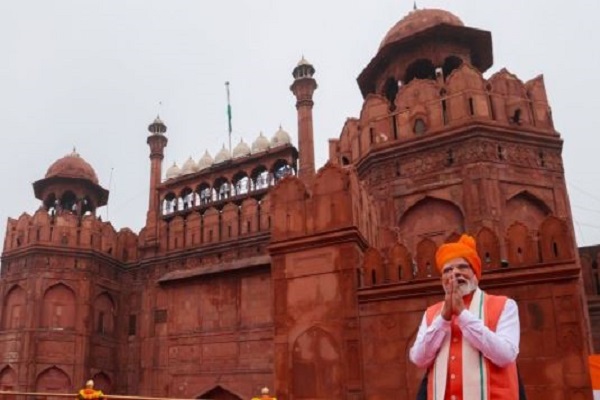
PM Modi said – The primary engine of India’s ‘Reform Express’ is the youth population and the courage of the people.

New Delhi, 30 December. Prime Minister Narendra Modi on Tuesday said that the primary engine of India’s ‘Reform Express’ is the country’s demography, our young generation and the indomitable courage of our people. In a post on professional social media platform ‘LinkedIn’, PM Modi wrote that 2025 has been very important in terms of reforms in every sector and this has given momentum to the country’s development journey and has also promoted the efforts towards a developed India.
2025 of historical changes in LinkedIn but gave information to the public
PM Modi wrote in the post, ‘2025 will be remembered for India as a year when the government focused on reforms as a sustained national mission based on the achievements made in the last 11 years. We modernized institutions, simplified governance, and strengthened the foundation for long-term, inclusive growth. These reforms aim to enable citizens to live a life of dignity, enable entrepreneurs to innovate with confidence and inspire institutions to act with clarity and trust.
All these reforms will make India a transparent, Will lead to technology-based tax administration
He further wrote in the post that GST 2.0 has reduced the number of tax slabs to two – 5 percent and 18 percent. This has reduced the tax burden on MSMEs, farmers and common people along with high labor intensive sectors. Additionally, the government has made income tax zero on those earning up to Rs 12 lakh. A large number of people have benefited from this. At the same time, the government has replaced the old Income Tax Act 1961 with the Income Tax Act 2025. All these reforms together will lead India towards a transparent, technology-based tax administration.
India has boarded the Reform Express!
2025 witnessed pathbreaking reforms across various sectors which have added momentum to our growth journey. They will also enhance our efforts to build a Viksit Bharat.
Shared a few thoughts on @LinkedIn
— Narendra Modi (@narendramodi) December 30, 2025
Turnover limit for small companies now fixed at Rs 100 crore
PM Modi said in the post that the turnover limit for small companies has now been fixed at Rs 100 crore. This has reduced the compliance burden on many small companies.
Apart from this, 100 percent FDI has been allowed in insurance companies. This will increase competition and people will be able to get better products. Securities Market Code Bill has been introduced in the Parliament. This will improve governance norms in SEBI, enhance investor protection, reduce compliance burden and enable technology based securities market for a developed India.
5 historic maritime laws passed in monsoon session
At the same time, five historic maritime laws were passed in the same session of Parliament (Monsoon session), which includes the Bill of Lading Act, 2025; Goods Transportation Bill, 2025; Coastal Shipping Bill, 2025; Merchant Shipping Bill, 2025; and the Indian Ports Bill, 2025. These improvements simplify documentation, ease dispute resolution and reduce logistics costs. Also, the old laws of 1908, 1925 and 1958 have also been replaced.
New Zealand, with Oman and UK signing of fta
Additionally, India has signed Free Trade Agreements (FTAs) with New Zealand, Oman and the UK. This will benefit investment, employment opportunities and local industries. Additionally, the Free Trade Agreement (FTA) with the European Free Trade Association, an organization of Switzerland, Norway, Iceland and Liechtenstein, has come into force. This is India’s first free trade agreement with developed European economies.
Developed India- Ji Ram Ji Act, 2025 increased employment guarantee
PM Modi further said that the Developed India-Ji Ram Ji Act, 2025 has increased the employment guarantee from 100 days to 125 days. This will increase expenditure towards strengthening village infrastructure and livelihoods. Its objective is to make work in rural areas a means of ensuring higher income and better wealth.
The aim of these reforms is to build a prosperous and self-reliant India.
The significance of the 2025 reforms lies not only in their broad scope, but also in their underlying ideology. In line with the true spirit of modern democracy, our Government has given priority to cooperation rather than control and facilitation rather than regulation. The aim of these reforms is to create a prosperous and self-reliant India. Building a developed India is the guiding principle of our development journey. We will continue to pursue the reform agenda in the coming years.
In the end, Prime Minister Modi said, ‘I urge everyone in India and abroad to further strengthen their connection with India’s development. Keep believing in India and keep investing in our people!

Comments are closed.